
1794-1795 Thermidor
Géricault Life
Seal of the Revolutionary Court (Tribunal Révolutionnaire), 1793. Image courtesy of the Archives Nationales (France) O/2/494.
Terror: March 1793 – July 1794
Thermidor is the name given to the period following July 27th, 1794, (9 Thermidor An II), when Joseph Fouché, Paul de Barras, and Jean-Lambert Tallien and their allies deposed Maximillian Robespierre and his supporters, who were guillotined the next day in Paris. Thermidor ended the terror which had gripped France from March, 1793, and signalled a return to something like normal life. Rather than try to describe the impact of the Terror and of Thermidor, I will provide a short account of the experiences of two families: that of Étienne Anisson Duperon and of Carle Vernet, Théodore Géricault’s first formal teacher, and then briefly summarize the changes which followed as they would impact Théodore Géricault and his family.
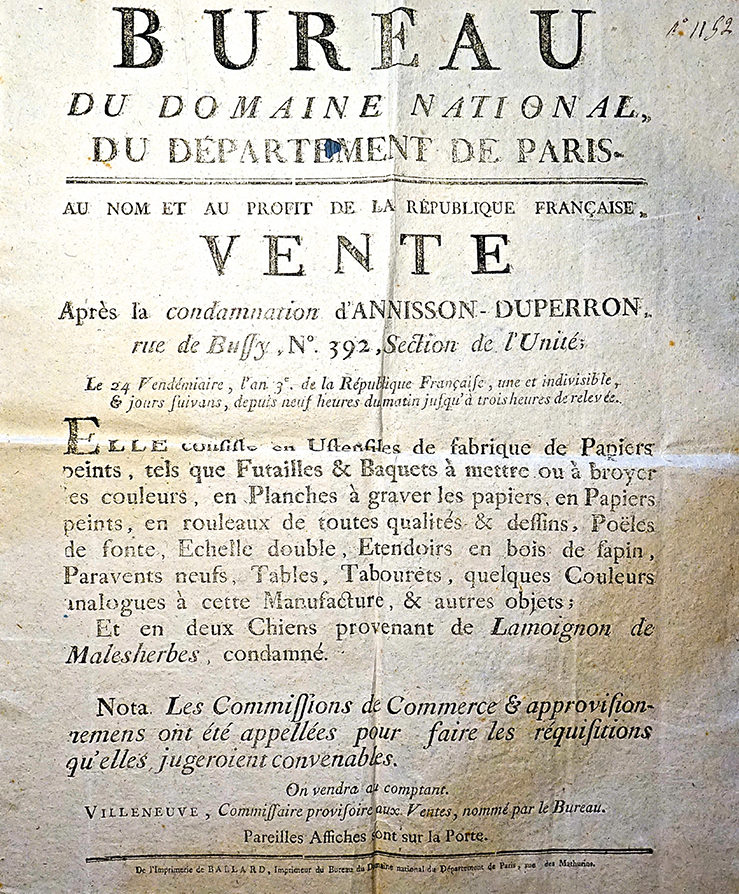
25 Vendemiaire An 3 (October 15th, 1794) Affiche Vente de Biens Nationaux de condamné Annisson-Duperron. Image courtesy of the Archives Nationales (France) O/2/494.
Étienne Anisson Dupéron (Duperron)
Étienne Anisson Duperon, as we discussed in earlier issues, established a wallpaper manufacturing firm in part of the space he leased at the Hôtel de Longueville. Duperon leased space at the Hôtel de Longueville to others; he also made a partner of Jean-Démosthène Dugourc, an elite craftsmen who designed Duperon’s republican wallpapers, and of François Gouron, who managed the firm and other properties. Dugourc also partnered with a Jacobin club member named Urbain Jaume to manufacture republican playing cards in a builiding nearby. Duperon and Gouron were both guillotined in the spring of 1794. Other figures closely associated with the Hôtel de Longueville were arrested and imprisoned, as was Urbain Jaume. Available evidence suggests Dugourc and members of Géricault’s family survived unscathed. The republican government seized Dupéron’s assets and sold them at public auction in October, 1794 (see image above).
Carle Vernet and Margueritte-Emelie-Félicité Vernet, femme Chalgrin
Margueritte-Emilie-Félicité Vernet was the sister of Carle Vernet. Emilie married Jean-François-Thereze Chalgrin, the royal architect, but separated from her husband. Emilie was close to members of the royal family. She and a number of her associates were arrested for the crime of corresponding with exiled aristocrats. When Carle Vernet learned of her arrest and imminent trial, he asked his former colleague and friend Jacques-Louis David to intercede with Robespierre and the Revolutionary court. Accounts differ about what happened next. Whatever the case, Emilie and her companions were executed at 5:00 in the afternoon on July 24th, 1794 (6 Thermidor, An II), three days before Robespierre was deposed. Fouquier Tinville, who signed the order for her execution, was one of those executed alongside Robespierre. The document below from Fouquier Tinville’s court commands the military authority to provide soldiers to ensure the executions of 6 Thermidor take place as ordered. Emilie is identified as “Vernet, femme Chalgrin.”
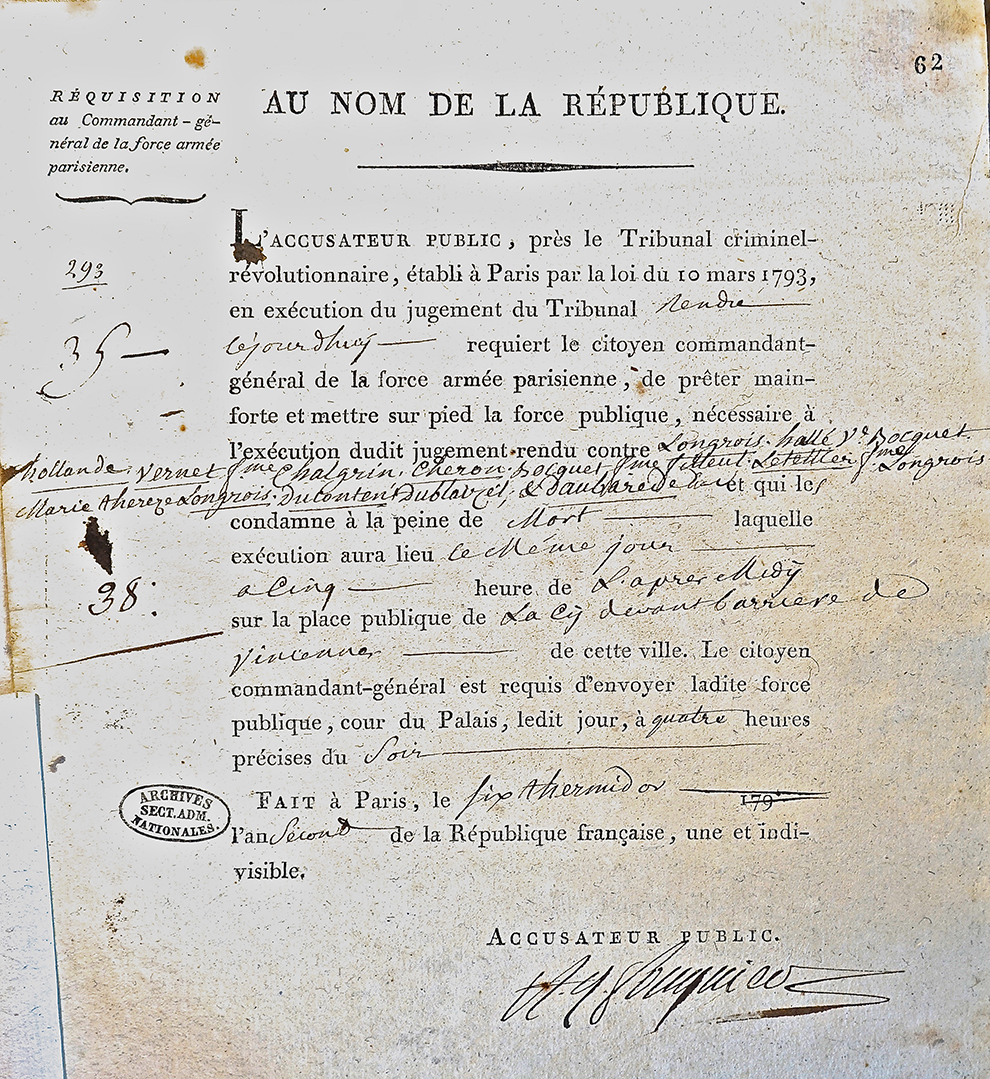
6 Thermidor An 2 (July 24th, 1794) Réquisition au Commandant-général de la force armée parisienne. Image courtesy of the Archives Nationales (France) AF/II/48 373 doc. 62.
Vernet contre David and After
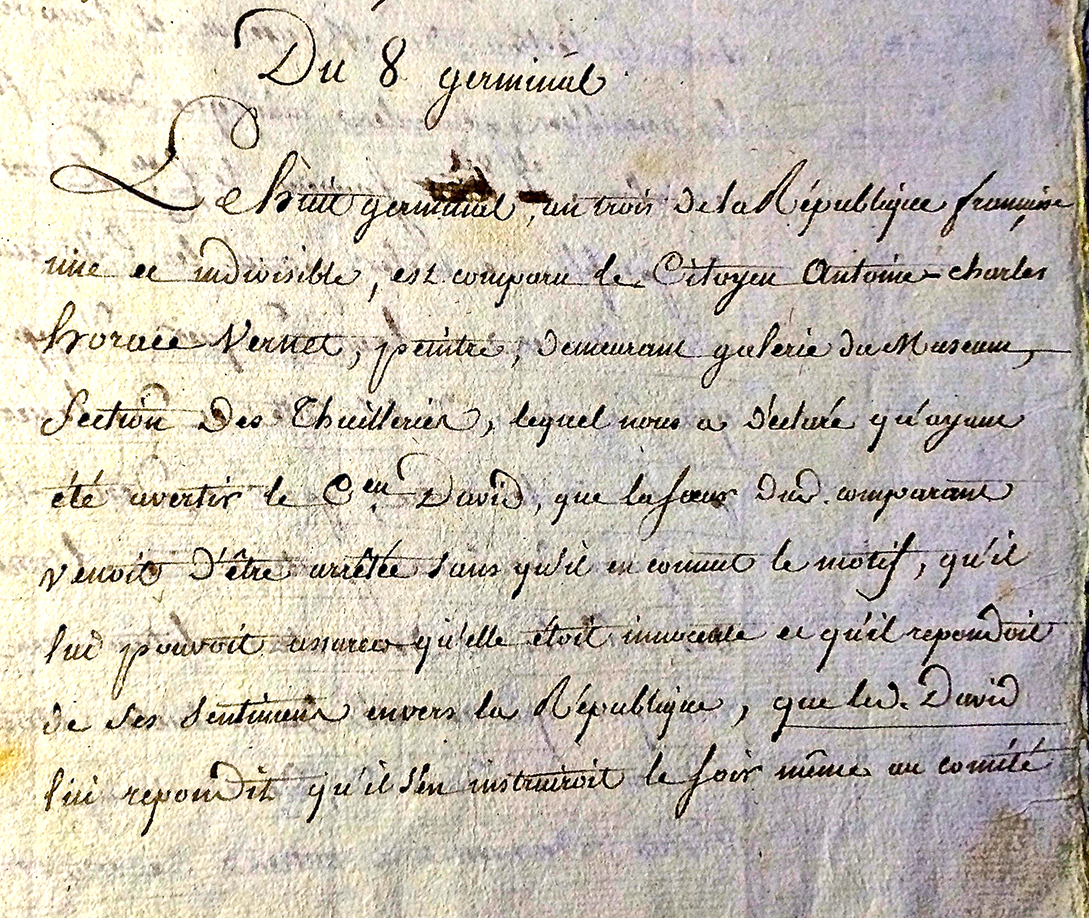
An 3 Germinal 8, (March 28th, 1795) Déclarations faites à…Section de Muséum – Cityoen Antoine Charles Horace Vernet (detail). Image courtesy of the Archives Nationales (France) AA//45 Doss. 1352A.
Jacques-Louis David narrowly avoided the guillotine alongside Robespierre. However, he had many enemies, Carle Vernet among them. The following year, in 1795, residents of the Museum section of Paris petitioned to have David re-arrested and tried for various crimes. The document above is Vernet’s testimony against David for his failure to act to save his sister. Blanc’s useful biography of Vernet (elsewhere in this issue) captures some of the grief, impotence, rage, and despair which Géricault’s future teacher must have felt at this point in his life.
The charges against David amounted to nothing and he was eventually released. David was not the only terrorist to escape justice, or the worst. The organizers of Thermidor – Fouché, Barras, and Tallien, were far more ferocious than David, and all thrived after Thermidor. Some believed that David was too capable to be allowed to languish in prison, and he was quickly put to work.
On October 5th, 1795, rebellious crowds massed in the streets leading to the national government in the Tuileries, as they had on August 10th, 1792. Paul de Barras was charged with defending the palace. He was ably aided by a young artillery officer from Corsica, who set up his artillery on the rue Saint Nicaise and other locations near the Géricault family residences in the Hôtel de Longueville. Once again, Géricault family members found themselves in the middle of a battle to determine the future of France. Barras and Napoleon repelled the attacks. Paul de Barras then joined the five-member national executive known as the Directory, formed that November to stabilize the government. Barras would become a key Géricault family ally during the years which followed.
Théodore Géricault had no direct experience with the Terror. Géricault, however, became a close friend with fellow painter Horace Vernet, the son of Carle and the nephew of Margueritte-Emilie-Félicité Vernet. Horace reputedly wore a cameo of his martyred aunt around his neck.
That Théodore Géricault had no direct experience with the Terror (nor did members of his immediate family, it seems), yet was surrounded by those who did partially explains, in my view, Géricault’s intense interest in death, violence, and even decapitation over the course of his life. The ritual executions of Margueritte-Emilie-Félicité Vernet and Étienne Anisson Duperon were significant events in the lives of those closest to Géricault during his childhood and as an adult. Géricault’s uncle Jean-Baptiste Caruel lived and worked at the Hôtel de Longueville, as did the family of Jacques-Florent Robillard. Recall, too, that Géricault’s relations in Saint Domingue survived violent revolution before eventually fleeing to Paris in 1797, around the same time the Géricault family arrived in Paris from Rouen.
The close proximity of the guillotine to the family residence at the Hôtel de Longueville, the attack on the palace on August 10th, 1792, and the resulting massacre of the Swiss Guards likely horrified and fascinated Géricault as a boy. As Théodore matured and entered the studio of Carle Vernet to train formally as a painter in 1808, following the premature death of his own mother that spring, we can easily imagine that death, and violent death would become topics Géricault wished to understand better.