
1800 – Rue Saint-Nicaise
Géricault Life
1795 Verniquet, Atlas du plan…Paris… (detail) courtesy of David Rumsey Maps.
Rue Saint-Nicaise – Hôtel de Longueville
In our May issue, we presented a profile of the lives of people in Géricault’s Paris – those who frequented the Louvre and adjacent garden, or worked there, when Géricault first arrived Paris around 1797. We continue that discussion here, with a list of individuals who happened to be on the rue Nicaise on the evening of December 24, 1800. This list is particularly useful because it includes the names of two figures who worked at the Hôtel de Longueville alongside Théodore Géricault’s father, Georges-Nicolas Géricault.
We can see on the Verniquet map above, the Hôtel de Longueville opened onto the rue (Saint) Nicaise and the Place du Carrousel. Géricault’s maternal uncle, Jean-Baptiste Caruel, and their Robillard relations also lived and worked at the maison Longueville, as it was often called. We can also see the Palais Royal, (Palais d’Égalité) to the north and, to the right, one corner of the vieux (old) Louvre. (The Hôtel d’Elbouf, another important building adjacent to the Hôtel de Longueville, also opened onto the Place du Carrousel and rue Nicaise.)
“La machine infernale”
The story behind this list, however, is tragic. Citoyenne Colinet was one of those working on the rue Nicaise on that winter night in 1800 selling eggs. This girl of 13 was among those injured when a large bomb concealed in a cart on the rue Nicaise exploded just as Consul’s carriage passed. The assassination attempt failed. Napoléon escaped harm. But eight citizens died and a number of others were injured. These individuals were named in a multi-part report on the ‘Machine Infernale’ published in the Gazette National on January 4, 1800. We present an excerpt from the report and the casualty llst below.
Report of the Prefect of Police, to the Consuls of the Republic, – Paris – December 31, 1800.
…On December 24, two barrels, one large and one small, packed with powder, were transported to the rue Nicaise, on a cart pulled by a mare. The carriage of the First Consul had just passed when a terrible explosion was heard. It threw families into mourning, plunged Paris into shock, and endangered all of France.
The head of state, having escaped danger, gave the order to the Prefect of Police to take him home. The wounded were transported to hospitals or conducted to their homes. Four corpses have been deposited at the morgue. Here is my report on both groups:
Dead
1. Citoyenne Jean-Elisabeth Hugaut, fish-seller, age 22, native of Paris, residing at the rue des Vielles-Etuves.
2. Citoyen Cléreau, grocer, rue Neuve-Egalité (dead after).
3. Citoyenne Adelaide Nouris, widow Ister, division Fontaine-de-Grenelle.
4. Citoyenne Marie-Anne Puessot, aged 15, who was sent on an errand to the corner of the rue Nicaise, and did not return to her mother’s home.
5. Citoyen Boyelledieu, age 28, day-laborer, residing on the rue d’Ecosse n° 2, division du Panthéon, who died at the hospice de l’Unité, on December 26.
6. Citoyenne the wife of the glove-maker, residing near the wine merchant on the corner of the rue de Malte, who died the day after the explosion.
7. Citoyen Leclerc (Jean-Claude), dead during the night of December 26-27 at the Hospice de Santé, rue des Cordeliers. He passed at the moment of the explosion.
8. Citoyen Platel, police officer, who died at the hospice de l’Unité on December 28.
Wounded
1. Citoyenne femme Honoré, street-sweeper.
2. Citoyen Warmé, wine seller, rue de Malte, and the corner of the rue Marceau.
3. Citoyenne femme Leger, drink vendor, on the corner of the rue de Malte and the rue Nicaise.
4. Citoyen Chatel (Charel?), boy of the same.
5. Citoyen Poché, idem.
6. Citoyen Louis Duverne, employed as a locksmith, ordinarily employed chez Evard, rue du Mail.
7. Citoyen Renault, rue de Grenelle-Honoré, hôtel d’Hambourg.
8. Citoyen Saint-Gilles, residing on the rue Denis, opposite the shipper Saint-Magloire.
9. Citoyen Lemierre, principal lease-holder of the hôtel de Nantes.
10. Citoyen François-Gilles Bataille, grocer, rue Nicaise, injured neck.
11. Citoyen Simon, boy of Girardin, food vendor, lightly wounded.
12. Citoyen Vitri, wig-maker, suffering contusions, having been knocked down.
13. Citoyen Chatelain, porter at the maison Longueville.
14. Citoyen his son.
15. Citoyen Gilbert Chapuis, residing in the division Fontaine-de-Grenelle.
16. Citoyen Orillard
17. Claude-Barthelemy Préville, furniture dealer, rue des Saints-Peres.
18. Citoyen Trepsat, architect.
19. Citoyenne femme Barbier, transported to the grand Hospice d’ Humanité.
20. Citoyenne femme Mathieu.
21. Citoyenne Colinet, age 13, egg-seller.
22. Citoyenne Frédéric Bannye, domestic.
23. Citoyen Barbier, roofer.
24. Citoyen Proverbie, advisor to citoyen Catanier, général de division of the Army of Italy.
25. Citoyen Henri Lepautre, watch-maker rue Nicaise, n° 12.
26. Citoyen Amiot, military man.
27. Citoyen Mercier, residing on the rue Honoré, near the rue des Bons-Enfans, house of the widow Signé, quincaillere.
28. Citoyen Hamont, dealer in paintings at the Palais-Egalité, n° 23. He passed at the moment of the explosion.
Written statements confirm the deadly effects of this infernal invention.
Forty-six houses are extremely damaged…
Conclusion
The Hôtel de Longueville once again involved Géricault family members in a major event in French history, events we have discussed in earlier issues. Jean-Baptiste Caruel, Théodore’s maternal uncle, lived in the Hôtel de Longueville from late 1791, at the latest Napoleon reportedly watched the attack on the Tuileries Palace on August 10, 1792, from rooms of the Encan National (national auction house) situated there. The first political executions occurred a short distance from the Hôtel de Longueville when the guillotine was installed in the Place du Carrousel that same year after the August 10 attack. Three years later, in 1795, Paul de Barras and Napoléon together defended the Republican government from unhappy citizens, placing canon outside the Hôtel de Longueville.
Théodore Géricault undoubtably knew Citoyen Chatelain, a porter at the maison Longueville, and his son, even if only by face. Indeed, it is entirely possible that Théodore Géricault, his parents, and other family members were at the Hôtel de Longueville sometime during December 24, perhaps even when the explosion occurred. The walls of the Hôtel de Longueville were blackened and damaged by the explosion. Debris and body parts were cast into the air and against nearby buildings. The damage done to the exterior of the Hôtel de Longueville and other structures was visible and extensive, serving as a permanent reminder of the explosion.
The list of those injured and killed by la machine infernale is an invaluable snapshot of life on the rue Nicaise in late December, 1800. On the list we find servants of the state, shop-keepers, day-labourers, and children, some of whom Géricault’s father, uncle, and Robillard relations undoubtably knew and worked with. However abstract and distant the violence of the times may have been for Théodore, up to that point, we can be sure that the explosion that destroyed lives and buildings on the rue Nicaise that evening had some personal and perhaps lasting impact on the nine-year old from Rouen. We do not know how Théodore reacted to the attack, or to the injuries citizen Chatelain and his son sustained.
We can say, however, that we now have concrete evidence directly connecting Théodore to the violence of his time. People he knew had been injured near his father’s work place, near a building Théodore visited often, a building which was home to his uncle, and to his Robillard cousins, Pierre and Amédée-Selim, boys his own age. Horace Vernet, his future friend, lost an aunt to the guillotine. Théodore grew up with tales of violence in Rouen, Saint Domingue, and Paris. We do not know whether Théodore had any earlier direct connections with violence prior to 1800. But we can say that violence in the abstract became real, or more real, that night with the deadly explosion outside the family home at the Hôtel de Longueville.
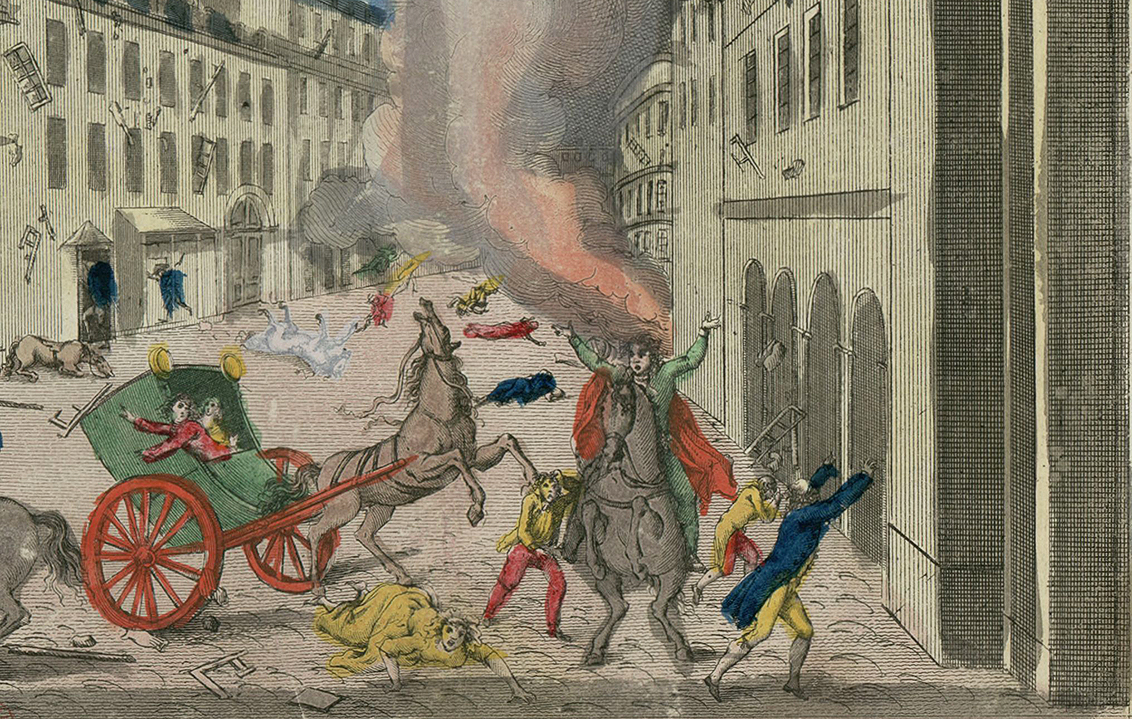
“Explosion d’une Machine Infernale” (detail) A Paris chez Basset Marchand d’Estampes et Fabricant de Papiers peints, rue Jacques au coin de celle des Mathurins. Image Courtesy of Gallica.