
1818 Dawson Turner – Rouen
Géricault Life
Avenue of Chestnut Trees (Detail) Théodore Rousseau 1837-1842 Louvre
Dawson Turner – Rouen
Théodore Géricault was born in Rouen in 1791. Normandy was and is very different from Paris in many respects. Only contemporary witnesses can provide us with a sense of what daily life was like in Rouen during Géricault’s lifetime. We begin our exploration of Rouen with excerpts from the account of Dawson Turner, an English observer who recorded his visit to the ancient city in the spring and summer of 1818.
“… I believe it is always expected that a traveler in France should say something respecting the general aspect of the country and its agriculture. I shall content myself with remarking that this part of Normandy is marvelously like the country which the Conqueror conquered. When the weather is dull, the Normans have a sober English sky, abounding in Indian ink and neutral tint. And when the weather is fine, they have a sun which is not a ray brighter than an English sun. The hedges and ditches wear a familiar livery, and the land which is cultivated repays the toil of the husbandman with some of the most luxurious crops of wheat I ever saw. Barley and oats are not equally good, perhaps from the stiffness of the soil, which is principally of chalk; but flax is abundant and luxuriant. The surface of the ground is undulated, and sufficiently so to make a pleasing alteration of hill and dale; hence it is agreeably varied, though the hills never rise to such a height as to be an obstacle to agriculture. There is some difficulty in conjecturing where the people by whom the whole is kept in cultivation are housed; for the number of houses by the road-side is inconsiderable; nor did we, for the first two-thirds of the ride, pass through a single village, excepting Totes, which lies mid-way between Dieppe and Rouen, and is of no great extent.
Yet things in France are materially altered in this respect since 1814, when I remember that, in going through Calais by way of the Low Countries to Paris, and returning by the great road to Boullogne, the whole journey was made without seeing a single new house erecting in a space of four hundred miles. This is now far from being the case; there is every where an appearance of comparative prosperity, and were it not for the coins, of which the copper bear the impress of the republic, and the gold and silver chiefly that of Napoleon, a stranger would meet with but few visible marks of the changes experienced in late years by the government of France. Much has been also done of late towards ornamenting the chateaux, of which there are are several about Totes, though in the opinion of an Englishman, much is also yet wanting. They are principally the residences of Rouen merchants.
Upon approaching Malaunay, about nine miles from Rouen, the scene is entirely changed. The road descends into a valley, enclosed between steep hills, whose sides are richly and beautifully clothed with wood, while the houses and church of the village beneath add life and variety to the plain at the foot. Here the cotton manufactories begin, and, as we follow the course of the little river Cailly, the population gradually increases, and continues to become more dense through a series of manufacturing villages, each larger than the preceding, and all abounding in noble views of hill, wood, and dale; while the tracts around are thickly studded with picturesque residences of manufacturers, and extensive, often picturesque manufactories. Such indeed was the country, till we found ourselves at Rouen, shortly before entering which the Havre road unites to that from Dieppe, and the landscape also embraces the valley of the Seine, as well as of the Cailly, the former broader by far and grander, but not more beautiful.
Rouen, from this point of view, is seen to considerable advantage, at least by those who, like us, make a détour to the north, and enter it in that direction: the cathedral, St. Ouen, the hospital and church of La Madelaine, and the river, fill the picture; nor is the impression in any wise diminished on a nearer approach when, through a long avenue, formed by four rows of lofty elms, you advance by the side of a stream, at once majestic from its width and eminently beautiful from its winding course.
Rouen is now unfortified; its walls, its castles, are level with the ground. But, if I may borrow the pun of which old Peter Heylin is guilty when describing Paris, Rouen is still a strong city, “for it taketh you by the nose.” The filth is extreme; villainous smells overcome you in every quarter, and from every quarter. The streets are gloomy, narrow, and crooked, and the houses at once mean and lofty. Even on the quay, where all the activity of commerce is visible, and where the outward signs of opulence might be expected, there is nothing to fulfill the expectation. Here is width and space, but no trottoir (pavement) and the buildings are as incongruous as can well be imagined, whether as to height, color, projection, or material. Most of them, and indeed most in the city, are merely of lath and plaster, the timbers uncovered and painted red or black, the plaster frequently coated with small grey slates laid one over another, like the weather-tiles in Sussex. Their general form is very tall and very narrow, which adds to the singularity of their appearance; but mixed with these are others of white brick or stone, and really handsome, or, it might be said, elegant. The contrast, however, which they form only makes their neighbors look the more shabby, while they themselves derive from the association an air of meanness. The merchants usually meet upon a small open plot, situated opposite to the quay, enclosed with palisades and fronted with trees. This is their exchange in fine weather; but adjoining is a handsome building, called La Bourse à couvert, or Le Consulte, to which recourse is always had in case of rain. It was here that Napoleon and Maria-Louisa, a very short time previous to their deposition, received from the inhabitants of Rouen the oath of allegiance, which so soon afterwards found a ready transfer to another sovereign.
About the middle of the quay is placed the bridge of boats, an object of attraction to all strangers, but more so from the novelty and singularity of its construction than from its beauty. Utility rather than elegance was consulted by the builder. This far-famed structure is ugly and cumbrous, and a passenger feels a very unpleasing sensation if he happens to stand upon it when a loaded wagon drives along it at low water, at which time there is a considerable descent from the side of the suburbs. An undulatory motion is then occasioned, which goes on gradually from boat to boat till it reaches the opposite shore. The bridge is supported upon nineteen large barges, which rise and fall with the tide, and are so put together that one or more can easily be removed as often as it is necessary to allow any vessel to pass. The whole too can be entirely taken away in six hours, a construction highly useful in a river peculiarly liable to floods from sudden thaws, which sometimes occasion such an increase of the waters, as to render the lower stories of the houses in the adjacent parts of the city uninhabitable. The bridge itself is commonly attributed to a monk of the order of St. Augustine, by whom it was erected in 1626, about sixty years after the stone bridge, built by the Empress Matilda in 1167, had ceased to be passable. It seems the fate of Rouen to have wonderful bridges. The present is dignified by some writers with the high title of a miracle of art: the former is said by Taillepied, in whose time it was standing, to have been “un des plus beaux édifices et des plus admirables de la France.” (“one of the most handsome and admirable edifices in France.”) A few lines afterwards, however, this ingenuous writer confesses that loaded carriages of any kind were seldom suffered to pass this admirable edifice, in consequence of the expense of repairing it; but that two barges were continually plying for the transport of heavy goods. The delay between the destruction of the stone bridge, and the erection of the boat bridge, appears to have been occasioned by the desire of the citizens to have a second similar to the first; but this, after repeated deliberations, was at last determined to be impracticable, from the depth and rapidity of the stream. Napoleon, however, seems to have thought that the task which had been accomplished under the auspices of the Empress Matilda, might be again repeated in the name of the daughter of the Caesars and the wife of the successor of Charlemagne; and he actually caused Maria-Louisa to lay the first stone of a new bridge, at some distance farther to the east, where an island divides the river into two. This, I am told, will certainly be finished, though it will occasion great inconvenience to many inhabitants of the quay, whose houses will be rendered useless by the height to which it will be necessary to raise the soil upon the occasion. My informant added, that, small as is the appearance yet made above water, whole quarries of stone and forests of wood have been already sunk for the purpose.
From the site of the projected bridge, the view eastward is particularly charming. The bold hill of St. Catherine presents its steep side of bare chalk, spotted only in a few places with vegetation or cottages, and seems to oppose an impassable barrier; the mixture of country-houses with trees at its base, makes a most pleasing variety; and, still nearer, the noble elms of the boulevards add a character of magnificence possessed by few other cities. The boulevards of Rouen are rather deficient in the Parisian accompaniments of dancing-dogs and music-grinders, but the sober pedestrian will, perhaps, prefer them to their namesakes in the capital. Here they are not, as at Paris, in the center of the town, but they surround it, except upon the quay, with which they unite at each end, and unite most pleasingly; so that, immediately on leaving this brilliant bustling scene, you enter into the gloom of a lofty embowered arcade, resembling in appearance, as well as in effect, the public walks in Cambridge, except that the addition of females in the fanciful Norman costume, and of the Seine, and the fine prospect beyond, and Mont. St. Catherine above, give it a new interest. On the opposite side of the Seine, the inhabitants of Rouen have another excellent promenade in the grand cours, which, for a considerable space, occupies the bank of the river, turning eastward from the bridge. Four rows of trees divide it into three separate walks, of which the central one is by far the widest, and serves for horses and carriages; the other two are appropriated exclusively to foot passengers. In these, on a summer’s evening, are to be seen all classes of the inhabitants of Rouen, from the highest to the lowest; and the following sketch, which you will easily perceive to be from a pencil more delicate than mine, gives a most lively and faithful picture of them. It may indeed be in some measure in the nature of a treatise de re vestiariâ (‘on ancient clothing’), yet such details of gowns and petticoats never fail to interest, at least to interest me, when proceeding from a wearer.
“Our carriage had scarcely stopped when we were surrounded with beggars, principally women with children in their arms. The poor babes presented a most pitiable appearance, meagre, dirty to the utmost degree, ragged and flea-bitten, so that round the throat there was not the least portion of ‘carnation’ appearing to be free from the insect plague. Their hair, too, is seldom cut; and I have seen girls of eight or ten years of age, bearing a growing crop which had evidently remained unshorn, and I may add, uncombed, from the time of their birth. It is impossible not to dread coming into contact with these imps, who, when old, are among the ugliest conceivable specimens of the human race. The women, even those who inhabit the towns, live much in the open air: besides being employed in many slavish offices, they sit at their doors or windows pursuing their business, or lounge about, watching passengers to obtain charity. Thus, their faces and necks are always of a copper color, and, at an advanced age, more dusky still; so that for the anatomy and coloring of witches, a painter needs look no further. Their wretchedness is strongly contrasted by the gaiety of the higher classes. The military, who, I suppose, as usual in France, hold the first place, appear in all possible variety of keeping and costume, with their well-proportioned figures, clean apparel, decided gait, martial air, and whiskered faces. Here and there we see gliding along the well-dressed lady (not well dressed, indeed, as far as becomingness goes, but fashionably), with a gown of triple flounces, whose skirt intrudes even upon the shoulders, obliterating the waist entirely, while her throat is lost in an immense frill of four or more ranks; and sometimes a large shawl over all completes the disguise of the shape. The head of the dame or damsel is usually enveloped in a gauze or silk bonnet, sufficiently large to spread, were it laid upon a table, two feet in diameter, and trimmed with various-colored ribbons and artificial flowers: in the hand is seen the ridicule (a small purse), a never-failing accompaniment. The lower orders of women at Rouen usually wear the Cauchoise cap, or an approach to it, rising high to a narrowish point at top, and furnished with immense ears or wings that drop on the shoulder, then opening in front so as to allow to be seen on the forehead a small portion of hair, which divides and falls in two or three spiral ringlets on each side of the face. The remainder of the dress is generally composed of a colored petticoat, probably striped, an apron of a different color, a bodice still differing in tint from the rest, and a shawl, uniting all the various hues of all the other parts of the dress.
Some of the peasants from the country look still more picturesque, when mounted on horseback bringing vegetables: they keep their situation without saddle or stirrup, and seem perfectly at ease. But the best figures on horseback are the young men who take out their masters’ horses to give them exercise, and who are frequently seen on the grand cours. They ride without hat, coat, saddle, or saddle-cloth, and with the shirt sleeves rolled up above the elbow. Their negligent equipment, added to their short, curling hair, and the ease and elasticity they display in the management of their horses, gives them, on the whole, a great resemblance to the Grecian warriors of the Elgin marbles.
Men, as well as women, are frequently seen without hats in the streets, and continually uncravatted; and when their heads are covered, these coverings are of every shape and hue; from the black beaver, with or without a rim, through all gradations of cap, to the simple white cotton nightcap. A painter would delight in this display of forms and these sparkling touches of color, especially when contrasted with the grey of the city, and the tender tints of the sky, water, and distance, and the broad coloring of the landscape…”
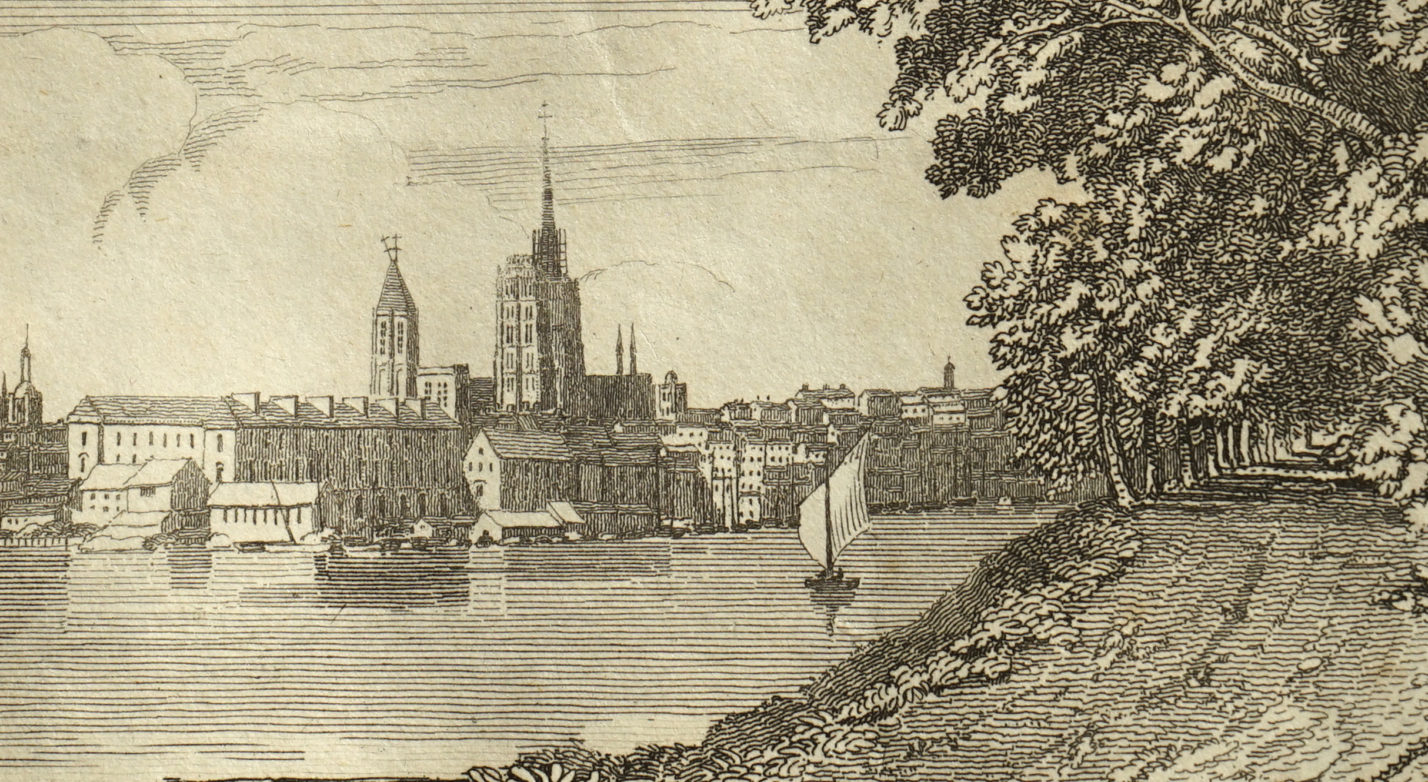
“Rouen from the Grand Cours” (Detail) John Cotman, 1818.
John Cotman accompained Dawson Turner in Normandy as his illustrator. The text and illustration are from Turner’s Account of a Tour in Normandy, Volume I, London: John and Arthur Arch, 1820. pp. 45-53. Private collection.