
Quiberon – Chaumereix
Géricault Life
Quiberon – Brittany (Map 1765 Brion de la Tour) courtesy David Rumsay maps
Quiberon – Chaumereix
Jean-Hugues Duroy de Chaumereix (1763-1841) was a French naval officer hostile to the new Republican government living in England in 1795. England was at war with France and hoped to aid French rebel armies operating in western France at that time. The English landed an army of French exiles on the coast of Brittany on the Quiberon peninsula on June 23rd, 1795. The invasion was a disaster. Republican armies operating in the area were ready to repel the invaders, who were badly organized and fought among themselves. By July 21st, Republican armies had regained control of the region and captured a sizeable number of prisoners, many of whom were later summarily executed.
De Chaumereix survived, aided in part by a former fellow-officer, and by dissembling about his role in the invasion, a sensible strategy given the nature of warfare at that time. De Chaumereix penned an account of his ordeal which was translated into English. Readers familiar with Gericault’s career will recognize de Chaumereix as the future commander of the Medusa, the French naval vessel wrecked off the coast of Africa in 1816, and immortalized by Gericault in his 1819 masterpiece.
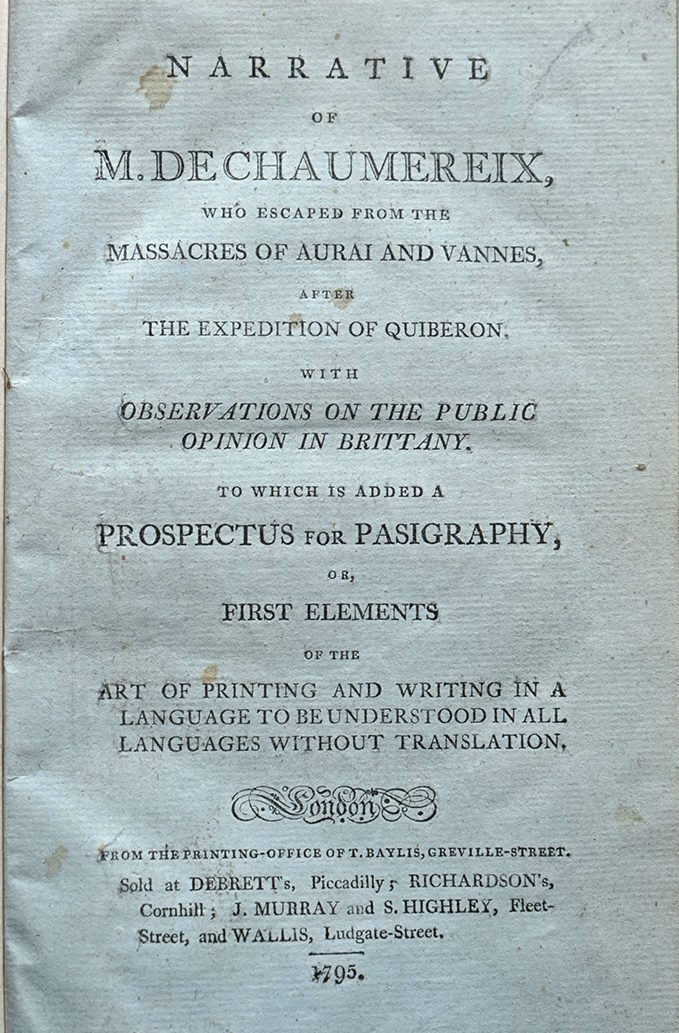
Cover of Jean-Hugues Duroy de Chaumereix’s 1795 account translated into English.
Domfront and Mortain
The wars in western France from 1793 to 1799 are part of the untold story of the Géricault family. Siméon-Jacques-Henri Bonnesœur Bourginière, Théodore’s uncle, was elected to represent Manche in the National Convention in 1792. Bonnesœur is a key figure in Géricault scholarship for this reason. Bonnesœur voted to execute Louis XVI, but asked for clemency. Bonnesœur was exiled as a regicide, nonetheless, during the second Bourbon restoration in 1816. Bonnesœur’s notoriety in 1792-3 and again in 1816, as well as his long political career, command the attention of Géricault scholars.
In the June issue I presented a translation of a letter written shortly after Théodore’s birth in 1791 by his father, Georges-Nicolas Géricault, to Haye de la Diverre, a surgeon living in St. George de Rouelle near Domfront. Georges-Nicolas Géricault was born in St.-Cyr-du-Bailleul, close by, and a cluster of Théodore Géricault’s relations – cousins, aunts, and uncles – lived around Avranches, Mortain, Barenton, and Domfront, clustered around the departments of Orne and Manche.
The impact of the fighting between rebel and republican forces upon Géricault family members in Mortain, Barenton, and Domfront must have been similar to the impact of events in Paris upon Gericault family members living at the Hôtel de Longueville and on the rue de Belle Chasse. Bonnesœur maintained a residence in Paris at n°4 rue des Moineaux, near the Tuilleries palace.
The differences between the Domfront and Paris, are significant, however. There were two major battles fought near the Hôtel de Longueville in Paris, and the combat was sharp and severe – with clear victors at the end of each engagement. (See my article Thermidor in this issue.) Géricault’s family members in Orne and Mortain lived through years of protracted civil war, with the local populace subjected to prolongued periods of military occupation, and conscription by the national government.
The civil wars fought in Manche and Orne affected both of Théodore’s parents on the rue de l’Avalasse. Théodore’s maternal aunts and their husbands lived near Mortain, and Théodore paternal relations, as we have noted, lived around Barenton and Domfront. We easily imagine their desire for peace and stability during this fractions period. Géricault no doubt knew much of the local history through family members. In the months to come, we will continue our discussion of Géricault family members living in Orne and Manche.