Robillard de Peronville & de Barras
Géricault Life
1788 Nov. 5 Marriage contract between Robillard de Peronville (Perronville; Péronville) et de Barras. Image courtesy of the Archives Nationales (France) DPPC NOT *SDOM 414
Marriage Contract: Robillard de Peronville & de Barras 1788
This is our first discussion of the marriage in Saint Domingue in 1788 which united the family of Louis-Nicolas-Joseph Robillard de Peronville family with that of Marie-Anne-Charles de Barras, cousin of Paul de Barras – the future Director of France from 1795 to 1799. To the best of my knowledge, this is the first detailed discussion of the de Péronville & de Barras marriage contract to appear. This marriage contract is mentioned in several notarial documents passed in Paris, a topic we shall address elsewhere.
The contract uniting the families of Robillard de Péronville and Marie-Anne-Charles de Barras in Saint Domingue was signed in Le Cap at the home of Veuve (widow) Bailly, a de Barras by birth, on the rue du Gouvernement. The marriage was a good match for both families, it appears, and perhaps a better one for the Robillards. Our study of the holdings of the respective families suggests that the extended de Barras family was the more successful of the two. That said, Marie-Anne-Charles de Barras owed her inheritance to her aunts and uncles, so marrying into a stable extended family with good connections in Dieppe and Paris would have made sense.
The contract, of course, would have an immense impact on the Robillard-Caruel family, as we discuss elsewhere in this issue. The most important consequence, of course, in the medium term, was to unite the Robillard family in Saint Domingue and Paris with the family of Paul de Barras, who terrorized Toulon as a revolutionary, captured Robespierre and his allies to end the Terror, and defended the revolution from armed citizens, (with the help of Napoléon) on the very steps of the Robillard-Caruel family home at the Hôtel de Longueville, before becoming a member of the five-member Directoire, which ruled France from November, 1795 to November, 1799, when Napoléon seized power.
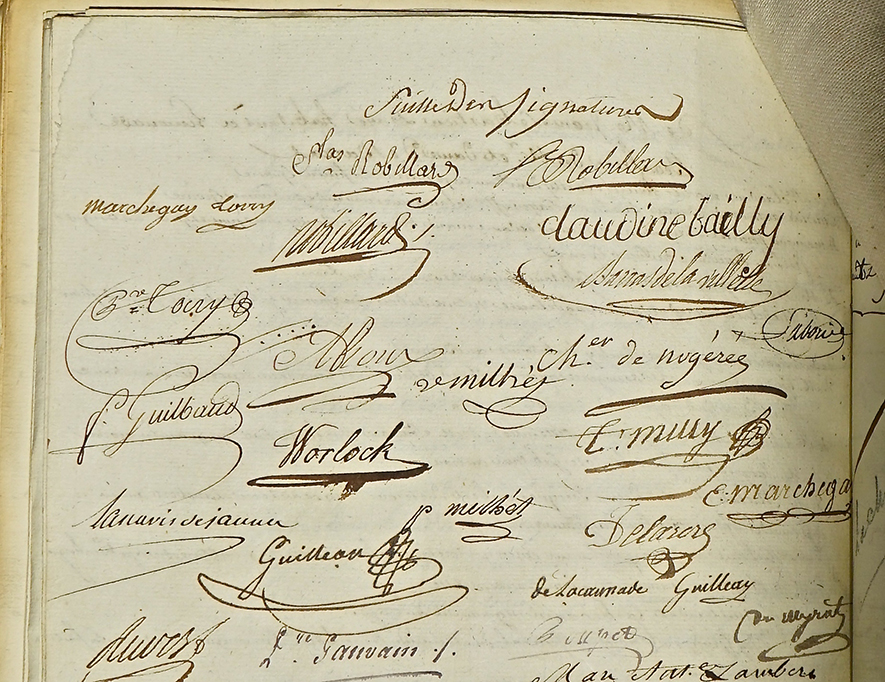
Worlock signature, among others. Image courtesy of the Archives Nationales (France) DPPC NOT *SDOM 414
The list of marriage witnesses serves as a kind of who’s who for the Robillard de Peronville and de Barras families on Saint-Domingue. We will discuss individuals who signed this document at greater length. The de Barras relations appear to have been the more active in Saint Domingue. We will also examine other archival documents associated with both families which further illuminate the lives of the colonists, as well as on the slaves and the church in Saint Domingue.
In our February discussion of the woeful condition of the slaves on the sugar plantation Jean-Guillaume Robillard purchased in 1772, we suggested a professional and personal relationship between the Robillards and Simon Worlock, the ‘miracle-worker’ who inoculated so many slaves on the island. Worlock, of course, may have attended the wedding as a guest of the de Barras family. Even so, we believe it likely he provided his services to the Robillard slave owners as well. Certainly, the slaves on Jean-Guillaume’s plantation were in dire need of medical assistance.