1792 Louvre
Géricault Life
A View of Avignon, from the Right Bank of the Rhône near Villeneuve, Claude-Joseph Vernet.
Géricault & the Louvre
The community of artists and entrepreneurs living at the Louvre and related buildings played a vital role in the life of Théodore Géricault. We begin our exploration of this community with Carle Vernet (Géricault’s teacher), his family, and life at the Louvre.
At the time of Géricault’s birth in 1791, the Louvre was one of a number of Paris buildings occupied by artists, inventors, and administrators working for the crown. The Robillard family and the administrators of the royal tobacco monopoly lived at the Hôtel de Longueville close by, as part of the Maison du roi (the royal household) under a similar arrangement, prior to the dissolution of the tobacco monopoly in 1791.
In October, 1761, Claude-Joseph Vernet, Carle’s father, received his brevet granting him an apartment and studio in the Galeries du Louvre, the long narrow building connecting the Tuileries Palace and the Louvre palace. Claude-Joseph Vernet was part of a family of painters. His brother François Vernet decorated Versailles from 1764 to 1770, and other royal properties, (see Culture – Commerce II in this issue). Like many European painters, Claude-Joseph Vernet lived for a time in Italy – studying and painting. While there he met other artists, such as Joshua Reynolds of England, and a young Englishwoman named Virginia-Cecile Parker, the daughter of an English naval officer serving the pope. The couple fell in love and married in Italy in 1745. Their first son, Livio, was born in Italy. The family returned to France and settled in Avignon.
Claude-Joseph Vernet died in December of 1789 and the brevet for the family apartment passed to his son Antoine-Charles-Horace (Carle) Vernet. Carle Vernet was a painter and member of the royal academy in his own right and had been something of a prodigy. Carle’s sister Marguerite-Emilie-Félicite Vernet had been married to Jean-François Chalgrin, the royal architect who later designed the Arc de Triomphe. Carle was a friend and rival of Jacques-Louis David. Both Vernet and David belonged to the Jacobin club, which met in a converted religious house on the other side of the Tuileries palace. This mix of establishment pedigree and republicanism is emblematic of the changes taking place at the time.
The community of artists and inventors holding royal brevets at the Louvre were permitted to take on private commissions. While the aristocracy thrived, so did the community. The apartments were large and joined by a corridor with ran along the interior of the Seine side of the structure. The corridor connected the interior of the Tuileries palace with the quadrangle of the old Louvre and the garden of the Infanté abutting both. Not all artists, however, lived in these two buildings. Jean-Michel Moreau (Moreau le jeune), Carle Vernet’s father-in-law and a member of the same community lived on the Rue de Coq. When the battle for the Tuileries palace spread to the Galeries du Louvre on August 10th, 1792, Carle and Fanny fled with their children down this corridor and made their way to the Moreau residence and safety. Louis XVI and his family fled the Tuileries palace earlier that same morning.
The attack on the Tuileries palace of August 10th, 1792, had immense consequences for all of France, not just the Tuileries. Within days the National Assembly decreed that all those living on brevets provided by the crown must leave their properties. The artists holding brevets at the Louvre and similar buildings, however, were exempt from this edict. Carle Vernet and his family, Jacques-Louis David, and the other residents of the Louvre and the Galeries du Louvre continued to live and work out of their apartments. The community at the Louvre would continue to share experiences with other residents living near the Place du Carrousel and the palace, a community which included Géricault’s relations at the Hôtel de Longueville. As we discussed in previous issues, Théodore Géricault’s relations were well-established at the Hôtel de Longueville from late 1791.
Change came quickly. Carle Vernet’s family would be directly affected in ways we shall explore elsewhere. With bodies from the battle still being counted, the government moved a new invention into the space between the palace and the Hôtel de Longueville. This device known as the guillotine was put into use to punish political offenders almost immediately. The first functional model of this instrument of execution was built by a carpenter named Guidon, but named after the individual who first proposed its construction, the scientist and physician Joseph-Ignace Guillotin. The engraving of the guillotine in use just outside the Hôtel de Longueville was displayed and sold distributed in Paris and Rouen by Fillion and Valmont: sellers of prints and of wallpapers soon after the attack.
The idea of using the top floor of Grande Galerie du Louvre to display paintings from the royal collection to the public took root during the 1780s. The new Muséum National was created by decree on September 16th, 1792. Carle Vernet and other artists living in the Galeries du Louvre continued to reside there, but only for a time. We will address this topic of the Louvre as a residence and a public display space in subsequent issues.
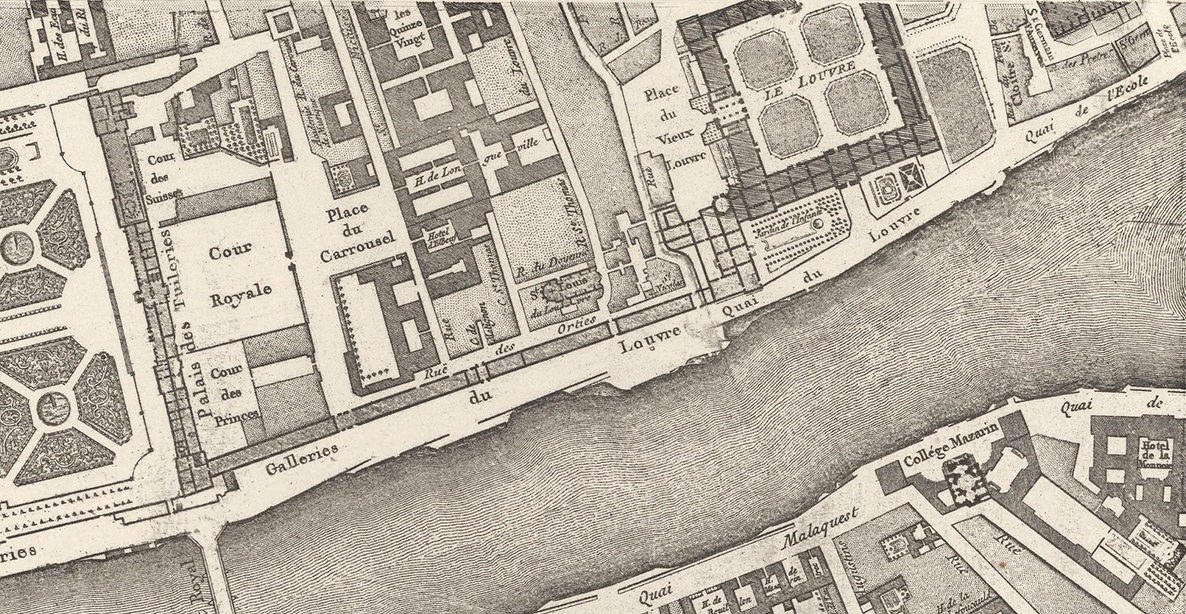
Map: 1775 J.B. Jaillot (detail), courtesy of David Rumsey (David Rumsey Maps).