1795 Hôtel de Longueville
Géricault Life
Histoire Secrette de 10 Aoust (The Secret History of August 10th) frontispiece published Chez LeRouge at the Maison Longueville (Hôtel de Longueville) in 1794.
The Hôtel de Longueville was critical to Théodore Géricault’s development as an artist and an individual. We discuss here some of the changes which took place at the Hôtel de Longueville in 1795 – the most important of which, for our purposes, was the formation of the second Robillard tobacco society.
Culture at the Maison Longueville
At the time of Théodore Géricault’s birth on September 26, 1791, the Hôtel de Longueville was still generally known by it’s traditional name and the ci-devant Hôtel de Longueville. But after the fall of the monarchy, a year later, the more republican “Maison” Longueville became the preferred public name for this venerable edifice in the heart of Paris. The business activities and businesses based at the Hôtel de Longueville changed, but the structure itself remained largely unchanged during the final decade of the eighteenth-century. The exact number of businesses operating out of the Maison Longueville is difficult to establish. We identified earlier the Encan National (National Auction House), which occupied a large space within the property, and Brunton’s haberdashery, facing onto the Place du Carrousel. As I noted in the July issue, Étienne Anisson Duperon – one of the largest lease holders at the Hôtel de Longueville, did not survive the period of Terror which ended in 1794. Nor, it seems, did his Republican Wallpaper Manufactory within the Maison Longueville. That particular part of the building remained leased in his name, but we do not know precisely how the space was used.
Anisson Duperon leased part of the space he controlled within the Hôtel de Longueville to various businesses. The most significant Anisson Duperon sublease holder was Louis Rondonneau, who remained active at the Hôtel de Longueville. Rondonneau operated one of the most important law librairies in Paris and also published books. Rondonneau’s collection of law texts was situated within the Hôtel de Longueville and was available to lawyers working for various government agencies and for private firms. Rondonneau, however, was not the only publisher based at the Hôtel de Longueville. My research identifies three other publishers/editors/book sellers based at the Hôtel de Longueville after 1795.
The first publisher to move into the Maison Longueville after Louis Rondonneau was probably the firm of Lerouge indicated above. The Imprimerie Lerouge is known primarily as the publisher of newspapers, rather than books. But proximity to the events of August 10th, 1792, may have inspired the firm to produce the slim volume the Histoire Secrette de 10 Aoust. We have not been able to locate any other books by Lerouge. The Lerouge firm was based first on the rue de Chartes close to the Hôtel de Longueville, then at the Hôtel de Longueville, and then on the Rue des Orties in front of the Galeries du Louvre. (The BnF Data entry for Lerouge is useful, but omits any mention the relocation to the “rue des Orties du Louvre” around 1797.) The two other firms, Revol and Michel, were principally booksellers who set up shop in the Passage Longueville around or after 1797, we believe. (See below and “Birth of a Street” in our March issue.)
I will not detail all the changes which occured at the Hôtel de Longueville from 1792 through the end of the century, but believe it important to stress that the business of commerce and culture continued to thrive within this space. Anisson Duperron’s wallpaper manufactory and store closed, it seems, but other businesses continued. Some of these new businesses were of great interest to Théodore Géricault and members of his family, as well as to the public at large.
In my July issue (Thermidor), I reminded readers that the Hôtel de Longueville’s proximity to the Tuileries palace and the center of government placed members of the Géricault family close to the violence that erupted in 1795 and after. Théodore had two cousins living at the Hôtel de Longueville at this time. Pierre Robillard was several years older and perhaps a friend of Horace Vernet and other boys living at the Louvre. Amédée-Selim Robillard was a year younger than Theodore almost to the day. It is easy to imagine Théodore and Amédée-Selim celebrating birthdays together. We will discuss family life and recreation at the Hôtel de Longueville and the family homes on the rue de l’Université and the rue de Belle Chasse in our September issue. The Robillard tobacco firm thrived after Thermidor, in part perhaps due to the support of key family member Paul de Barras, member of the Directory, the five-person executive which ruled France from late 1795. I discuss the restructured organization of the Robillard tobacco firm below.
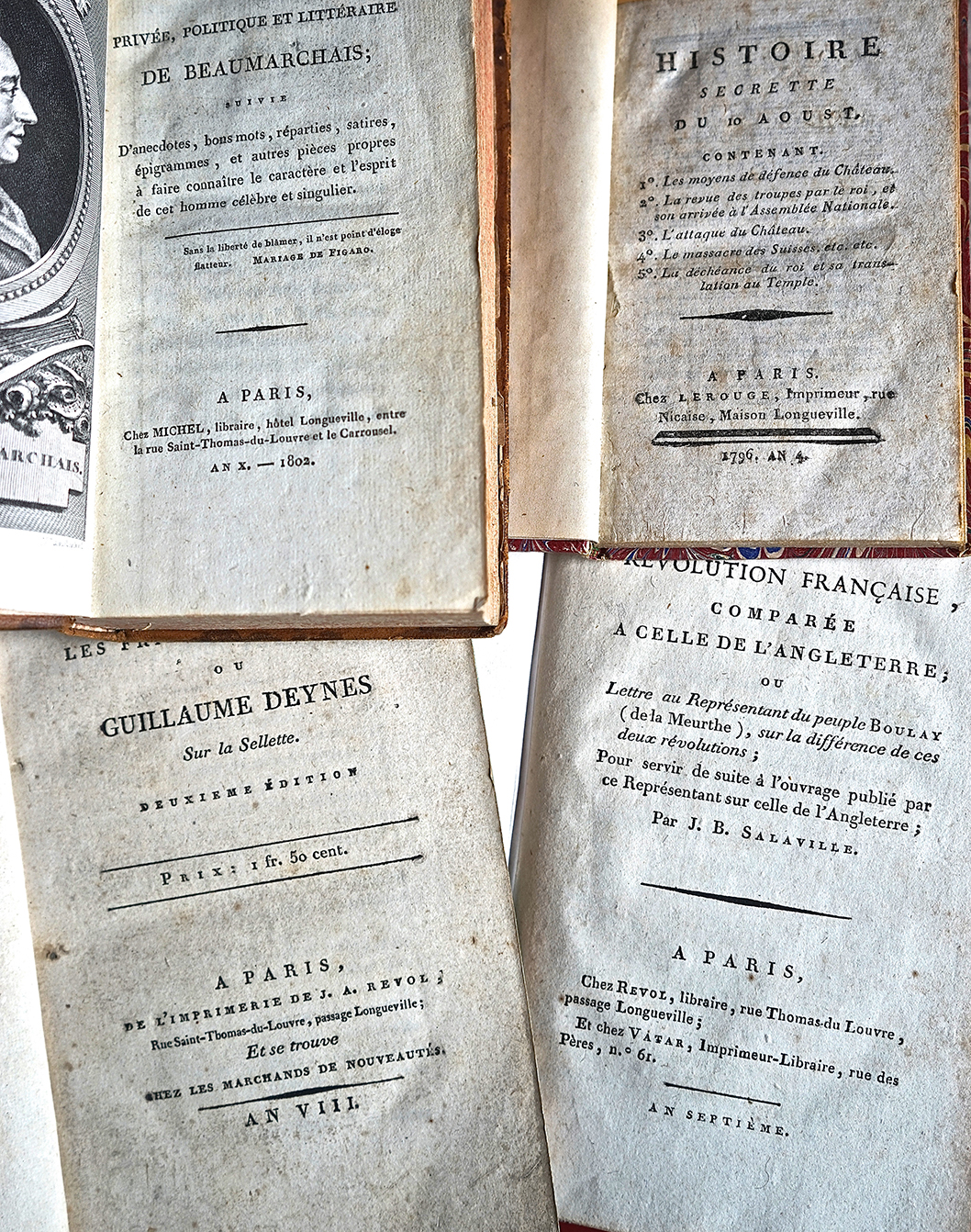
Some of the titles sold or published at the Hotel de Longueville.
Robillard Tobacco Society 1795
In September, 1791, Jacques-Florent Robillard took control of the palace of the Hôtel de Longueville, as well as the machinery and buildings involved with producing tobacco products. In an earlier issue (see Huber Tobacco – February), we discussed the foundation of the first Robillard Tobacco Society. By 1795, a new society had been formed. As with the society of 1791, we do not possess any record of a notarized acte de société for the 1795 Robillard tobacco society.
We do, however, possess notarized documents identifying the seven partners in what we believe is the second society. The individuals and their domiciles are listed as: Pierre-Antoine Robillard oncle (uncle) rue Belle Chasse; Jacques-Florent Robillard on the rue Thomas du Louvre; Jacques-Marie Chapelain and Charles-Jacques Chapelain both at the Vieille rue du Temple; and Jean-Baptiste Caruel, Charles Biancourt and Étienne Carvoisin – all three at the maison Longueville. These are the known partners in the Robillard firm. As noted, we have evidence that partners dispersed shares to family members. (Géricault’s grandmother held shares in the concern.)
We do not know precisely when the original 1791 society was dissolved. Alexandre-Pierre Riche Le Vandy was a partner in the original society and was, we believe, still alive until 1796. The second Robillard society represents stability and continuity. Not all the partners in the Phelippon tobacco firm survived the Terror. However, all the partners of the Robillard society survived and emerged more financially secure. Jean-Baptiste Caruel, Théodore Géricault’s uncle and a partner in the firm, embarked on a program of serious real estate speculation from 1797, purchasing several very substantial properties.