1851 Géricault – Art Journal
Géricault Life
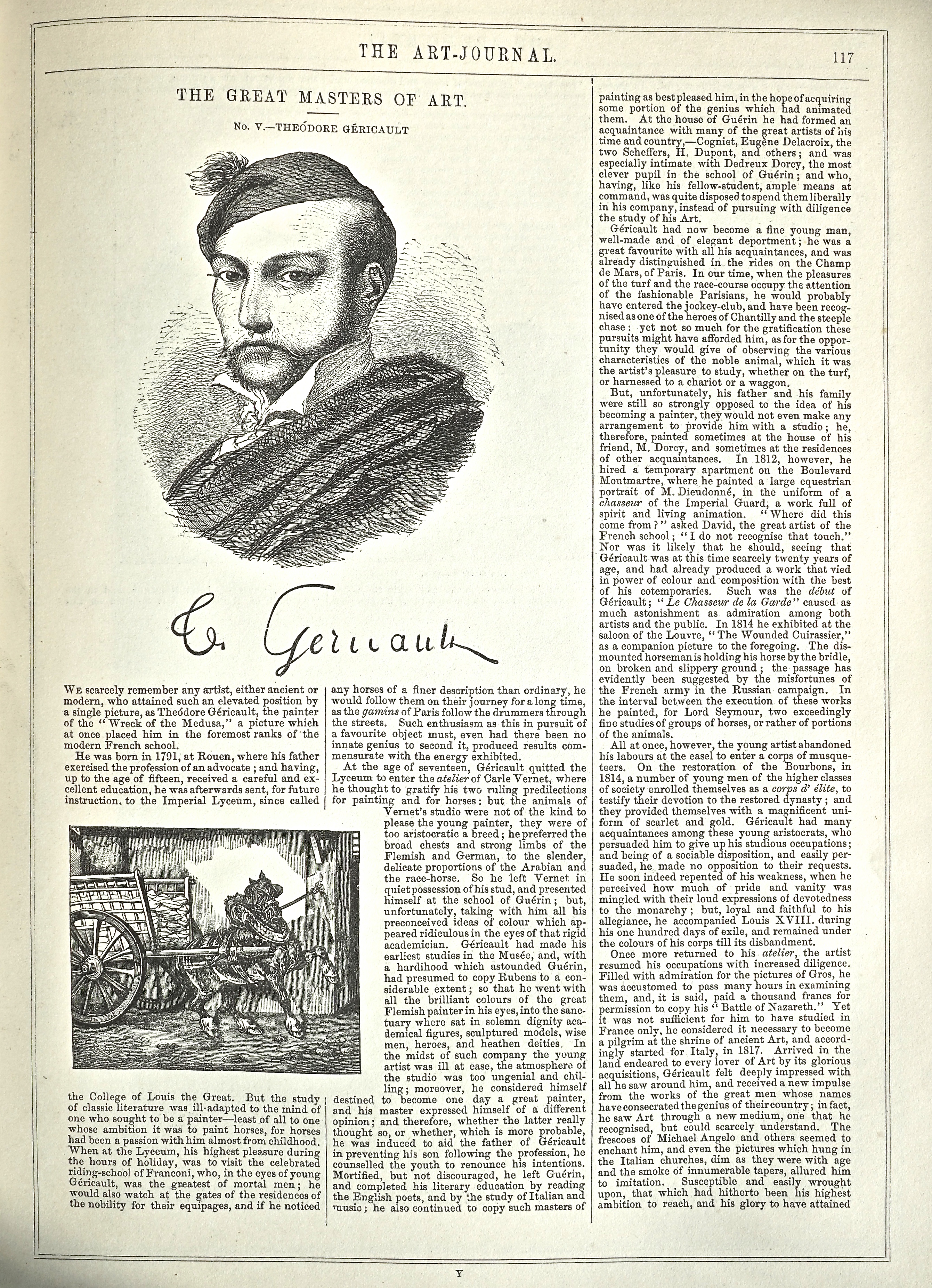
The first portrait of Théodore Géricault to feature in a biographical study of the artist appeared in the Art Journal of London in an unsigned essay published in April, 1851, pp. 117-119. No references to the Art Journal essay of 1851 appear in any study I can locate. The unsigned portrait of Géricault is by Louis Dujardin (1808-1859), whose signed portrait of Géricault published later in the century is well known to Géricault scholars.
Background
19th-century Géricault scholarship changed dramatically during the years 1845 through 1851. Louis Batissier’s authoritative study of Géricault of 1841 coincided with the presentation of the grave monument completed by Antoine Etex at the Paris Salon of 1841. A short essay on Géricault in the revue of the Etex sculpture published in the Magasin Pittoresque in 1841 provided added more detail to the Batissier biography. In 1842 Academy of Rouen established a commission to locate the precise location of the Géricault family home in Rouen and other key details. In 1845 Charles Blanc presented his own study of Théodore Géricault and established himself as a Géricault critic of the first rank.
Blanc’s study of Géricault differed significantly from that of Batissier, who composed an elegy to the artist which was closer to a well-researched hagiography than a biographical study. In his own study of Géricault, Blanc argued that Delacroix was superior to Géricault in some respects. Moreover, Blanc stated emphatically that Géricault experienced several emotional crises from 1815, the severest of which occurred during the latter part of his short life. In 1848, Jules Michelet presented a portrait of Géricault bent on self-destruction. In 1851, two essays on Géricault further explored Géricault’s mental and emotional health In the essay published in English here, the anonymous author of the Art Journal biography asserted bluntly that, for a period of time, Géricault’s mind was “altogether unhinged” after his return to France from London. In France, in 1851, critic Gustave Planche, asserted in the conclusion of his study of Théodore Géricault that the painter tried to end his own life. We are currently publishing Planche’s essay on Géricault in sections.
Art Journal Images
The Art Journal essay on Géricault was part of the journal’s illustrated Great Masters of Art series, a series which usually included a copy of the signature of the featured artist. The Art Journal presents the Dujardin portrait, Géricault’s signature, and the Plastermaker’s Horse (discussed below) on the first page of their essay on Géricault. The second page features the Coal Wagon and the Horse Dealer’s Stud. The author/editor concludes the essay with a copy of the Wreck of the Medusa on page 119.
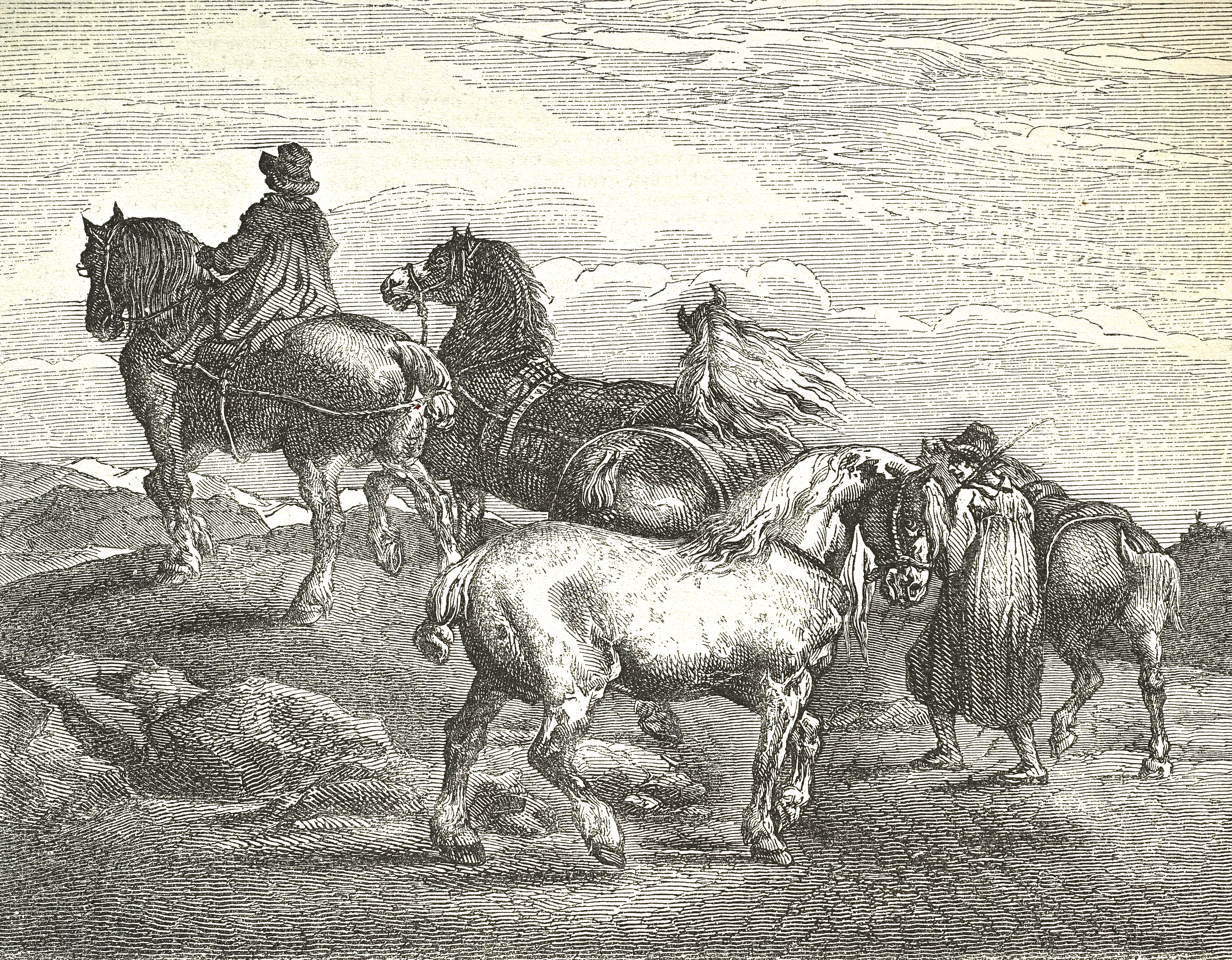
The Horse Dealer’s Stud (unsigned copy) Art Journal, 1851, April, p.118.
A Portrait of Madness?
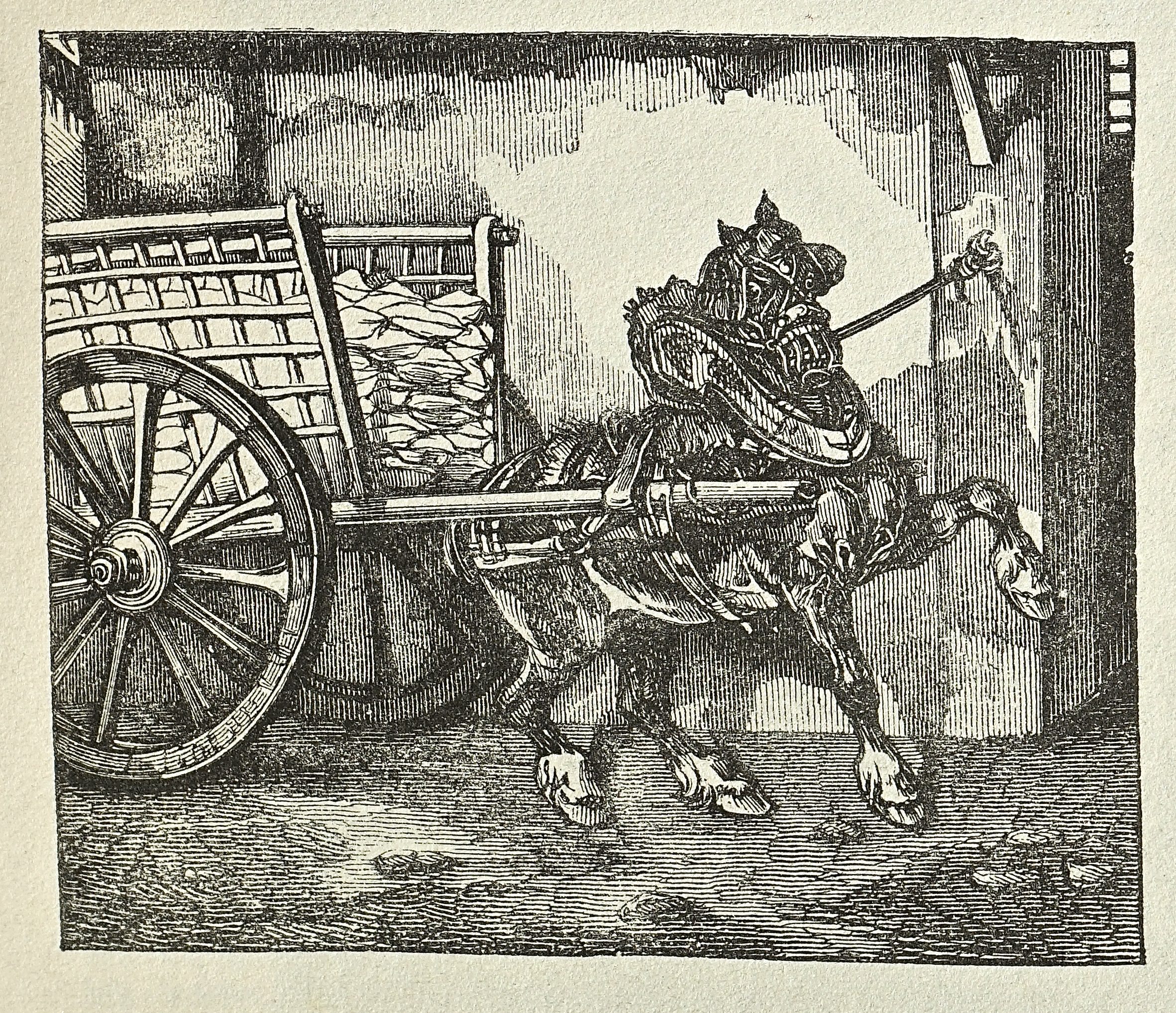
Untitled and unsigned detail of Le Cheval de Plâtrier (The Plastermaker’s Horse) Art Journal, 1851, April, p.117.
I invite readers to re-examine the Dujardin portrait uppermost. I detect no particular warmth in the eyes, the unsmiling mouth, or the subject’s general demeanor; the Dujardin portrait of Géricault is opaque. The contrast between this placid portrait and the animal straining in harness in the Plastermaker’s Horse could hardly be more dramatic. The eyes of the horse stare out between the leather straps and buckles, bound between the shafts, stamping, and tied to an iron ring on a stone wall, the image positively pulses with tension, energy, and implied violence. The editor/author cropped Géricault’s lithograph (the full image is linked below) to focus our attention on the animated animal.
When first viewed, the Dujardin portrait appears neutral. Seen again with other elements of the page, the excited state of the horse below bleeds into the portrait of the painter above – implying, at least, a similar battle for control raging below the artist’s calm veneer. The necks of man and beast are both encollared. The tassle above the horse’s wild eyes echoes the tassle on the top of Géricault’s cap. Why did the author or editors select this particular image – an image of a solitary animal, bound up and full of constrained vitality as pendant to the Dujardin portrait? Is the author or editor implying a connection between the mental states of the artist and the horse he depicts? The Dujardin portrait of Géricault coupled with the companion image of the straining horse seems to us striking, even provocative.
I contend that this juxtaposition is far from accidental. The neutral (at best) portrait of Géricault set above the image of an isolated animal bound up in a state of nervous excitement, below on the same page, is an effective and subtle way to introduce an essay in which the author will flatly assert that Géricault was “altogether unhinged” during a significant period in his life. Consider how different the effect of the opening page might be had the author/editor selected instead the docile animals in the Horse Dealer’s Stud above, for example, or one of the other article images as pendant to the Dujardin Géricault portrait. Much of the public, we contend, was visually literate and would consciously, or subconsciously, connect images and text. We will continue to examine how 19th-century critics approached the delicate problem of explaining the state of Géricault’s mental and emotional health in our next issue.
*View a high-resolution version of the Plastermaker’s Horse courtesy of the Metropolitan Museum of Art. (Opens in a new window.)