Jaume – Dugourc
Géricault Life
Cartes Républicaines
Sometime before the end of 1792, Urbain Jaume, a member of the Jacobin club, and Jean-Démosthène Dugourc formed a partnership to manufacture republican-themed playing cards in the old Academy of Music on the rue Saint-Nicaise. (See maps below.) We present here for the first time archival documents describing the foundation of the Jaume and Dugourc factory, floor plans of the site, and their petition dated February 19th, 1793, to expand their operations within this building, a building situated just steps from the Géricault family home in the Hôtel de Longueville.
Image courtesy of the Archives Nationales (France) F/13/324.
Jaume and Dugourc
Urbain Jaume (Jaune) is an interesting figure who pops up at various points in our study. Both Jaume and Dugourc had strong connections to Lyon and may have met there. In late 1792, Jaume and Dugourc leased space in Paris in a building close by the Hôtel de Longueville which had been home to the former Academy of Music until late in the 18th century. The laws suppressing images of feudalism passed after August 10th, 1792, did not extend to playing cards. Yet, the opportunity to profit from making and selling widely-used playing cards, redesigned to propagate republican values was obvious. Given the climate of fear building in the Tuileries after August 10th, 1792, and the September Massacres, Dugourc may have also wished to cultivate a more radical profile, and to distance himself somewhat, both politically and financially, from the Republican Wallpaper Manufactory at the Hôtel de Longueville and his partnership with Étienne Anisson Duperon. For Dugourc, a celebrated servant of royal clients, the optics of partnering with Jaume, the Jacobin, were certainly preferable to being tied in the public eye to Anisson Duperon, the cy-devant (former) royal printer. In fact, the two factories were steps apart as we can see. That part of the Hôtel de Longueville controlled by Anisson Duperon is visible on the lower right of the plan, as is the Passage Longueville opening onto the Place du Caroussel. (See above and below.)
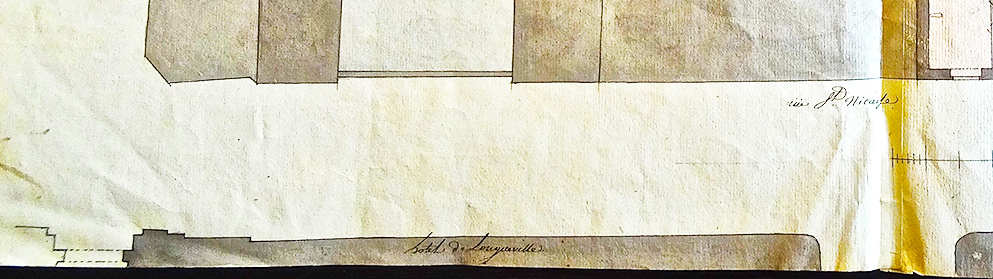
Image courtesy of the Archives Nationales (France) F/13/324
Cartes Républicaines
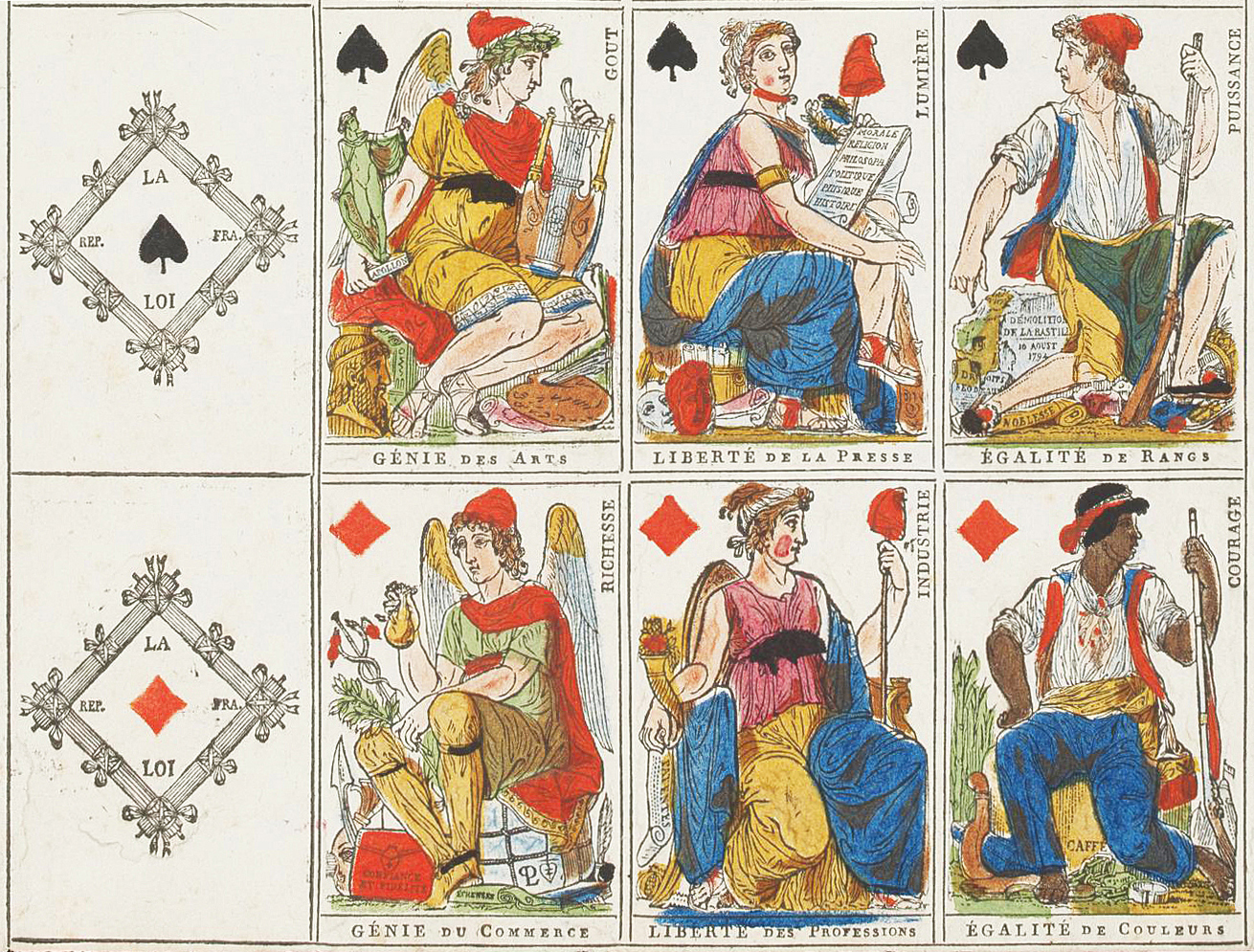
Image courtesy of the Victoria and Albert Museum.
The Cartes Républicaines produced at the Jaume and Dugourc factory figure in some very fine studies of playing cards, and of culture at this time. I recommend the Victoria and Albert Museum site (linked), for example. But in most cases discussions are brief and often tangential, in part because archival documents related to their production are scarce, and because playing cards, like wallpapers, normally disappear with time. Indeed, few samples survive.
The republican cards which Dugourc designed in late 1792 have been somewhat understudied, as consumer items often are. Each card embodies an ideal, or set of ideals, rather than the actual state of affairs. Nonetheless, in many cases these cards depict a kind of real person, who represents an ideal to be worked towards and achieved. Dugourc’s designs are didactic, serious, purposeful, and occassionally triumphant; the cards differ dramatically from most of Dugourc’s other work, work crafted from the most expensive materials at great expense, work designed principally to delight, amuse, and appeal to the senses, as much as the mind. At some later date we would like to examine the cards as cultural texts – individually and as part of an evolving mosaic of political-social consumer objects always present in everyday life.
What the cards tell us emphatically is that Jean-Démosthène Dugourc had come full circle. The designer of clocks, furniture, ornate arabesques and wallpapers for elite consumers was, by late 1792, an equal partner in a business built upon manufacturing and selling a low-cost, portable, consumer product, a product which expressly attacked the motifs and values which Dugourc had profited from propogating until 1792. Other artists faced the same, or similar, challenges.
Other manufacturers produced similar sets during this time. As noted, the National Convention did not outlaw the older style of playing cards, but the mood of the time suggests a strong demand for republican-themed cards, at least for a period of time. Indeed, Jaume and Dugourc sought to expand their operations in early 1793 and petitioned the government to lease more space at the former magasin de l’opéra on February 19th, 1793, the day after the execution of Louis XVI. The signatures reproduced here are taken from this document. (F/13/312/B) Archives Nationales (France).
June 16, 2023 Update: the original article incorrectly dated the Jaume-Dugourc petition as Febrary 22nd, 1793. The correct date is February 19th, 1793. Dugourc first leased space in the building late in 1792. The public could purchase cards from the Jaume & Dugourc Manufactory from March 22nd, 1793, or perhaps slightly earlier. (Prospectus et Avis, Supplement, Journal de Paris, March 22, 1793)
Signatures: Dugourc and Jaume
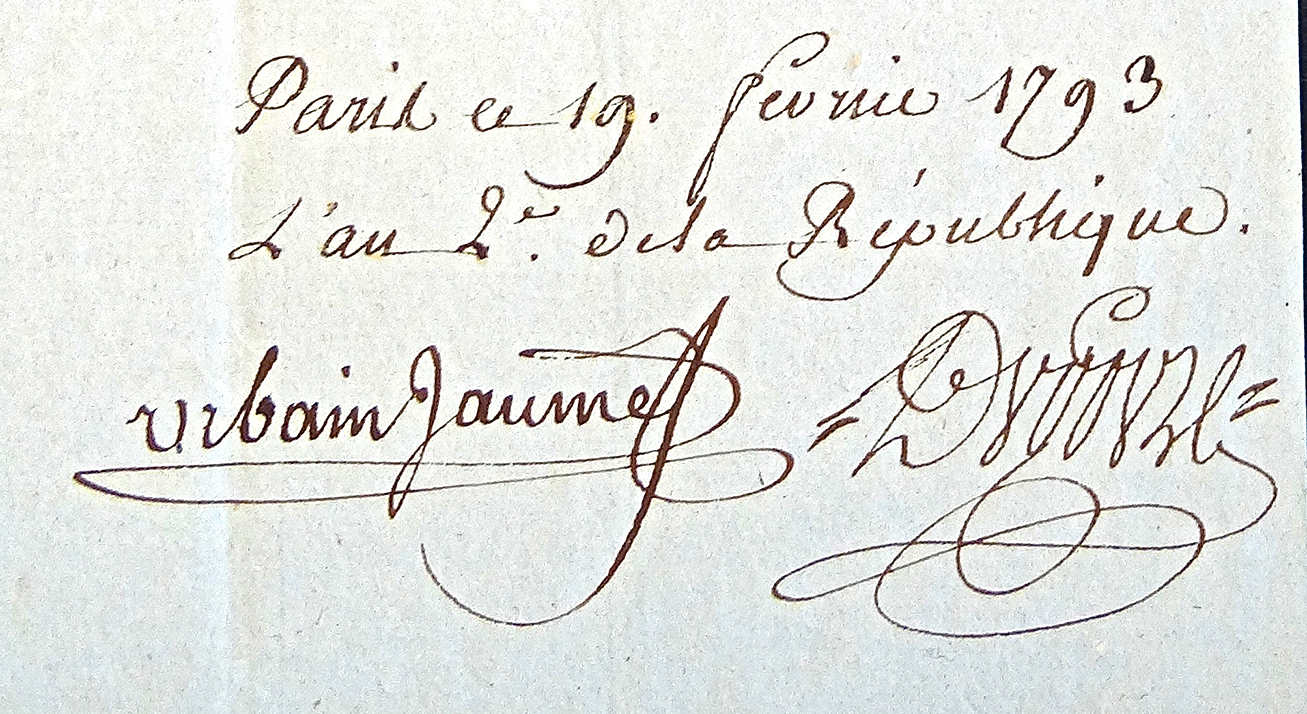
Image courtesy of the Archives Nationales (France) F/13/312/B.
We include these signatures for two reasons. First, the signatures appear on one of the very few archival documents we can definitively link to the Jaume and Dugourc factory in the Tuileries. Both signatures are therefore of considerable historical importance and interest. (Again, we are not aware of any other published study of Jaume and Dugourc which discusses their 1793 expansion, or which provides plans confirming the precise site of their factory.) The second reason, equally important, is to help confirm the identity of Urbain Jaume, a fairly minor figure compared with Dugourc, but one who is important all the same. Jaume will appear again in subsequent issues.
Dugourc and Jaume’s Factory
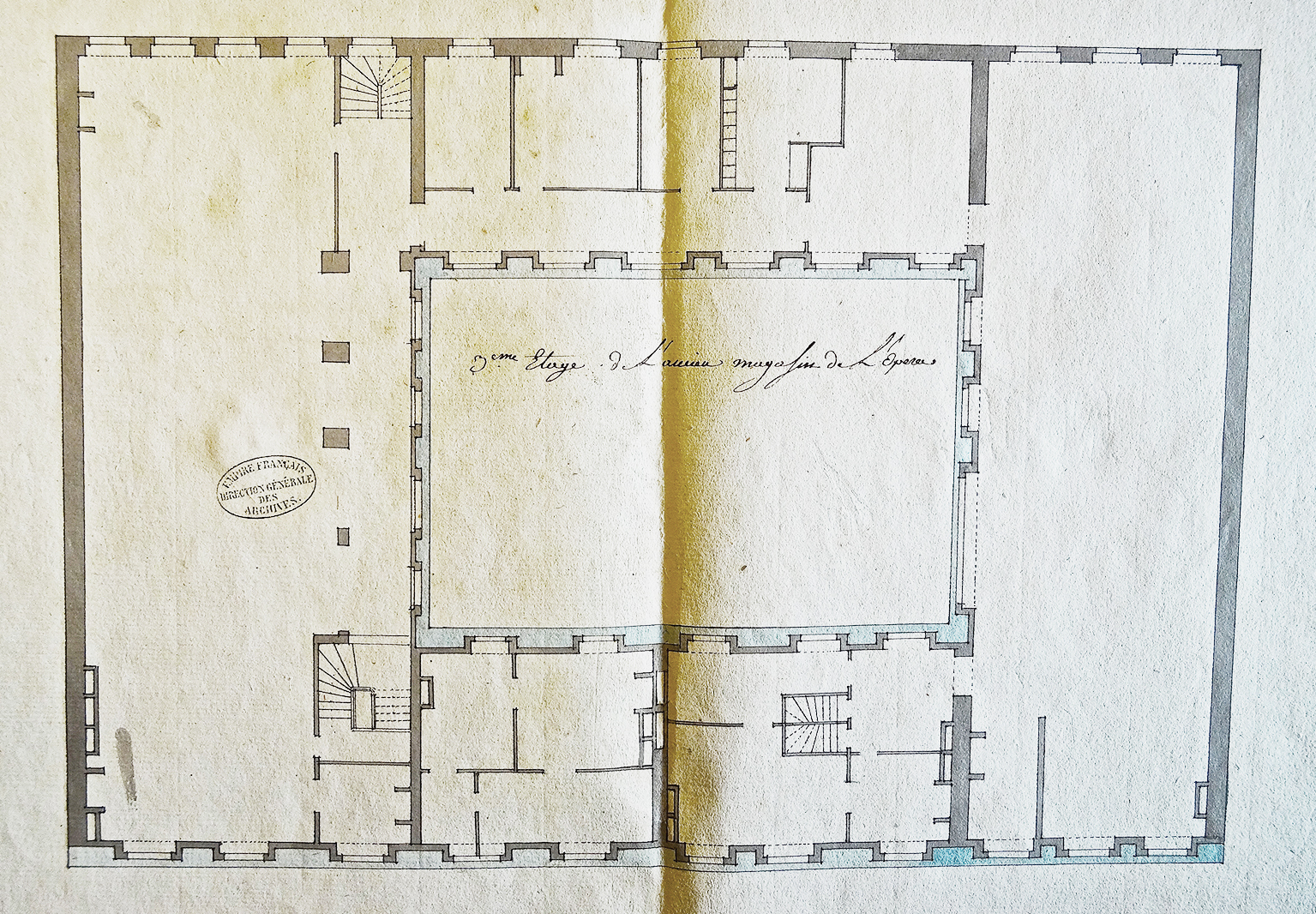
In their petition of Febrary 19th, 1793 (F/13/312/B – Archives Nationales), Jaume and Dugourc request permission to lease more space within the ancien magasin de l’opéra from the minister of the interior who, with others, had responsibility for national properties in the Tuileries. (The building served a variety of clients/tenants. The local police station, for example, was situated on the second floor.)
As we can see, the building is a quadrangle with an interior courtyard. The first part of the February 19th petition seeks to expand their work space on the third floor of the building, the site of their factory, to lower floors of the building. Jaume and Dugourc clearly hoped to increase/streamline production. The second part involves control of space on the rez de chaussée, (street level), and the right to use the interior courtyard for horses and carts for business purposes. Space facing onto the rue Saint-Nicaise would increase sales by providing direct access at street level to consumers and potential customers entering, or leaving, the Place du Carrousel and the Hôtel de Longueville.
We discuss brand awareness and other questions connected to Jaume and Dugourc’s playing cards in our discussion of culture and commerce in the Tuileries in early 1793 elsewhere in this issue.
Did Jean-Baptiste Caruel, Géricault’s uncle, or other residents of the Hôtel du Longueville purchase Jaume and Dugourc’s republican cards for personal use and/or as gifts for family, friends, and business associates, in France and abroad? A love of luxury and quality would not preclude the purchase of any product, especially one which so clearly and inexpensively serves as a kind of testament of support for the new egalitarian status quo, (sincere or not). That the republican playing cards happily carried the imprimateur of one of Paris’s elite designers was a major selling point. Our guess is an emphatic yes. We believe it is highly likely that residents of the Hôtel de Longueville and others in Géricault’s circle (such as Carle Vernet, Géricault’s future teacher) purchased packs of the Jaume and Dugourc cards.
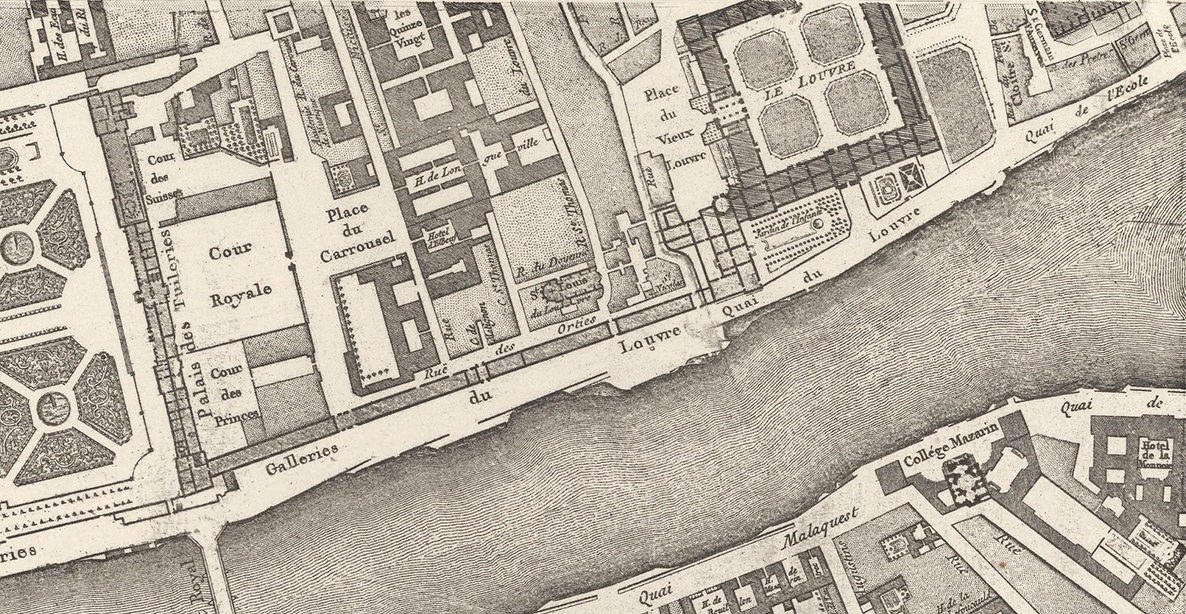
Map: 1775 J.B. Jaillot (detail), courtesy of David Rumsey Maps.