Culture and Commerce
Géricault Life
This image above depicts national troops, a tricolore banner, pikes, a phrygian cap, and an oak wreath, most of which are constructed symbols of change – rendered onto Sevres porcelaine in signature blue, ornamented with gold leaf. The scene on the saucer, which was produced at the royal ceramics manufactory in 1791, celebrates the 1st anniversary of the destruction of the Bastille. The quality of the porcelaine, the Sevres brand and the gold leaf confirm the object was designed for display on an elite table, irrespective of the egalitarian motifs decorating its surface.
Introduction
Théodore Géricault’s family was keenly interested in both the consumption and production of material culture. Opportunities to participate more fully in these activities increased from 1791, as key family members quickly became very wealthy. As a child, Théodore spent equal time in the stable and the salon. My view is that this broad range of experiences provided Théodore with a solid understanding of the evolution of material aesthetics and values in daily life, and the arts, long before he began his formal training as a painter.
Culture and commerce dominated life at the Hôtel de Longueville, the most important site in Paris for the Géricault-Caruel-Robillard family. We begin our discussion of specific influences on Gericault with two individuals who made culture their business at the Hôtel de Longueville in 1792.
Brunton – Place du Carrousel
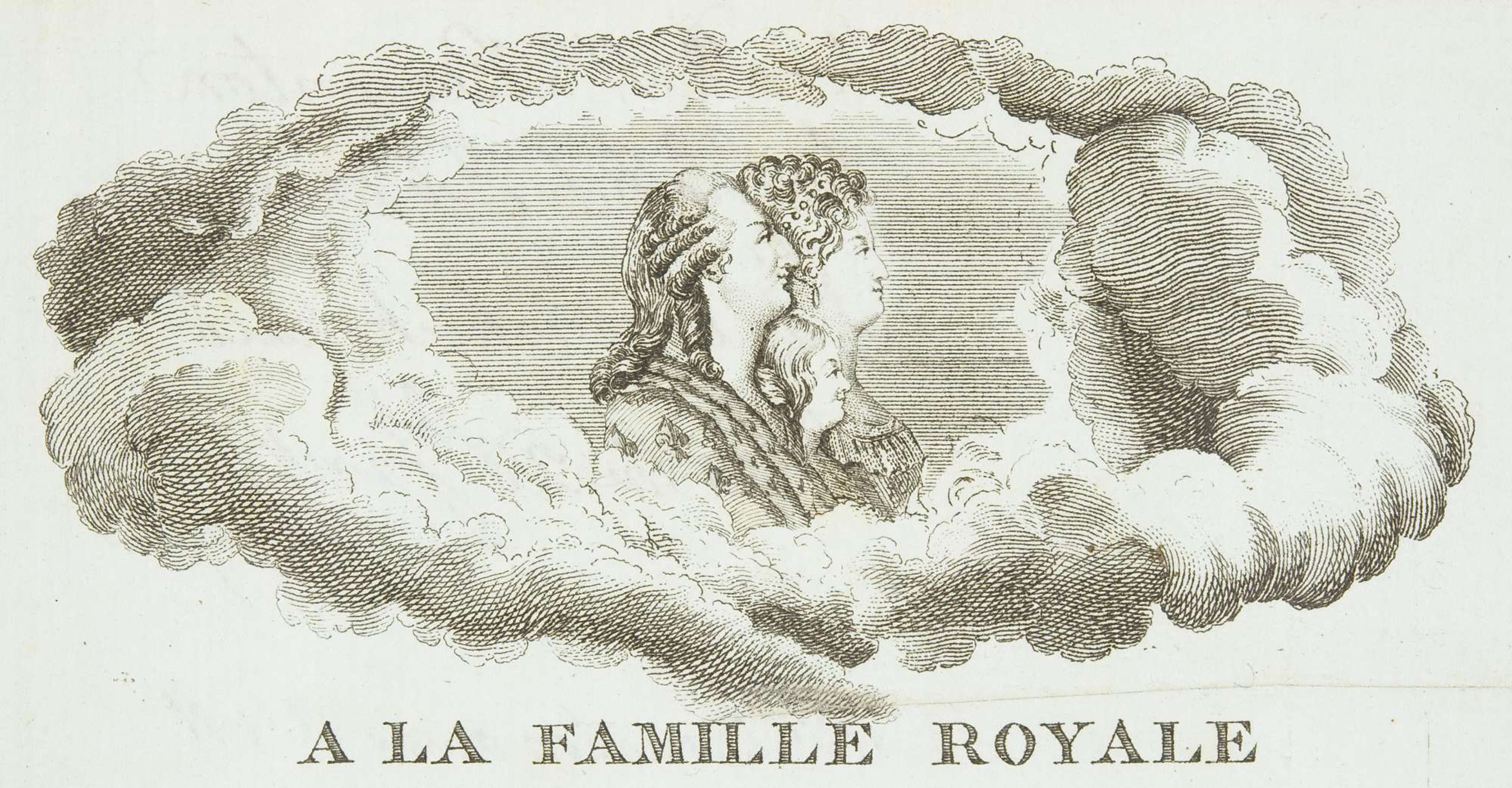
A la Famille Royale (to the royal family) – an image and caption of the sales bill of Brunton from January, 1792, whose haberdashery at the Place du Carrousel (Hôtel de Longueville) offered silks and fine fabrics to men and women. Brunton, an English mercer, was one of a number of smaller entrepreneurs leasing space within the property. Brunton’s shop was immediately north of the Hôtel d’Elbœuf and illuminated by windows facing the Place du Carrousel. (The tobacco manufactory was adjacent directly to the east.) Brunton also had an atelier, or workshop, within the inner courtyard, a space known as the cour de fabrique. Click the link above to view the image and the sales bill en français. (Image via the Archives Nationales (France) T//1147/5 and T//1147/6.)
Jean-Démosthène Dugourc – Designer Extraordinaire
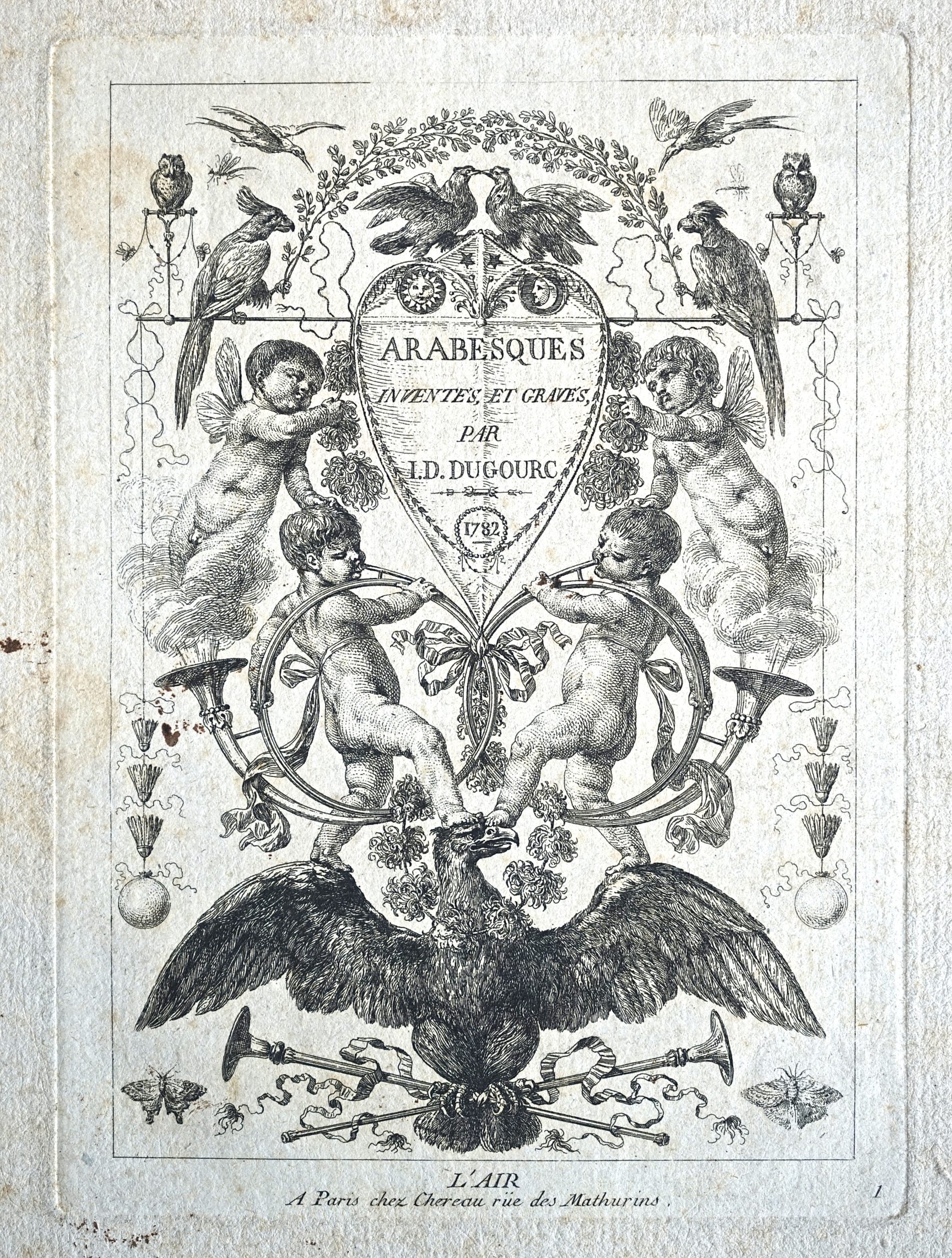
Jean-Démosthène Dugourc (Dugoure, Dugourre) was one of the most extraordinary and inventive artists working at this time. Étienne Anisson-Duperon, (see Passage Longueville in this issue) recruited Dugourc to design high-quality wallpaper for the Manufacture Républicain de Papiers Peints at the Hôtel de Longueville in January, 1792. We will discuss the Manufacture Republicain de Papiers Peints, Dugourc, Duperon and the commerce in culture in greater detail in subsequent issues.
The image above is a promotional piece from 1782, and one of a group of six. Over the course of his career Dugourc worked in a variety of media – gold, ivory, fabrics, paper, and others. Trained as an architect, Dugourc designed carriages, clocks, chairs, funerals, and playing cards. Like Jacques-Louis David, Dugourc designed pageants for the powerful. His clients were typically wealthy and he often designed for royalty. Dugourc survived to serve the Bourbon rulers of France when they returned in 1814. Examples of his work can be found at Versailles, Paris Museums, and other sites. The most comprehensive study of Dugourc and his art is Christian Baulez’s 1990 exhibition catalogue: De Dugourc à Pernon: nouvelles acquisitions graphiques pour les musées: 1890-1990 centenaire du Musée des tissus.
Investment and Consumption
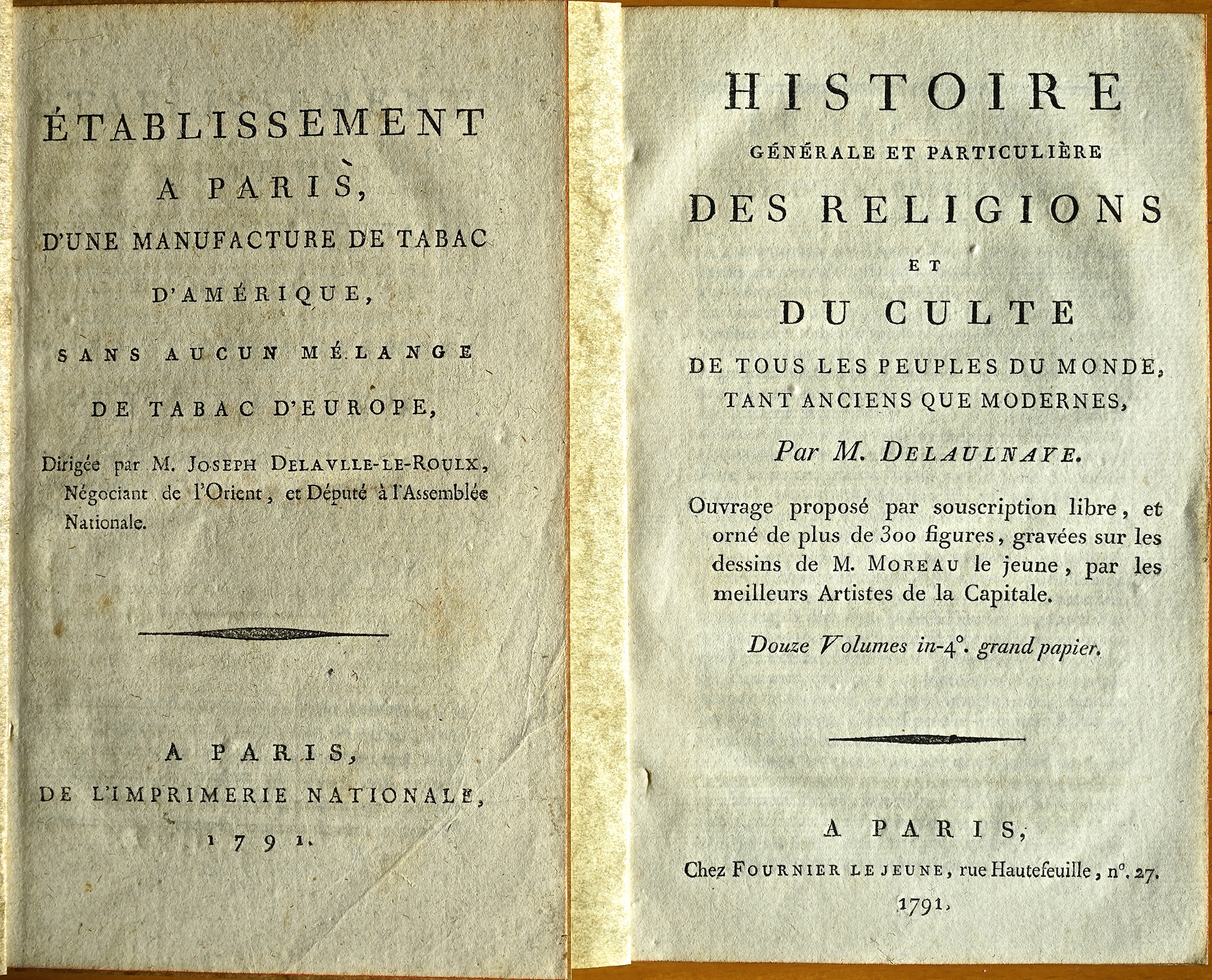
I conclude my initial inquiry with two documents – a prospectus for a new tobacco manufactory, and a prospectus for a series of 12 books. The prospectus for the tobacco enterprise is 11 pages. The prospectus for the book subscription is 16 pages, has many more words per page, and provides much more detail. Documents such as these help us better understand the commerce in culture in France at this time. We provide a brief introduction here.
One reason the government dissolved the royal tobacco monopoly in 1791 was to promote the consumption of tobacco grown in France. M. Joseph Delaville-Le-Roulx invites investors to purchase shares in a new manufactory which will cater to that part of the public which does not wish to consume domestic blends. M. Delaville-Le-Roulx hoped to raise a million livres; a single share in his tobacco enterprise cost 1,000 livres, which provides a sense of how much money was involved in the tobacco trade.
M. Delaulnaye invites consumers to subscribe to twelve illustrated volumes, published over time in 48 livraisons (issues). The late 18th century was a time of enormous ambition and excitement. Europeans had conquered India and were moving west across North America. Captain Cook mapped much of the South Pacific. Precision manufacturing and emerging technologies from England promised greater victories. France was keen to catch up; the educated public wanted reliable information about cultures and people, illustrated by the best artists. The prospectus for the General and Particular History of Religions and Cults… promises exactly that, with a total of 300 high-quality illustrations. Note the prominant position awarded Moreau Le Jeune (Jean-Michel Moreau) on the prospectus cover.
Both documents are invitations to invest in cultural capital. M. Delaville-Le-Roulx is offering a financial return, but the cultural capital is very much a part of the project. Being a shareholder in any major commercial enterprise conferred substantial cultural capital; for consumers, branding was as important to the tobacco trade then as it is now. The book prospectus makes no promise of financial reward; but the prospectus is an implicit invitation to invest in cultural capital, while ostensibly purchasing ‘knowledge.’ We see this in the Brunton sales bill: making proximity to the royal family at the Place du Carrousel an explicit part of the purchasing experience. Publishers often printed a list of subscribers within the volume to attract others. Prospectus writers often included an explicit appeal to snobbery in the prospectus – encouraging the canny to sign up early to win a place high on the subscription list, which in some cases included a number beside each position. The value of such cultural capital, of course, varies according to the audience, a topic we will pursue in greater depth elsewhere, espcially in terms of art. The Sevres saucer is an example of how boundaries blurred in 1791, whilst confirming that traditional emblems of status, embodied in gold leaf and the royal brand, still mattered a great deal. The available evidence suggests that Théodore Géricault’s family was deeply committed to acquiring wealth and cultural capital, and in this regard Géricault and his family were in no way unique.