Faubourg Bouvreuil
Géricault Life
1636 Vue d’un port avec le Capitole (detail) Claude (Lorrain) Gellée, Louvre.
Introduction
In 1842 the Academy of Rouen established a commission to determine the date and location of Théodore Géricault’s birth in Rouen. Read the abridged translation of the commission’s report below.
Academy of Rouen
“…It was vaguely known that Géricault, the painter of the Shipwreck of the Medusa, a composition that is ranked among the best of French paintings, was born in Rouen; or else in the area of Rouen according to some. The commission is certain that this latter claim is erroneous, and that Géricault, this great artist taken so young from the arts and from France, first saw the light of day in our city. Here is the copy of the act which confirms this: “Tuesday, the twenty-seventh of September 1791, was baptized by the servants of St. Romain: Jean-Louis-André-Théodore, born yesterday of the legitimate marriage of Georges-Nicolas Géricault, man of law, and of Louise-Jeanne-Marie Caruel of this parish; the godfather was Jean-Charles Passays, businessman of this city and of this parish, the godmother Louise-Thérèse-Depoix Caruel also of this parish, signed below with the father. Signed – Géricault, Depoix de Caruel, Passays and le Carpentier serving.” (Register of the parish of St. Romain, for 1791.)
The evidence provided in this authentic document confirms that Théodore Géricault was born in Rouen in the parish of St. Romain on the 26th of September 1791 (And not the 28th, as his biographer Mr. Louis Batissier claims.*) The act provides no indication of the street and of the house; this is an omission which, unhappily, is made in almost all old public acts. The commission was forced to examine other documents. The father of Géricault, who is identified in the act of baptism, was an advocate, (this term was replaced in 1791 by the term ‘man of law’). The record of advocates from 1779 ends in 1790, and still carries his place of residence. During this period, which preceded the birth of his son, the father of Géricault lived on the rue de l’Ecole, n° 34. The rue de l’Ecole was never part of the parish of St. Romain, it follows then that Géricault’s father changed his residence in 1791, or towards the end of 1790, and moved into a domicile in the parish of St. Romain, which is indicated in the act of baptism of his son.
Seeking other sources, we located a register which is, in effect, a list of advocates…and which allowed us to finally identify the precise place of Géricault’s birth. Consulting the list for the year 1791, for the parish of St-Romain, which was conserved in the archives of the city, we find the name of Géricault’s father, ‘man of law,’ residing at number 7, rue de l’Avalasse. Everyone knows that the rue de l’Avalasse was situated nearby the Church of St. Romain, and which was part of this parish. Thus, we find, on the basis of this information, and of the act of baptism, eminently authentic sources, that Théodore Géricault was born on the rue de l’Avalasse, n°7, on September 26th, 1791.
This house belonged to the grandmother of the painter. It was situated almost midway up the climbing street on the lefthand side. It was built on a considerable piece of land, where today we find the buildings carrying the numbers 13, 13bis, and 13A. The old number 7 was suppressed several years ago. We made this determination after examining these site and the titles of ownership.
This collection of buildings belongs to one sole owner, the widow Morel, who acquired them in 1808, from a Mr. Bouland, and who, in 1822, because of the state of the buildings, rebuilt them almost entirely. The former main entrance corresponds today to that of number 13a. If it is not possible today, because of these changes, to determine precisely the room in which the painter of the Shipwreck of the Medusa was born, we can at least indicate the place where this occurred…”
“Rapport de la commission,” (pp. 364-368) Précis analytique des travaux de l’Académie royale des sciences, belles lettres et arts de Rouen, pendant l’année 1842. Rouen: Periaux, 1843,
Commentary
The Géricault-Caruel family home was situated in the Faubourg Bouvreuil “almost midway” up the rue d’Avalasse, a steep street climbing from the old Porte Bouvreuil to meet the main road to Amiens. The great beauty of the boulevards which encircled the old city of Rouen like a “bower” impressed both Dawson Turner and Thomas Frognall Dibdin when they visited in 1818. The Géricault family lived just north of the Boulevard Bouvreuil, amidst the “hundreds of gardens, apple and pear orchards, and fields covering the surrounding hills” which the English observers described, and which are clearly visible on the 1801 BnF map. The Géricault home, situated just above the boulevards, offered a superb view of the the old city, the Seine, and the fields and hills beyond.
Rouen was still one of France’s most important northern ports when Géricault was born. Contemporary witnesses report seeing large ships loading and off-loading goods on the city’s quays. Visiting Rouen today one still gets a sense of the importance of the sea to Rouen. Today Géricault’s home is some hundreds of meters from Rouen’s principle passenger train station. However, many of the city’s relics still survive. One can walk the rue de l’Avalasse and view the plaque there honoring the artist.
Several towers of the Bouvreuil gate (the cluster of buildings just south of the Géricault home marked in red below) still stood. One tower (La Tour de la Pucelle) served as the prison of Joan of Arc during her trial and execution in Rouen. She was burned at the stake in the old city market in 1431. Other notable buildings nearby include the Recollets/Recolets, the Val de Grace, and the Church of St. Romain where Théodore was baptized, built as part of the Couvent de Carmes Dechassees. In the Faubourg Cauchoise to the west, we find Saint Gervais, where William the Conqueror spent his final days.
The 1842 report establishes for the first time the precise place and date of Théodore Géricault’s birth in Rouen, and the names of key family members, making the commission’s report an important marker in Géricault scholarship. We note also that the 1842 report is the first biographical account of Théodore Géricault based on archival evidence, rather than memory, speculation, and anecdote.
*Batissier wrote that Gericault was born on the 25th of September: “Jean-Louis-André-Théodore Géricault est né le 25 septembre 1791, a Rouen...” Gericault, Batissier 1841, p.2.
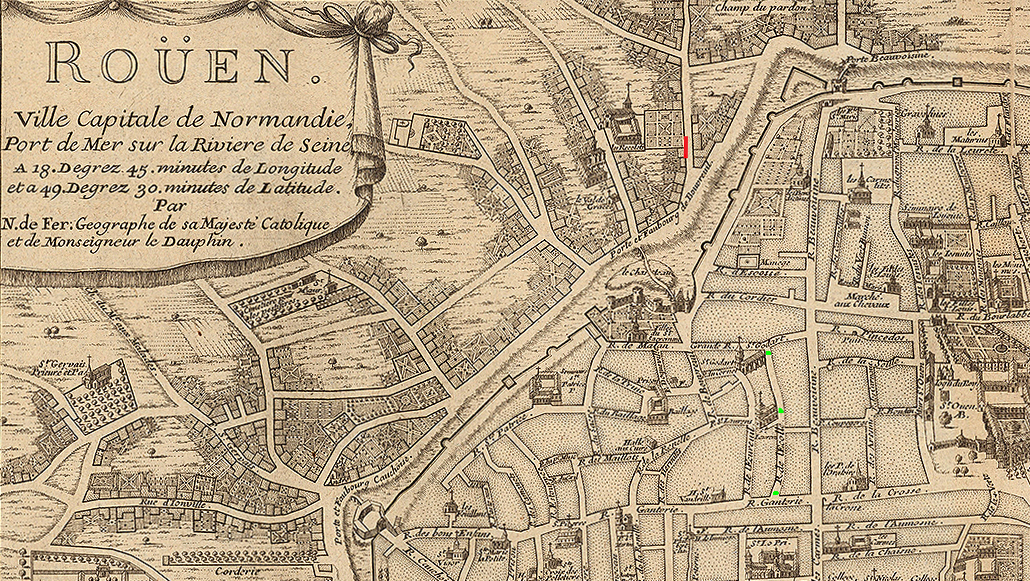
The Caruel-de Poix family home on the rue de l’Avalasse is indicated in red and the home of George Nicolas Gericault (Gericault’s father) on the the rue de l’Ecole in green. (Nicolas de Fer 1724 map (detail) courtesy of David Rumsey Maps.)
A second map (click BnF) is scalable, much clearer, and provides very precise details of the city in 1801, including all street names. (Opens in a new window.)