1829 reprint of 1802 image – Engraving of a School on the Rue de Monsieur (detail), Pierre-Nicolas Ransonnette. Image courtesy of gallica.bnf.fr / BnF.
Théodore Géricault & the Pension Dubois & Loiseau
A picture is worth a thousand words, the saying goes. This article is the first of four that I will present on Théodore Géricault at the Pension Dubois & Loiseau, the artist’s first boarding school in Paris. To date, Géricault scholars and art historians have produced very little work on Théodore Géricault’s childhood and early influences. In July of 1863, a letter written to Géricault biographer Charles Clément placed a young Géricault at the Pension of “M. Dubois-Loiseau on the Rue de Babylone.” In the century and a half since, Géricault scholars have learned only that a Pension Dubois & Loiseau was situated on the Rue de Monsieur, near the Rue de Babylone in Paris, and that Théodore Géricault likely boarded there from 1797 to 1804. Lacking today even a clear idea of the precise location of the Pension Dubois & Loiseau, formulating questions about Théodore Géricault’s experiences there, two centuries ago, has proved a daunting challenge.
Théodore Géricault was born in Rouen on September 26th, 1791, and died in Paris on January 26th, 1824. In 1796, or 1797, Géricault moved with his father, mother, and maternal grandmother into an apartment in Paris on the rue de l’Université, not far from the Seine river, in the fashionable faubourg Saint-Germain. Soon after, it seems, young Théodore began boarding at the Pension Dubois & Loiseau on the Rue de Monsieur, a short street to the south, about 1.5 kilometers from the Géricault home.
In this initial article on Théodore Géricault at the Pension Dubois & Loiseau, I will present evidence which establishes the exact location of the Pension Dubois & Loiseau on the Rue de Monsieur in 1802, and in 1808. This evidence will allow us to open wider and deeper avenues of investigation into this critical period in Géricault’s life.
Krafft & Ransonnette, 1802 – 1829
At the top of this page is a detail from Pierre-Nicolas Ransonnette’s 1802 engraving of the inner court and library of an unnamed school in Paris – situated at the Archives of the Chevaliers of Saint-Lazarus on the Rue de Monsieur. This unnamed school is, in fact, Théodore Géricault’s first boarding school in Paris: the Pension Dubois & Loiseau. Ransonnette produced this engraving with his partner, the architect Joseph-Charles Krafft, as part of a subscription series of “the most beautiful buildings constructed in Paris during the preceding twenty-five to thirty years,” which the pair began marketing to an international clientele in 1801. Every five weeks, or so, subscribers would receive a cahier (or livraison) of 6 engravings, along with descriptions of the plates in French, German, and English. The number of engravings within each cahier varied somewhat, but the quality remained high. The Krafft & Ransonnette engraving at the top of the page, for example, was one of 5 engravings that made up the 11th cahier published in the spring of 1802. Scroll down to view bibliographic sources dating these cahiers.
(*Note that street numbers and street and building names changed during the Revolutionary period and after. The Rue de Monsieur was also known as the rue Bigot/Bigault and the rue de Fréjus. To keep our discussion focused I will refer to the Rue de Monsieur as the Rue de Monsieur at almost all times in this initial article.)
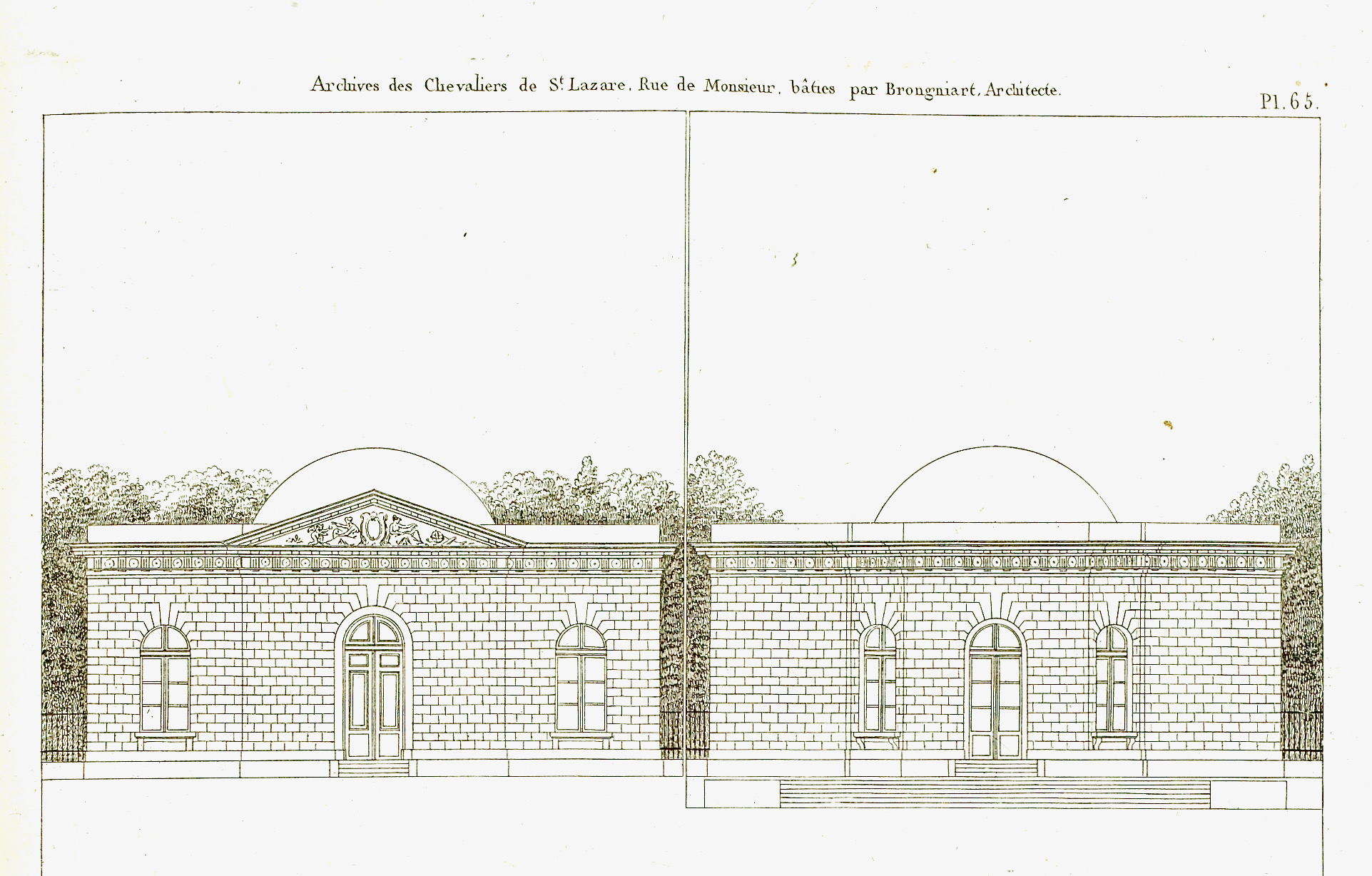
Plate LXV
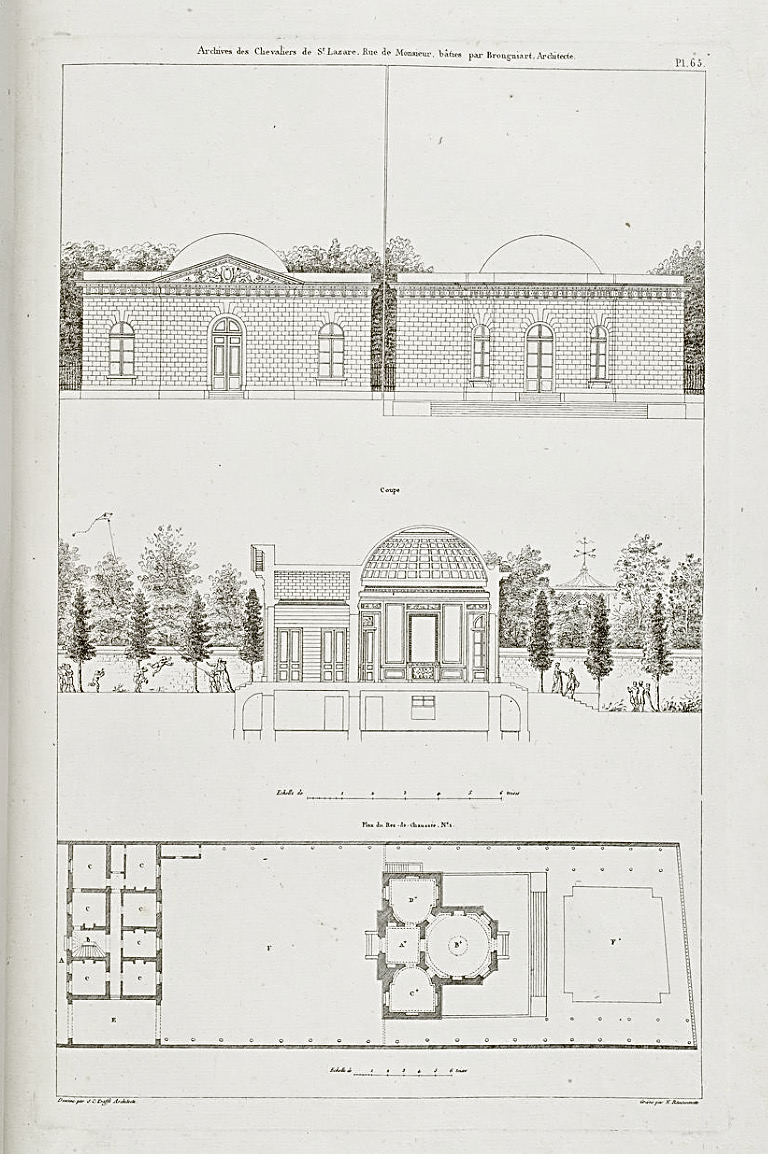
1829 reprint of 1802 image – Krafft & Ransonnette – Plate LXV. Image courtesy of gallica.bnf.fr / BnF.
Individual cahiers of any series produced during this time are rare. Fortunately, in 1829 Joseph-Charles Krafft supervised the republication of the original cahiers in one unpaginated volume. The engravings within this volume are organized in the orginal cahier order. The Archives des chevaliers de St.-Lazare thus appears among the other engravings of the 11th cahier and is listed as Plate 65 – Archives des chevaliers de St.-Lazare, Rue de Monsieur, built by Brongniart architect (Alexandre-Théodore Brongniart.) As we can see, Krafft and Ransonnette present three different views of the Archives in Plate 65 without any detailed explanations. This was not unusual in an illustrated series of this kind. The explanatory table in French, German, and English, providing more detailed information about each engraving, preceded the plates of each orginal cahier. In 1829, Krafft republished these explanatory tables within this bound volume on pages preceding each cahier of engravings. The English explanation of Plate 65 in the 1829 volume reads:
“Plate LXV – “Archives of the Chevaliers St.-Lazarus, street de Monsieur, formerly street sur les Boulevards de Plumet, built in the year 1787, by Brongniart, architect, at present a house of education. (My underline.)
A: The inncourt (Entrance Court) ; B: Stair-case; C: The school; D: Corridor; E: Passage; F: Court
A*: Hall; B*: Room where the scholars assemble; C*: Closet; D*: Library; E*: Terras (sic); F*: Garden.”
The entire explanatory table of the 11th cahier can be viewed here.
Krafft Architectural Plan – “Maison d’Education.”
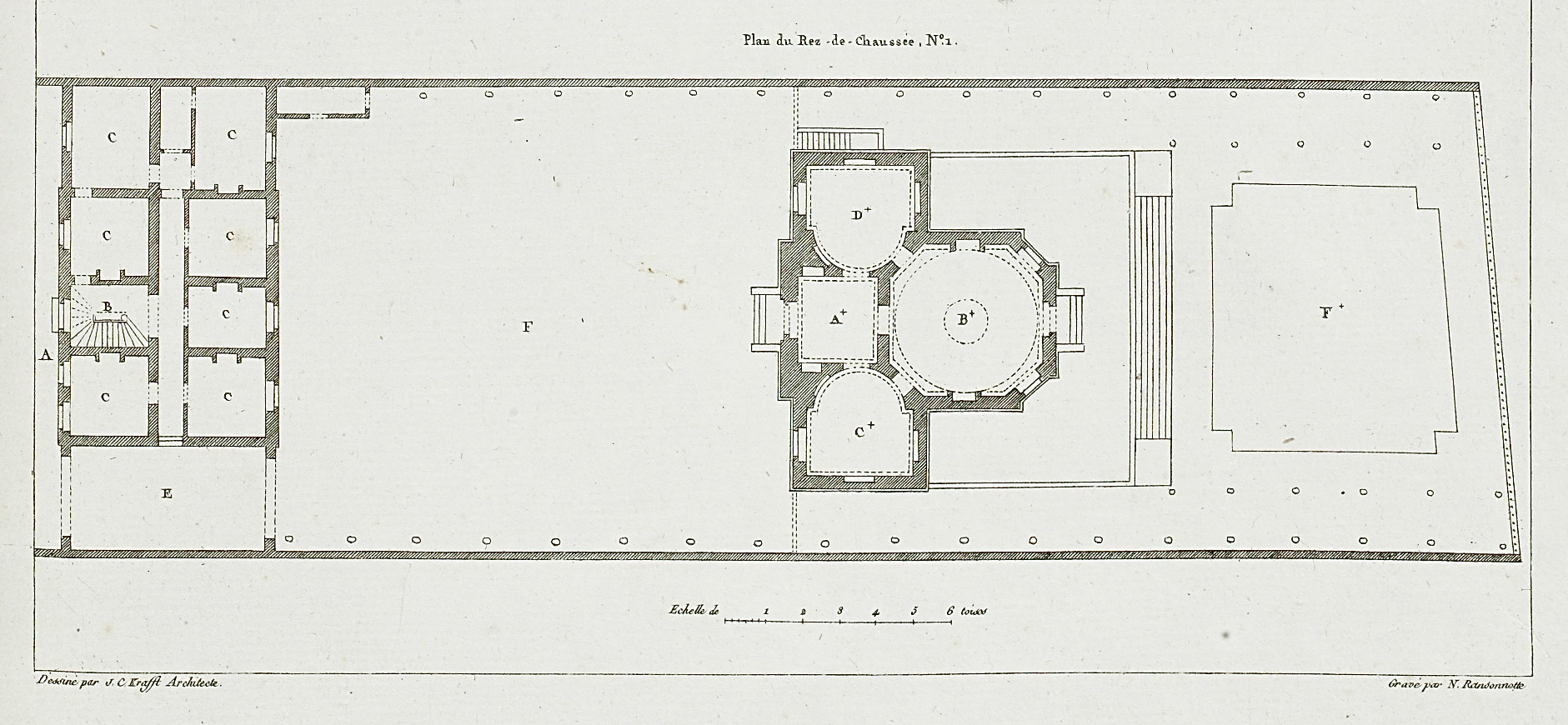
1829 reprint of 1802 image – Krafft Plan – Maison d’éducation – Archives. Image courtesy of gallica.bnf.fr/Bnf.
The explanatory table allows us to understand the plan of Plate 65 clearly, such that we learn the Archives of the Chevaliers of Saint-Lazarus had been repurposed as a school by 1802. Plate 65, in isolation, offers no hint of this important pre-1802 transformation. Now that we have clarified the dating and the actual content of the Krafft and Ransonnette engraving we turn to our second contemporary source.
1808 – Asker Khan at the Pension Dubois & Loiseau
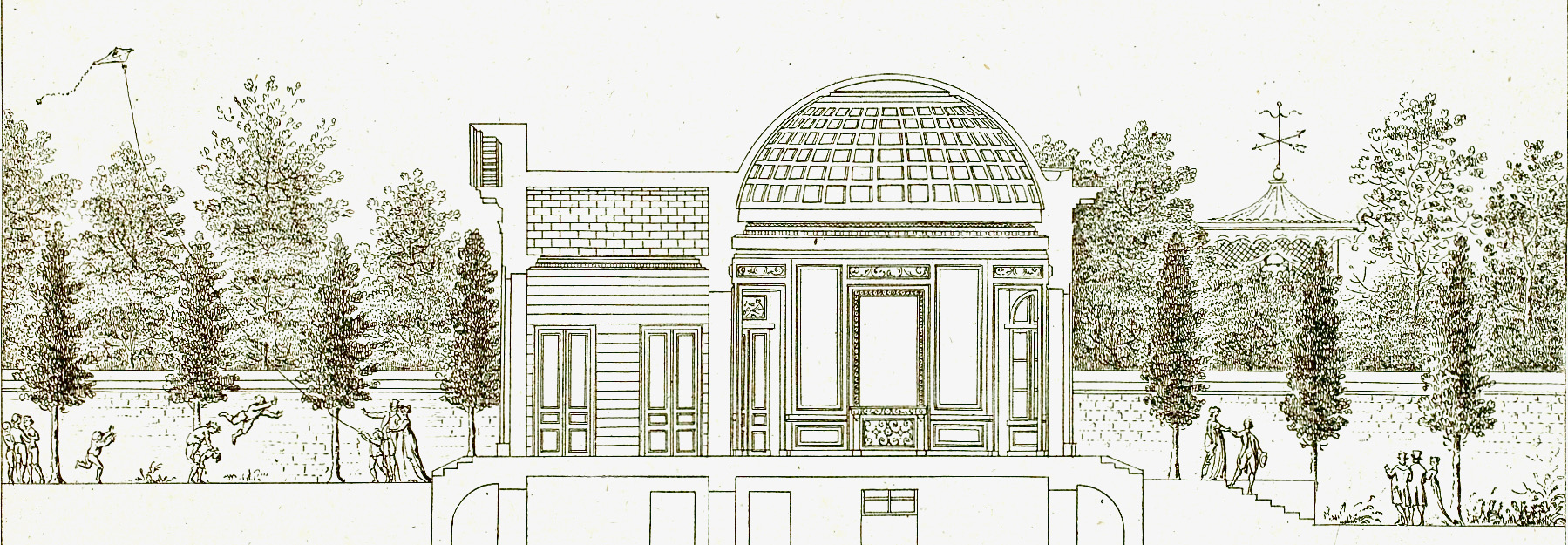
1829 reprint of 1802 image – Pension Dubois & Loiseau – Cross-section (Archives detail) – Court, Pavilion, & Garden. Image courtesy of gallica.bnf.fr / BnF.
In 1808, the Persian Ambassador to France, Asker Khan, moved with his entourage into the Hôtel de Condé (Bourbon) on the Rue de Monsieur, known as the rue de Fréjus at that time. The Hôtel de Condé (Bourbon) was, and is, perhaps the most beautiful and important of the Brongniart-designed buildings on this street. The Persian Ambassador quickly became an important celebrity in Napoléon’s Paris.
1808 07 31 Journal de l’Empire: … Paris 30 July – “The Persian Ambassador, Asker Khan, appears to have a great taste for the arts and sciences. His Excellency last night visited the maison d’éducation of MM. Dubois et Loiseau, adjacent to the Hôtel de Condé (Bourbon-Condé) which he occupies on the rue de Fréjus, (Rue de Monsieur) His Excellency was very satisfied with a séance on experimental physics given by M. Dubois, head of this establishment, and the different questions he posed via his interpreter indicate a precise and deep understanding of the phenomena of electricity…”
This brief account allows us situate the Pension Dubois & Loiseau adjacent to the Hôtel de Condé (Bourbon) on the Rue de Monsieur in 1808. The French reads “…S. Exc. fut hier visiter la maison d’éducation de MM. Dubois et Loyseau contingué à l’hôtel de Condé…” (Loyseau is an alternate spelling of Loiseau.)
A reliable period map will permit us to determine which buildings actually stood adjacent to the Hôtel de Condé (Bourbon) on the Rue de Monsieur in 1808.
1808 – Maire Map of Paris.
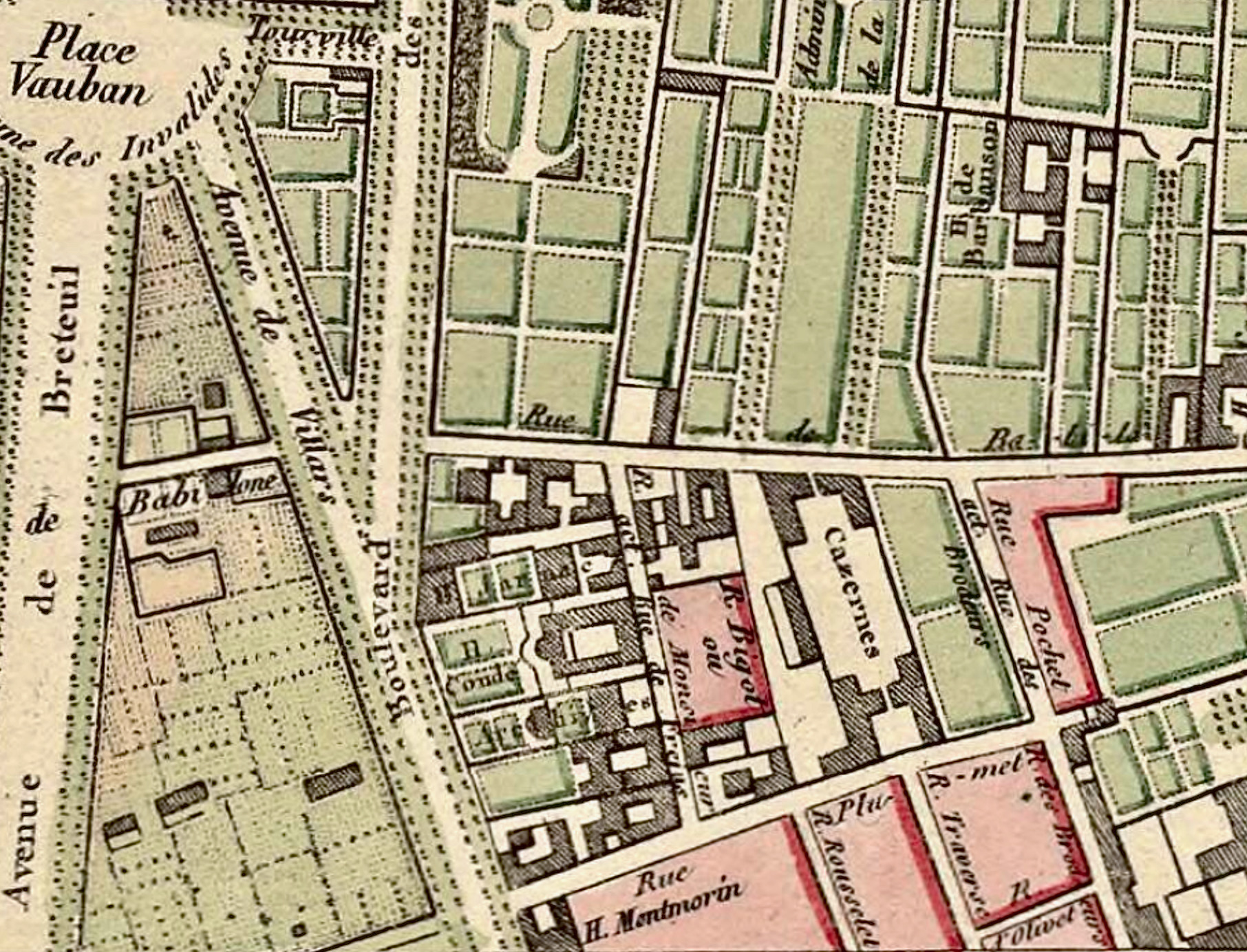
1808 – Plan of Paris, Planche 11 (detail), Nicolas Maire. Image Courtesy of gallica.bnf.fr / BnF.
This part of plate 11 of the 1808 Maire Plan of Paris reveals the rue de Babylone running east-west at the top of the image, and the rue de Fréjus (Rue de Monsieur) running northwest to southeast, more or less. Just six buildings stand on the west side of the Rue de Monsieur, three of which Maire identifies by name. North to south, these are: the Hôtel Jarnac, the Hôtel Condé (Bourbon,) and Archives. The Hôtel Jarnac is clearly north of, and adjacent to, the Hôtel Condé (Bourbon.)
I have discovered no record of any other archives on the Rue de Monsieur during the years 1802 to 1808, or any point during this period of French history. Absent evidence to the contrary, we must conclude that the Archives of the Maire map of 1808 are the same repurposed Archives of the Chevaliers of Saint-Lazarus which Krafft and Ransonnette depict in their 1802 engraving. The Journal de l’Empire confirms that in 1808 the Pension Dubois & Loiseau stood, side by side, contingué à the Hôtel Condé (Bourbon) on the Rue de Monsieur. The Archives in the Maire map of 1808 are clearly adjacent to the Hôtel Condé (Bourbon) on the Rue de Monsieur. These facts together place the Pension Dubois & Loiseau at the Archives of the Chevaliers of Saint-Lazarus on the west side of the Rue de Monsieur, adjacent to the Hôtel Condé (Bourbon) in 1802 through 1808.
Commentary
This article allows us to situate the Pension Dubois & Loiseau precisely on the Rue de Monsieur in 1802, and in 1808, and is historically significant for this reason alone. Our concern, however, is Géricault. Our new sources reveal that Théodore Géricault, sometime after arriving in Paris from Rouen, began boarding at a school famed for the beauty of its gardens and buildings, designed by Alexandre-Théodore Brongniart – one of the most influential architects of this period. We have learned that public lectures were held at the Pension Dubois & Loiseau – attended in 1808 by Asker Khan and others. Perhaps most important, we now know that images of the Pension Dubois & Loiseau exist, and have been digitalized. Ransonnette and Krafft’s evocative depictions of life at Géricault’s first boarding school on the Rue de Monsieur allow us to more closely connect with young Théodore, and his experiences there, with a confidence which only historically accurate images afford. The paths before us now are more open and more varied. We still have much to learn. We have yet to discuss how and when M. Dubois and M. Loiseau founded their educational institution, for example. This exploration of Théodore Géricault’s life at the Pension Dubois & Loiseau continues in my next article.
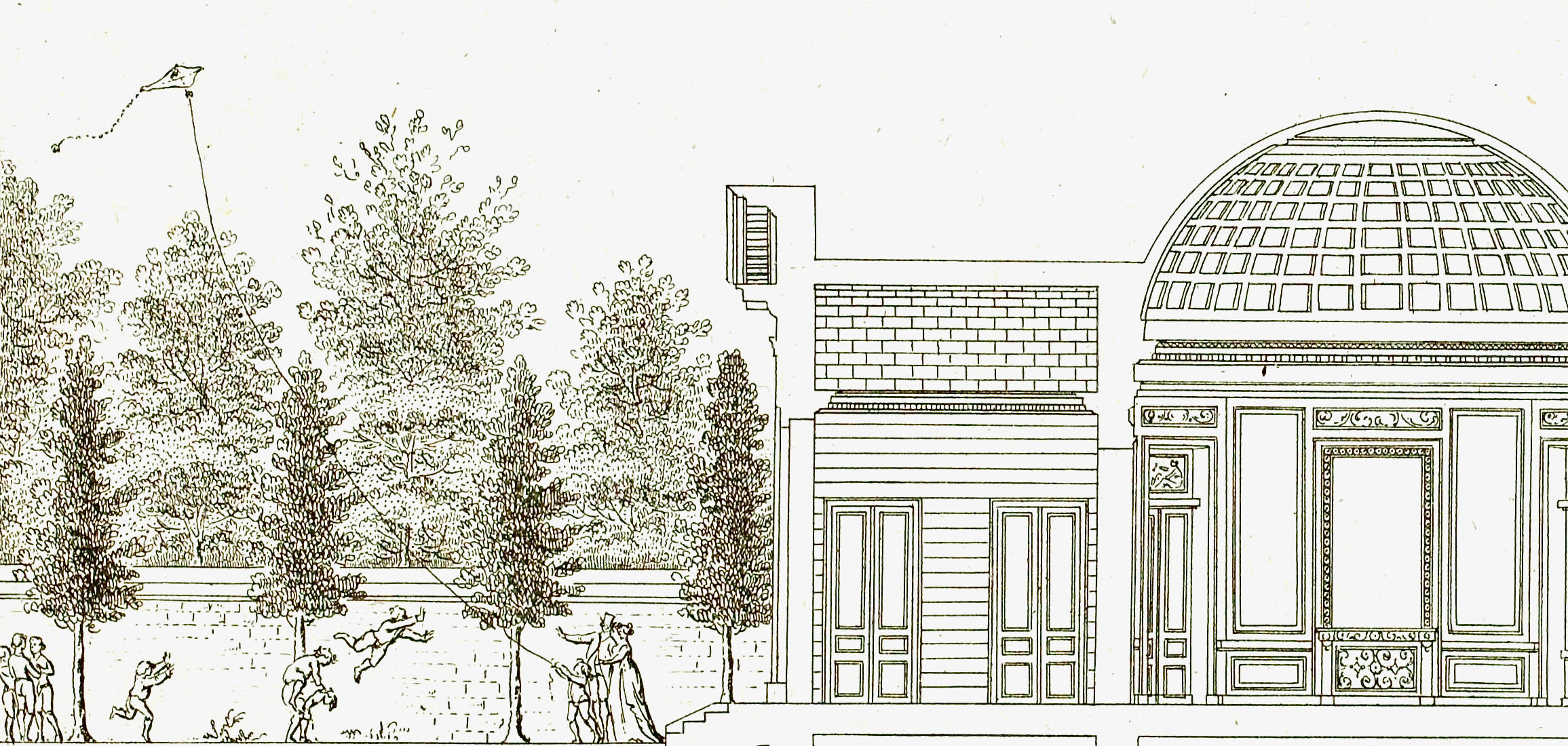
1829 reprint of 1802 image – Pension Dubois & Loiseau – (Archives detail) – Court and Pavilion. Image courtesy of gallica.bnf.fr / BnF.
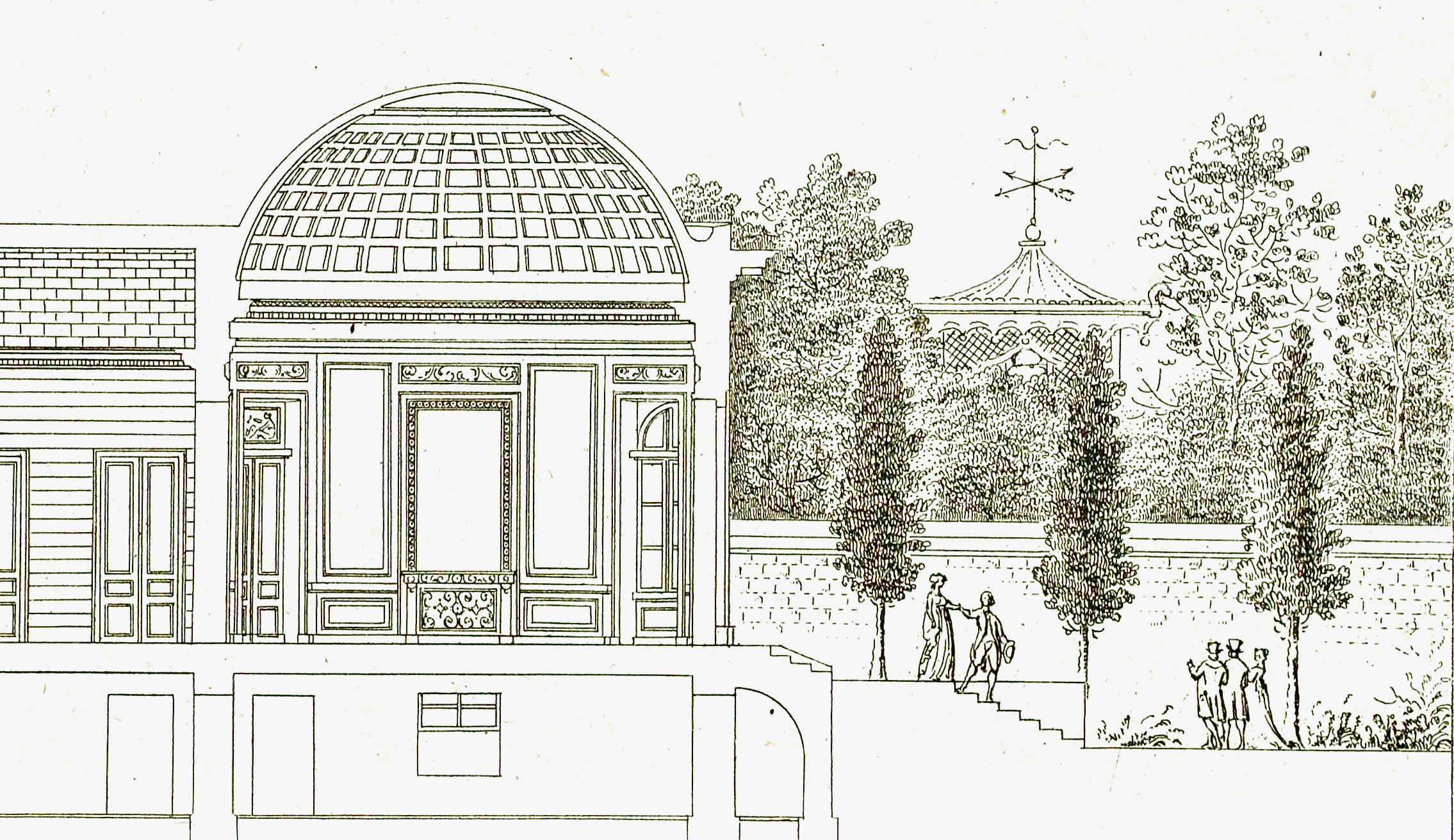
1829 reprint of 1802 image – Pension Dubois & Loiseau – (Archives detail) – Pavilion and Garden. Image courtesy of gallica.bnf.fr / BnF.
1829 reprint of 1802 image – Pension Dubois & Loiseau – (Archives detail) – Pavilion Front & Rear. Image courtesy of gallica.bnf.fr / BnF.
Bibliographic Sources
The first source below confirms that the 11th cahier of the Krafft & Ransonnette engravings was published in April of 1802. The second source confirms that the first cahier of the Kraff & Ransonnette series appeared sometime around May, 1801. The third source confirms that Krafft re-published his bound volume of all 20 cahiers/livraisons (without page numbers) early in 1829. Note this bound volume includes two extra cahiers, beyond the originally planned 18. More on the Krafft-Ransonnette cahiers to follow.
1802 04 05 Journal Typographique et Bibliographique, Du 15 Germinal, an 10. N° XXVI, Livres Nouveaux “Nouvelle Architecture Française, ou Collection des Edifices publics et Maisons particulières, établis à Paris et aux environs, depuis environ 30 ans, recueillis et publiés par les cit. J.-Ch. Krafft, architecte, et N. Ransonnsette, graveur. XIme Livraison. Format in-fol., avec texte français, anglais, et allemand, et six planches (plates). Paris Levrault frères, impr.-libr., quai Malaquais, et à Strasbourg, chez les mêmes. Noms des Maisons contenues dans cette livraison. Maison de Mademoiselle de Condé, rue de Monsieur; Intendance de la ci-devant école des Ponts et Chaussées, rue St.- Lazare; maison Bellanger, rue Pigalle; maison Castera, rue des Trois-Frères; Archives des chevaliers de St.-Lazare, rue de Monsieur; Elévations par différens architectes.”
1801 05 12 Gazette Nationale ou Moniteur Universel, 22 floréal an 9. “Livres Divers: Plans, Coupes, Élévations des plus belles maisons et hôtels construits à Paris et dans les environs, depuis vingt-cinq à trente ans, recueillis et publiés par les citoyens J.-Ch. Krafft, architecte, et Ransonette (sic), graveur. Ces plans sont accompagnés d’un texte français, d’un texte allemand, et d’un texte anglais. 1er Cahier. Le prix de chaque cahier est de 6 francs. Se trouve à Paris chez les deux associés Krafft, architectes, rue de Bourgogne, n° 1463; Ransonette, graveur, rue de Figuier, n° 43; Charles Pougens, quai Voltaire, n° 10, Levrault, imprimeur-libraire, quai Malaquais.”
1829 02 28 Bibliographie de la France N° 9, “1309. Recueil d’Architecture Civile, contenant les plans, coupes, et élévations des châteaux, maisons de campagne, etc., situés aux environs de Paris et dans les départemens voisins, etc. Ouvrage composé de 121 planches grand in-folio, accompagné du texte explicatif. Par J.Ch. Krafft. Nouvelle édition. In folio de 6 feuilles. Imp. de Ducessois, à Paris. – A Paris, chez Bauce.” (p.145)
Finally: a link to a representative example of standard Krafft & Ransonnette scholarship at the generally excellent Paris Museums website. We owe their staff, and others digitalizing contemporary sources, an immense debt for the wonderful work they do.
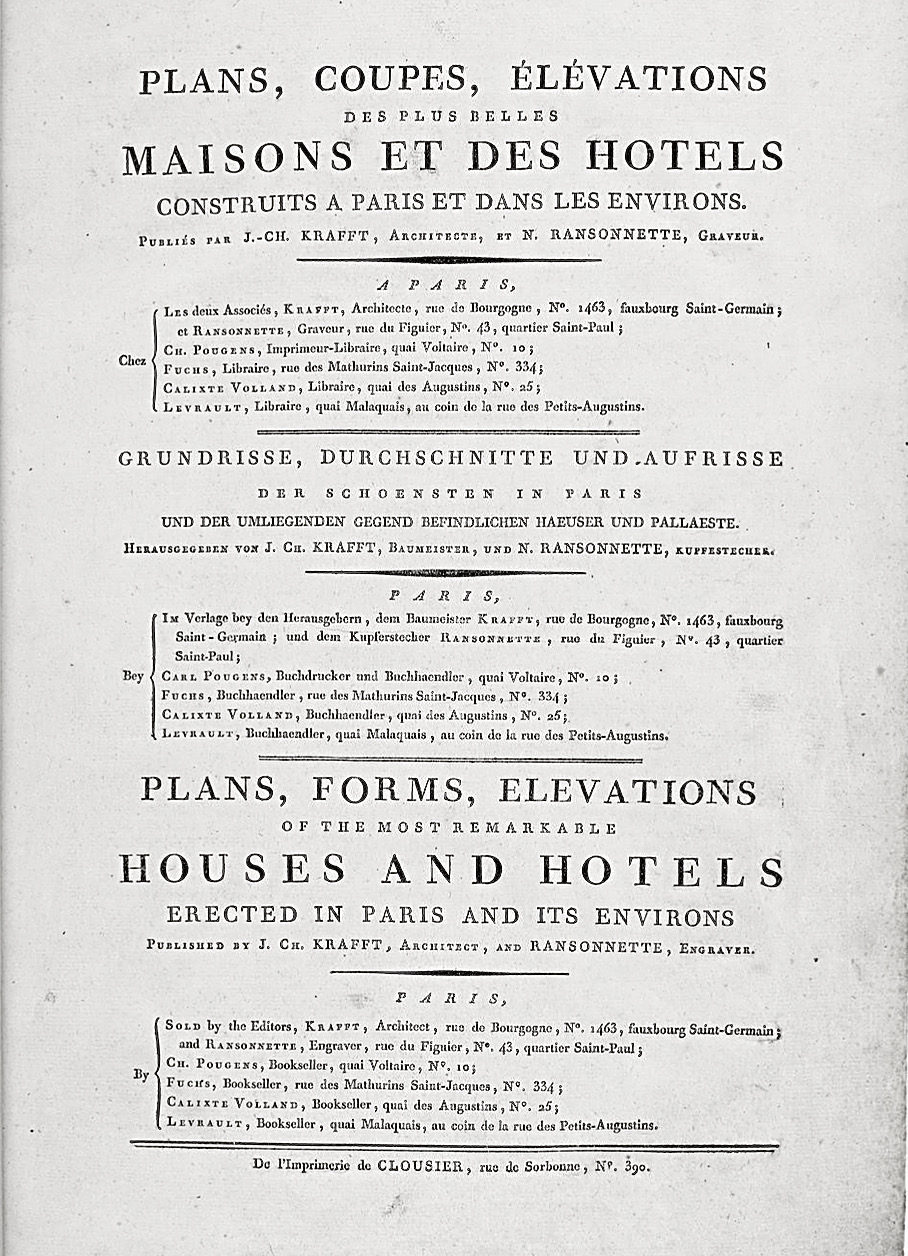
1829 – Krafft & Ransonnette – Frontispiece. Image courtesy of gallica.bnf.fr / BnF.
* Marijke Jonker and Monique Camps very kindly provided invaluable feedback on an earlier version of this article.