Parguez Géricault
Géricault Life
Fireplace Lion – Musée Jacquemart-André, Paris.
Parguez – Géricault
In the spring of 1861, an important sale of Géricault lithographs was held at the Hôtel des Commissaires-priseurs, n° 5 rue Drouot in Paris. The lithographs were part of a vast collection assembled by Adolphe-Isadore Parguez known as the Collection Parguez. The quality and rarity of the lithographs in the Collection Parguez made the event one of the most important sales of the century both for collectors and Géricault scholars.
Adolphe Parguez first began acquiring Géricault lithographs, as well as lithographs by Horace Vernet, Nicolas-Toussaint Charlet, and other members of Géricault’s circle sometime in the 1820s.* I have recently uncovered evidence, however, connecting Théodore Géricault with the Parguez family as early as 1807.
The enterprise which brought the families of Théodore Géricault and Adolphe-Isadore Parguez together in 1807 was the production and sale of engraved copies of the paintings, statues, and bas-reliefs of the national collection housed at the Muséum Central des Arts at the Louvre, in Paris, known as the Musée français, a private business supported by Napoléon, which I have discussed frequently on this site.
The Musée français was a collaboration between two Géricault relations – the engraver Pierre Laurent, and the capitalist Louis Robillard de Péronville. In March of 1802, the pair formed a society to produce a series of 80 livraisons, or folios. Each livraison would contain 4 or 5 extremely high-quality engravings of paintings, statues, and bas reliefs along with informed commentary on the object and the artist.
I argued first in 2010, and then more expansively in 2019 in Géricault Life Magazine, that Théodore Géricault’s close proximity to the Musée français as a youth in Paris played a critical role in Théodore Géricault’s growth as an individual and as an artist. In this article, I suggest that the Parguez family’s partnership with Pierre Laurent in the production of Musée français, from 1807 on, played an equally signficant role in the development of a young Adolphe Parguez. Indeed, the Parguez family’s involvement in the Musée français enterprise for well over a decade very likely brought Adolphe Parguez into direct contact with many members of Géricault’s circle, including Horace Vernet and Eugène Delacroix, and perhaps even Théodore Géricault himself.
Background
The production and marketing of the Musée français from 1802 through 1809 involved key members of Théodore Géricault’s circle. Pierre Laurent produced select engravings for the Musée français and hired the finest engravers and artists in Europe to produce the engravings for each folio, including reproductions of paintings by Claude-Joseph Vernet, the father of Carle Vernet, Géricault’s future teacher. Jean-Michel Moreau, Moreau le Jeune, Carle Vernet’s father-in-law, also worked on the Musée français, producing important decorative engravings for Pierre Laurent. Pierre Bouillon who instructed Théodore Gericault at the Lycée-Louis-le-Grand from 1806 to 1808, was also involved in the Musée français. Titon Laneuville, the Robillard family painter, and perhaps the first to nurture Géricault as an artist, was a subscriber. Livraisons of the Musée francais could be found in the Géricault home no later than 1804, when Théodore’s uncle Jean-Baptiste Caruel, a Musée français subscriber, moved from his luxurious apartments at the Hôtel de Longueville into the Gericault-Caruel residence on the rue de l’Université.
Designed to cater to an international elite, the response was extremely positive when the first livraisons of the Musée francais appeared in 1803. Almost as quickly, the peace between France and Britain ended. Foreign subscriptions, a vital source of revenue, were cancelled, or suspended. Prospects for profit dwindled. Louis Robillard de Peronville became increasingly concerned about recouping his investment and by 1806 was taking steps to end his involvement in the project. Robillard de Peronville was contractually bound to continue financing production until all 80 livraisons had been produced and distributed. However, if Pierre Laurent hoped to produce a 2nd series of engravings, he would need a new backer.
On August 21st, 1807, François Parguez (a relation of Adolphe Parguez), of the Parguez bank, signed an agreement with Pierre Laurent and his son Henri Laurent, under the terms of which the Maison Parguez would provide the Laurents, père et fils, with a series of loans to finance the production of a 2nd series of 80 livraisons to be called the Musée Napoléon.
Acte de Société … Laurent & Parguez – August 21, 1807
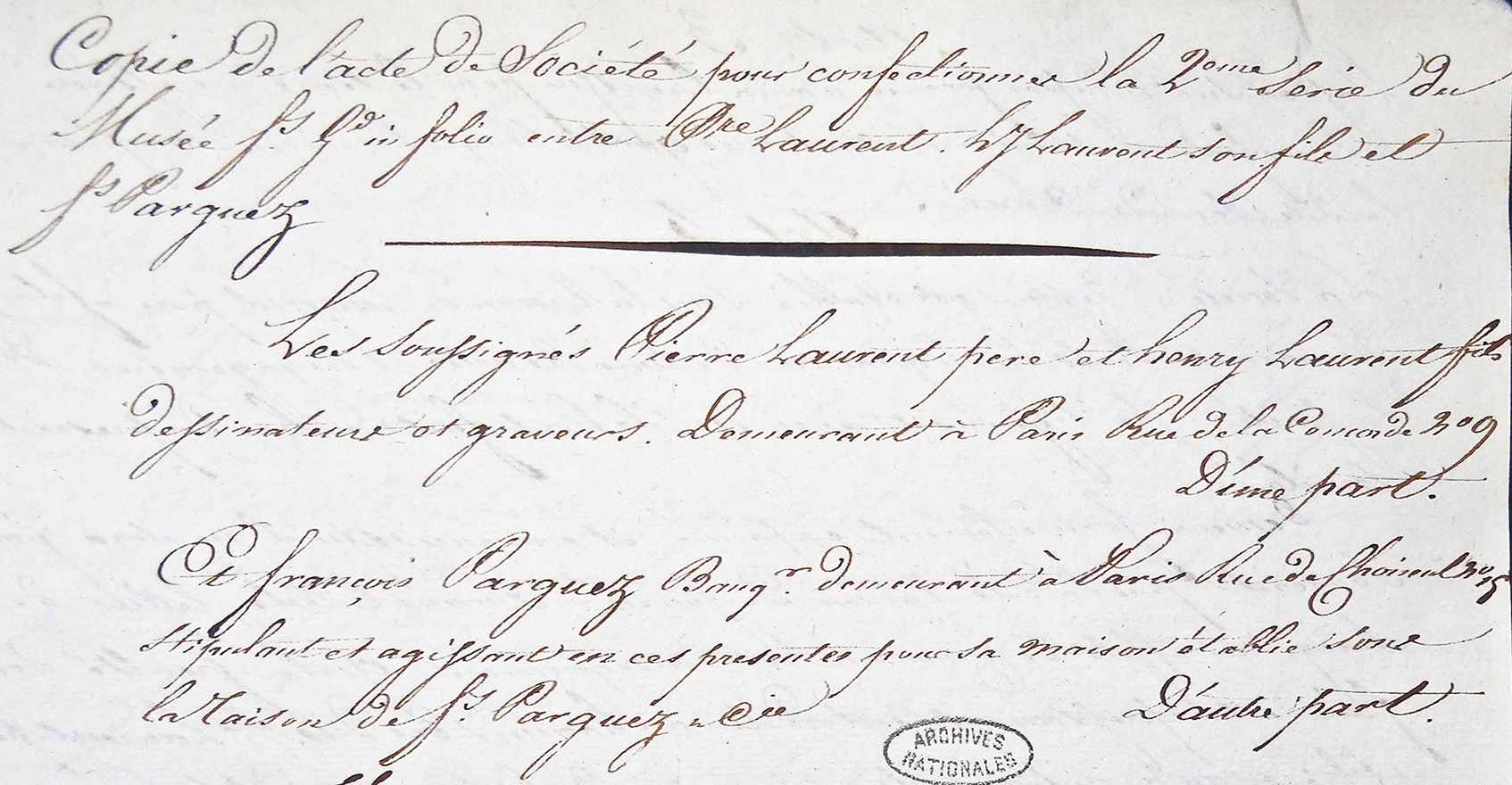
Copie de l’acte de société pour confectionner la 2eme Serie du Musée… (detail) between Pierre Laurent and Henri Laurent, his son, and François Parguez on 21 August 1807, F/21/564. Image courtesy of the Archives Nationales (France).
1809
Securing funding for the 2nd series did nothing to alleviate the problems Pierre and Henri Laurent, père et fils, still faced in the summer of 1807 – attracting new subscribers and disposing of unsold livraisons of the 1st series to unreceptive consumers. A single livraison, avant la lettre, cost 96 francs, an after the letter livraison cost 48. That said, the beauty and quality of the Musée français engravings ensured the public’s perception of the Musée français remained very positive.
The well-publicized passing of both principals, Louis Robillard de Peronville and Pierre Laurent, months apart in the summer of 1809, made completing the remaining 17 numbers of the Musée français an immense challenge for Henri Laurent and those still involved in the enterprise. The Inventaire après le décès de Pierre Laurent of August 7th, 1809, (MC/ET/XIX/935) explains why.
The 1807 agreement between Parguez and the Laurents was designed to survive the death of Pierre Laurent, meaning that Henri Laurent and François Parguez were still co-associés, or partners, in August, 1809. However, the terms of that relationship had changed because Pierre and Henri Laurent borrowed 100,000 francs from François Parguez to begin the 2nd series well before Pierre Laurent died in 1809, and before the 1st series of livraisons had been completed. We do not know why Henri and Pierre Laurent began producing engravings for the 2nd series of livraisons before the first had been completed. The most likely explanation is that engravings of this quality take a long time to produce.
The reality, however, was that when Pierre Laurent passed in the summer of 1809, Henri Laurent and his father owed the Parguez bank more than 125,000 francs, with no immediate means to repay this debt. Henri Laurent could not begin distributing the first livraison of the 2nd series and start earning much needed revenue until the final livraison of the 1st series had been completed and distributed to subscribers. Louis Robillard de Peronville’s death in July of 1809 deprived Laurent of the funds necessary to complete the final livraisons of the 1st series. Subcribers to the 1st series, Géricault’s relations among them, would have to wait nearly three years to receive the final livraisons of the Musée français.
Worse, the 125,000 francs Henri Laurent owed the Parguez bank exceeded the assessed total value of all 2nd series assets: engravings, drawings, and such. As noted, the 1807 agreement stipulated that the assets of the 2nd series serve as collateral for the Parguez loan. Henri Laurent’s outstanding debt to the Parguez bank, and the conditions of the loan, made Henri Laurent the junior member in the Parguez-Laurent partnership.
1811 Rapport sur l’Entreprise Parguez
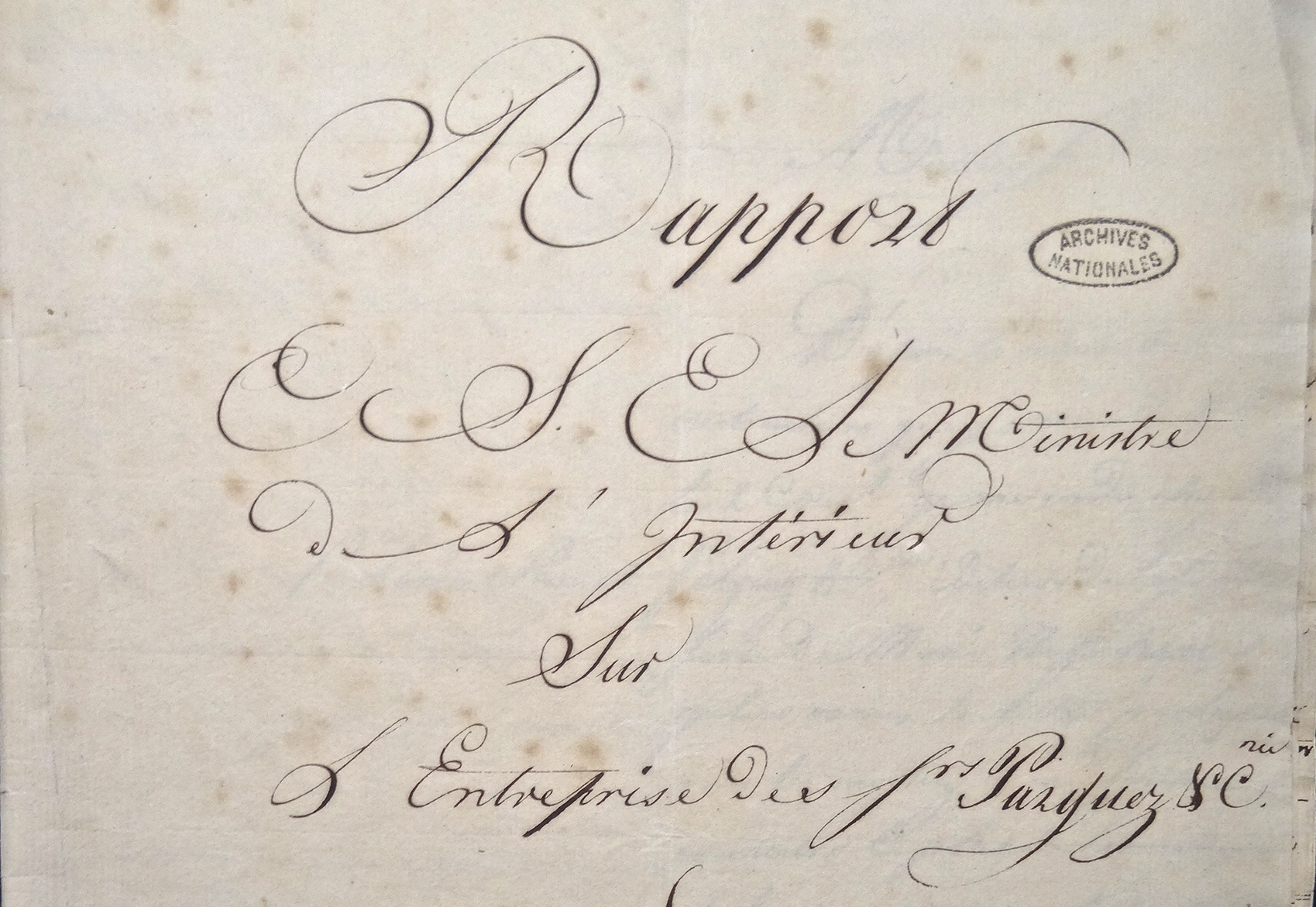
Rapport a S. E. Ministre de l’Intérieur sur l’Enteprise des Srs. Parguez & C. (detail) F/21/564. Image courtesy of the Archives Nationales (France)
With Robillard de Peronville’s estate in the hands of his rather unsympathetic Robillard relations from 1809 on, Henri Laurent immediately sought financial support from the government. However, Henri Laurent’s standing as directeur of the musée project was very much diminished both by the money he and his father clearly owed François Parguez, and by the glaring shortcomings of their business model. Henri Laurent’s subordinate status is evident in the government report on the Laurent-Parguez partnership.
In the summer of 1811, the French government examined the assets and debts of both the 1st and 2nd series. The name Laurent does not even appear on the cover of the report prepared by Henri Le Brument, the government auditor for the minister of the Interior. Within his report Le Brument repeatedly refers to the Laurent-Parguez partnership as the Entreprise Parguez. At some later date Le Brument, or another individual, wrote the name Laurent over that of Parguez in these documents. Indeed, when Henri Laurent submitted his formal proposal for funds in the summer of 1811, Laurent did so with the written consent of his co-associés, the Srs. Parguez, attached, as was required by law.
In March of 1812, Henri Laurent and his team released the final livraison of the 1st series. Demand for the second series of engravings never matched that of the first. Foreign subscriptions dropped or were suspended. Facing the imminent collapse of the entreprise Parguez, François Parguez finally added own his name to the list of paying subscribers of the Musée Napoléon (avant la lettre) sometime before December 31, 1813, but to no avail.
Conclusion
Adolphe-Isadore Parguez was on the cusp of manhood in 1819, when the Parguez family shared the gold medal honors awarded Henri Laurent for Calcographie et lithographie at the Industrie Nationale competition in Paris that October. Three years earlier, in 1816, the Bourbon government revived the Musée Napoléon as the Musée Royal, after a two-year interval, with Henri Laurent as editor and Louis XVIII as the publication’s patron.
We can be confident that Parguez family members visited the Salon of 1819 that fall, where they would have seen Théodore Géricault’s Raft of the Medusa. Adolphe Parguez was a boy of just ten when Géricault presented his Charging Chasseur at the Salon of 1812, and may have become a fan as early as that.
It is of course quite possible that Adolphe Parguez only discovered Géricault after the painter’s death in 1824. We choose to believe that Parguez knew of Géricault, as an artist, and that the two may have met, if only briefly. Both families were involved in banking, and both were wealthy. Jacques-Florent Robillard, Louis Robillard de Peronville’s banker brother, and Jean-Baptiste Caruel, Théodore Géricault’s uncle and Robillard’s partner, were both subscribers of the Musée français. The Caruel and Parguez families certainly travelled in the same elite circles. Both families would have undoubtably known the role François Parguez played in the production of the 2nd series livraisons. Louis Robillard de Peronville’s losses were likely known within certain segments of elite society. Parguez family members likely suffered similar humiliations when wealthy art lovers declined to subscribe to the Musée Napoléon, though not of the sort inflicted upon Robillard de Peronville and his family.
Théodore Géricault’s biographers tell us that the ranks of the painter’s most fanatical supporters included young artists and artisans keen for a new type art, an art we know Adolphe Parguez collected from an early age. I contend that the Parguez family’s involvement in the Musée Napoléon, later the Musée Royal, shaped Adolphe-Isadore Parguez’s development in much the same way as the Géricault family’s involvement in the Musée français earlier changed the arc of Théodore Géricault’s life. François Parguez’s decision to back Pierre and Henri Laurent and the production of the Musée Napoléon engravings thrust the Parguez family deep into the business of making and selling art in the latter half of the First Empire, and continued well into the reign of the Bourbons. Théodore Géricault’s family underwent a similar immersion – of a shorter duration, but one that was at least as intense.
We are told that Théodore Géricault’s family strongly objected to Géricault’s efforts to build a career in the arts. Now, we have a clearer idea why. The losses incurred by his Robillard relation would have undoubtably figured in any discussion on this topic between Théodore and his family. Théodore nonetheless pursued his dream, perhaps with the support only of Alexandrine-Modeste Caruel, his uncle’s young wife by 1810.
We possess one additional piece of evidence pointing to an early personal connection between Adolphe Parguez and Théodore Géricault, which comes via Eugène Delacroix. In a letter dated February 6, 1828, Delacroix wrote that he just moved into in a state of luxury far greater than his station merited, at n° 15 rue de Choisseul, the same address as the Maison Parguez in 1807. I have yet to confirm whether the Parguez family still had some connnection with the property in 1828, but believe the Parguez family’s residence at the same address for so many years prior cannot be mere coincidence.
If the Parguez family did still own that residence, Eugène Delacroix’s presence at n° 15 rue de Choisseul strongly points to a more intimate Parguez family interest in artists and the arts. We know that Adolphe Parguez collected also collected works by Eugène Delacroix over the years. For Adolphe-Isadore Parguez, the act of acquiring Théodore Géricault’s art, and that of other artists, may have been a way of memorializing each artist as individuals he met and knew, or wanted to meet and know, connections created, in part, thanks to his family’s role as financiers of the second series of the Musée français engravings.
My own view is that we still have much more to learn much of Adolphe Parguez’s early involvement with the Musées of Laurent & Robillard de Peronville, and of Pierre and Henri Laurent from 1807, and about the Parguez family’s early connections with Théodore Géricault, Eugène Delacroix and other artists of this time.
The only reference we can locate connecting the Parguez family to Pierre and Henri Laurent, outside of archival documents, appears in the 1861 Collection Parguez catalogue as a footnote in the catalogue’s introduction. (pp. XII-XIII)
* While Ms. Sylvie Legrand-Rossi does not discuss the Musée project, or the Laurents, in the exhibition catalogue: “Dessiner et ciseler le bronze. Jean-Louis Prieur (1732–1795)” (15 October 2015 – 17 January 2016) Musée Nissim de Camondo, Paris, I wish to direct readers to her scholarship and that of her collaborators. Ms. Legrand-Rossi’s essay: “Les dessins de Jean-Louis Prieur achetés par l’Union centrale des Arts décoratifs à la baronne Parguez en 1896” in the exhibition catalogue is the best study of the Parguez family I have found.