1841 Revue Étex – Géricault
Géricault Life
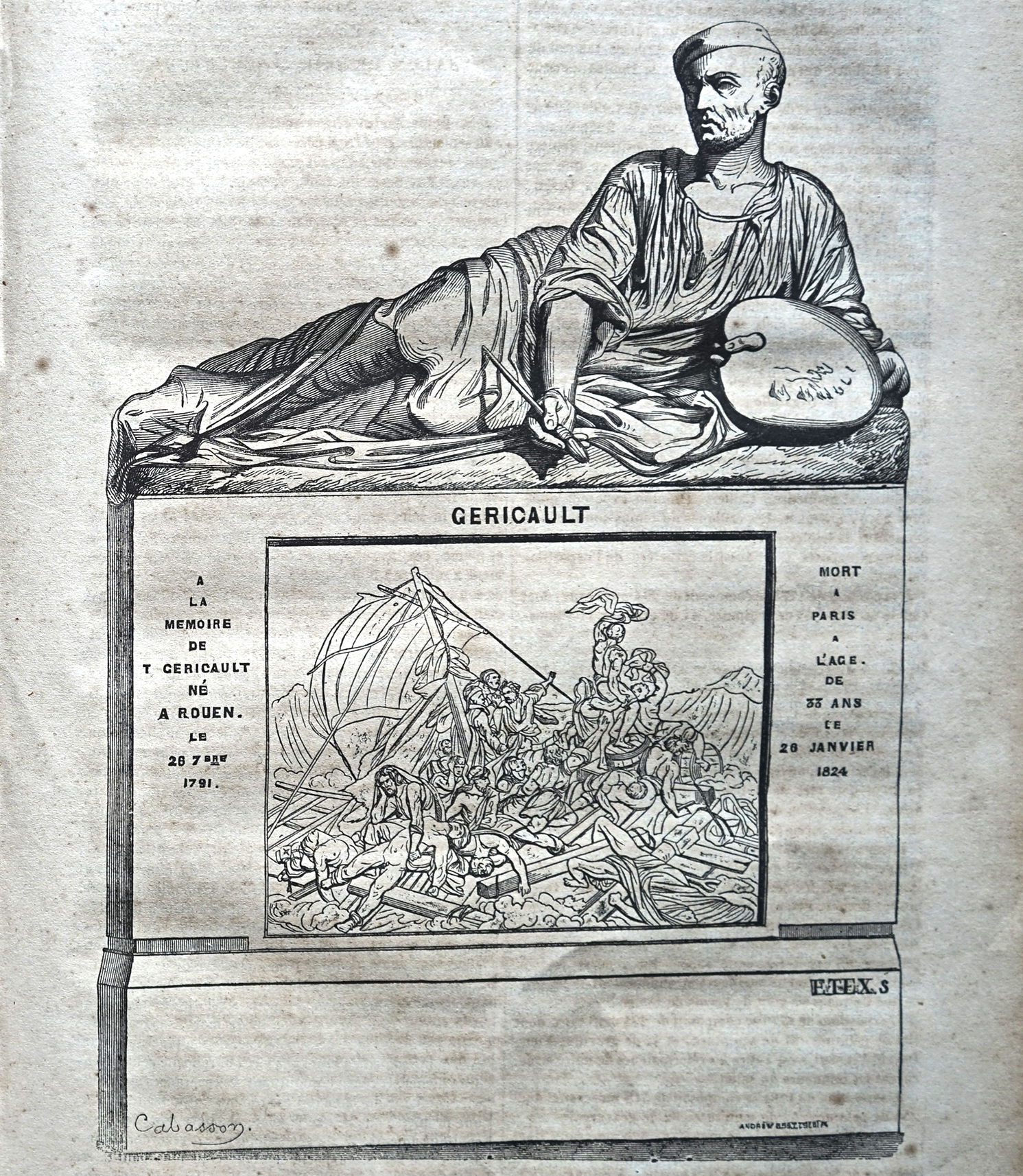
1840 Monument funéraire de Géricault (front panel) Antoine Étex, Musée des Beaux-Arts, Rouen. (donation by the artist 1845)
Théodore Géricault died on January 26, 1824. More than a decade later Géricault’s friends raised funds for a monument to be placed at the artist’s grave in Père Lachaise cememtary. The sculptor Antoine Étex played a pivotal role in this effort and produced the monument to honor Géricault. The Magasin Pittoresque published a revew of the Étex sculpture along with a crude illustration of the monument (image below). This review contains important details about Géricault not present in Louis Batissier’s biograpy of the artist, and likely reached a broader audience.
Magasin Pittoresque
Salon of 1841- Revue: Tomb of Géricault, by Mr. Étex.
“Jean-Louis-André-Théodore Géricault was born in Rouen on September 26th, 1791. His father was a ‘man of the law;’ his mother, Louise-Jeanne-Marie Caruel, died when he was just ten years old. Her death robbed him of some of his strength, and removed from him forever a vital source of happiness. His sense of loss was so great in this regard, that he both feared and loved to summon memories of his cherished mother, whose character was so similar to his own. Whenever he spoke of his regret he always conveyed his deep respect and admiration for her.
Géricault was sent to college. Sadly, made little progress there. Full of energy and very much engaged with the material world, he was passionate about his physical development. One form of exercise consumed him above all others, and held a singular power over him, dominating his imagination; Géricault loved riding and the equestrian arts. The elder Franconi, whom he had seen at the Olympic Circus at different times, was, in his childish opinion, one of the great men of the century. Géricault dreamed of a similar fame. Following the rules of the Perfect Cavalier, each night before going to bed Géricault strapped all his dictionaries and other books together, and placed between his legs in order to shape and strengthen his limbs. However, he found these instruments of torture too feeble for his purposes. He replaced the books with an iron device of his own design to bend his legs while he slept in an act of martyrdom. One day, while on vacation, he encountered a handsome horse. He began to follow it; the horse began to trot. He trotted. The trotting turned into a gallop. He ran behind with all his might – crossing the town, wandering the countryside, and did not stop until he collapsed on the road covered in sweat, exhausted, and gasping for breath. Géricault recounted this passion of his youth much later, a passion which remained with him throughout his life, explaining: “Horses captivate me. My spirit transports me into imaginary cavalcades even when I have grammar and prose before my eyes. Indeed, I believe that I would have been among the best scholars of Latin and Greek had I been made to understand that the reward for hard work would include the ability to immerse myself freely in the beautiful tales of men and horses which so abundantly fill the works of the ancient poets.”
Géricault’s first teacher was Carle Vernet. Studying the horses painted by the son of Joseph Vernet, and the father of Horace, must have thrilled Géricault and spurred his young imagination. He then entered the studio of Pierre Guérin. By this point, however, Géricault already preferred the fiery creator of the Battle of Aboukir to the painter of Marcus Sextus. His time in the studios of Vernet and Guérin was short, though, for he preferred to work on his own. His first painting was the Imperial Scout on Horseback (the Charging Chasseur) which is today in the gallery of the Palais Royal. This painting, in which he revealed his great power, was exhibited at the salon of 1812. Two years later, he presented his Wounded Cuirassier, in 1814. During the interval between these two exhibitions he completed a great number of canvases, including the beautiful studies of the chests of horses, which he completed at Versailles. He also tried his hand at sculpture at this time.
The misfortunes of 1814 arrived to interrupt his studies. Even so, his need to detail the sufferings of this disastrous year with his brush and in his own manner was overpowering. Artists admired the accuracy of his renderings, in which he presented our brave soldiers returning to Paris bleeding and wounded, one supporting the other. We can see a breadth of style and a nobility of expression in these figures worthy of antique art. Beneath their tattered coats, torn and blackened in battles, these soldiers of Napoleon have the strength and grandeur of Homer’s heroes.
Always possessed of the love of horses and uniforms, in 1815 Géricault surrendered to the unique temptation of joining the Red Musketeers in 1815, a corps which had been only recently formed. Once there he indulged himself with a child’s joy, consumed by the happiness of living all his days in a world of horses, military exercises, and brilliant costumes. However, disenchantment arrived soon enough, forcing him to put down his arms and once again take up his pencil. He decided to travel to Italy. We find it remarkable that Géricault managed to lose his finesse with color, which marks in such high degree the works which he composed before he departed France, during his studies of the masters of Italy.
While there, Géricault started a great painting of the horse races in Rome. The painted studies which he made for this composition show clearly the influence of Michelangelo and his genius, and are of great beauty. Géricault began simply, taking the races of the Barberi horses for his motif; but rather than portray the Birbacioni citizens of modern Rome, he placed the citizens of ancient Rome among his horses, which allowed the artist to present these figures as nudes. This canvas was never finished, however. Géricault received a letter from his father calling him back to Paris, which he obeyed with considerable regret. For this passionate man – energetic, prideful, even violent – as one can easily become possessed of a talent such as his, was a respectful and dutiful son. Géricault deserves all the more merit for his rigorous observation of his filial duties because his father, despite being both good and honest, frequently objected to his son’s vocation for painting, a calling which he little understood, and which, as a consequence, he could never properly esteem or judge. It is also true that Géricault, because of his tastes, tested the patience of a loving father on more than one occasion. He was, for example, taken with an extraordinary passion for oriental costumes for several months, and wanted to have a Turkish servant. He found one who did not understand a word of French; and, as one can easily imagine, this resulted in endless blunders and misunderstandings which the father, who lived with his son, had great difficulty accommodating.
It was upon his return from Italy that Géricault began his relationship in Paris with Mr. Corréard, whose life had been so cruelly exposed upon the raft of the Medusa. Moved by the account of this celebrated shipwreck, the painter conceived the plan for his masterpiece. He prepared a considerable number of small painted sketches. We can only imagine the number of cadavers which entered his studio in the Roule district during this time. Beaujon hospital was a short distance away and sent him all their dead. The painting was completed in six months. Hung badly when it was presented at the Salon of 1819, the work was criticized for the most part, and received coldly, or disdainfully. Géricault found no more buyers for the Medusa than he had for his previous works: the Imperial Scout and the Wounded Cuirassier. If the Louvre today possesses the Shipwreck of the Medusa, we must thank Mr. Dedreux Dorcy [Pierre de Dreux d’Orcy], his close friend, who presented the painting to the Museum administration for the sum of 6,000 francs, the same price he originally paid, after rejecting an offer of 23,000 francs which an English collector had offered him.
The truth is that England appreciated the talents of Géricault well before France, we regret to say. The studio of the painter was crowded with works which nobody in Paris cared to acquire. After his reverse of 1819, it was proposed to him that he show these in London. He agreed, solely to judge the effect that the Shipwreck might produce there, and not at all out of self-interest, for he was already rich. However, we are assured this exhibition was a great success and produced a considerable sum; such that the producers, who took the lion’s share, provided him with 17,000 francs even after expenses. These are the circumstances which brought the artist to London, the city in which he composed his lithographic studies. Géricault was ill for four months during his stay there.
When he returned to France he returned to work with a new fervor. He loved riding for pleasure and to reinvigorate himself, and it was this passion which caused his death. Géricault possessed three handsome horses, high-spirited, and difficult to manage. One day he was thrown at his own gate just as he returned from a ride. The fall did not appear dangerous at the time, but the knot of his trouser belt had pressed against his spine. An abscess formed in the days and weeks after, undetected. His health began to decline, all the while the artist was unaware of the real damage done. Then a second accident occurred. While mounted upon his favorite horse at the Champ-de-Mars, the steed bolted into a gallop and crashed into another rider. The collision ruptured the abscess. Following this accident, Géricault was unable to leave his bed and suffered horribly. Yet, his pain did not prevent him from working. Up to his final moment, his love of art provided him with some consolation. Indeed, he begged his friends to prop him up on his pillows so that he could continue to paint as long as he could hold a brush. And, as all his force was being devoured, his eyes remained fixed upon himself. One day he presented a sketch of his hand which he had crafted as he lay dying, and said to his companions: “Look thus! What painter, what sculptor has ever rendered a hand as supple as this here?” The night before he died, he uttered the harrowing words: “How sad it is to die at thirty-three years filled with the regret, believing I having accomplished so little of what I hoped to achieve!” Exhausted and finally defeated by his sufferings, he passed away at four in the morning of January 26th, 1824, in the arms of his friend Dedreux Dorcy. It had taken a year of horrible tortures to destroy this powerful spirit.
One might imagine that his family would feel obliged to honor such a special talent, and rush to erect a monument to honor his memory. Yet, fifteen years have passed in vain. So, a group of artists took it upon themselves to correct this omission, which so afflicted them. Mr. Horace Vernet, Mr. Paul Delaroche, Mr. Scheffer, Mr. Delacroix, Mr. Cogniet and Mr. Charlet took charge of ensuring the commission would be faithfully executed. A call went out to sculptors; submissions were reviewed, and the plan of Mr. Etex was adopted.
The work born of this project is the tomb of Géricault, which we reproduce here in our engraving. Eight years ago, we published the group of Cain and his Cursed Race, a debut which placed Mr. Étex among the masters. Since then the young sculptor has worked with verve and courage. He has applied himself to diverse subjects, overcome challenges, and triumphed in more than one test. But it seems to us that of all the works which have followed his debut none surpass this tomb, or recall the qualities of simplicity and strength we so admired in the Caïn group. None better attest to his studies, his vigils, and his experience. The figure of Géricault draws us in by the finish of the details and the skill of the chisel, efforts which are matched by the calmness of the pose and the harmony of the lines. Note how Mr. Étex avoids the normally insurmountable difficulties of modern clothing, and the implausibility of an antique nude. Mr. Étex depends on the sentiment of the first conception to preserve his sculpture from this double disadvantage. Mr. Étex wanted to present Géricault in that moment when he had been greatest, and thus most greatly honor his memory. So, he placed Géricault on his death bed, committed to the end to his art, armed with his palette and brush, saying his cruel adieu to life, a scene which recalls the departure of André Chénier. Yet, this representation of Géricault displays the confidence of a soul who remains at peace, even as he abandons hope, implying that what genius did not entirely achieve here might continue elsewhere. When the artist expresses in his own work the most noble thoughts of the man he is committed to perpetuating in memory, we can usually expect excellence in the result. The painter and the sculptor, if the artist be truly worthy of the name, employs his talents and his art to express the spiritually we too often find only in prose.”
Magasin Pittoresque, n° 14, April 1841, Tome IX (pp. 105-112)