1865 – Blanc Géricault – Suicide
Géricault Life
1819 Raft of the Medusa (Detail), Théodore Géricault – Salon of 1819, Louvre.
Charles Blanc’s 1865 study of Nicolas-Toussaint Charlet in Blanc’s Histoire des Peintres de Toutes Les Écoles – École Française (Vol. 3) is one of the most significant, and least recognized, pieces of 19th-century Géricault criticism.
1865 – Charles Blanc – Théodore Géricault, Charlet, and Suicide
“We can actually say that Charlet saved the life of Géricault. Possessed to the extreme by an impressionable nature, the painter of the Medusa had contracted a black melancholy in his spleen, and continual ideas of suicide…” (Charles Blanc: Nicolas Toussaint Charlet in Histoire des Peintres de Toutes Les Écoles – École Française (Vol. 3) 1865)
Charles Blanc’s 1865 study of Théodore Géricault in Blanc’s Histoire des Peintres de Toutes Les Écoles – École Française Vol. 3 is one of the most important biographies of the artist in Géricault scholarship. Two decades earlier Charles Blanc published a longer version of this essay on Géricault in his study of French painters Histoire des Peintres Français au dix-neuvième siècle, Vol. 1 (1845). The 1845 essay is far more frequently cited by modern scholars and includes historically significant observations which Blanc omits in his 1865 essay on Géricault, particularly Blanc’s remarks on the significance of the nègre in Géricault’s Raft of the Medusa.*
That said, the most significant dimension of Blanc’s 1865 study of Géricault is the essay’s immediate proximity to Blanc’s almost entirely ignored essay on Nicolas-Toussaint Charlet, Théodore Géricault’s companion and collaborator from 1818, in which Blanc fully embraces Charlet’s claim that Théodore Géricault tried to end his own life on more than one occasion, a claim that was very much a part of the public’s perception of Géricault in 1865.
In 1865, Charles Blanc presented readers with his illustrated and shortened essay on Théodore Géricault – followed by a new essay on Nicolas-Toussaint Charlet, Géricault’s companion in London. Thus placed, Blanc’s essay on Charlet serves as both pendant and appendix to his essay on Théodore Géricault. It is in his essay on Charlet that Blanc presents his new explosive account of Théodore Géricault’s mental and emotional state.
In 1845 Charles Blanc referred only obliquely to Géricault’s emotional and mental health struggles. By 1848 Géricault scholarship began to change, and then changed dramatically in 1851 with the publication of Charlet’s reports of Géricault’s suicide attempts by Gustave Planche and then others, as we have discussed. In his revised essay on Théodore Géricault of 1865, however, Charles Blanc chooses to omit any mention of Géricault’s suicide attempts, leaving most of the 1845 text intact.
Why did Charles Blanc add images and remove text from his 1865 essay on Géricault and yet omit of all mention of Théodore Géricault’s suicide attempts? Perhaps out of a sense of fidelity to his original essay, or to honor agreements made with Pierre de Dreux D’Orcy, and other of Géricault’s former friends who served as Blanc’s sources.
Blanc’s essays on Géricault and Charlet in 1865 suggest Charles Blanc chose to compartmentalize his updated discussion of Théodore Géricault’s mental and emotional dificulties in England and France post 1819. Rather than make such a dramatic change to his 1845 essay in his 1865 revision, Blanc elected to publish the account of Géricaut’s suicide attempts in his pendant essay on Charlet – an essay which begins within the 1865 volume precisely where Charles Blanc’s essay on Théodore Géricault ends.
I see nothing accidental in Blanc’s editorial decision. Charles Blanc was then one of the most experienced editors and critics in France. Charles Blanc clearly intended his essays on Théodore Géricault and Nicolas Toussaint Charlet to be read separately and together, in sequence perhaps, but definitely as a piece – with parts of the latter essay on Nicolas Toussaint Charlet serving as a meaningful and important update and expansion of Blanc’s earlier writing on Théodore Géricault, both in 1865 and in 1845.
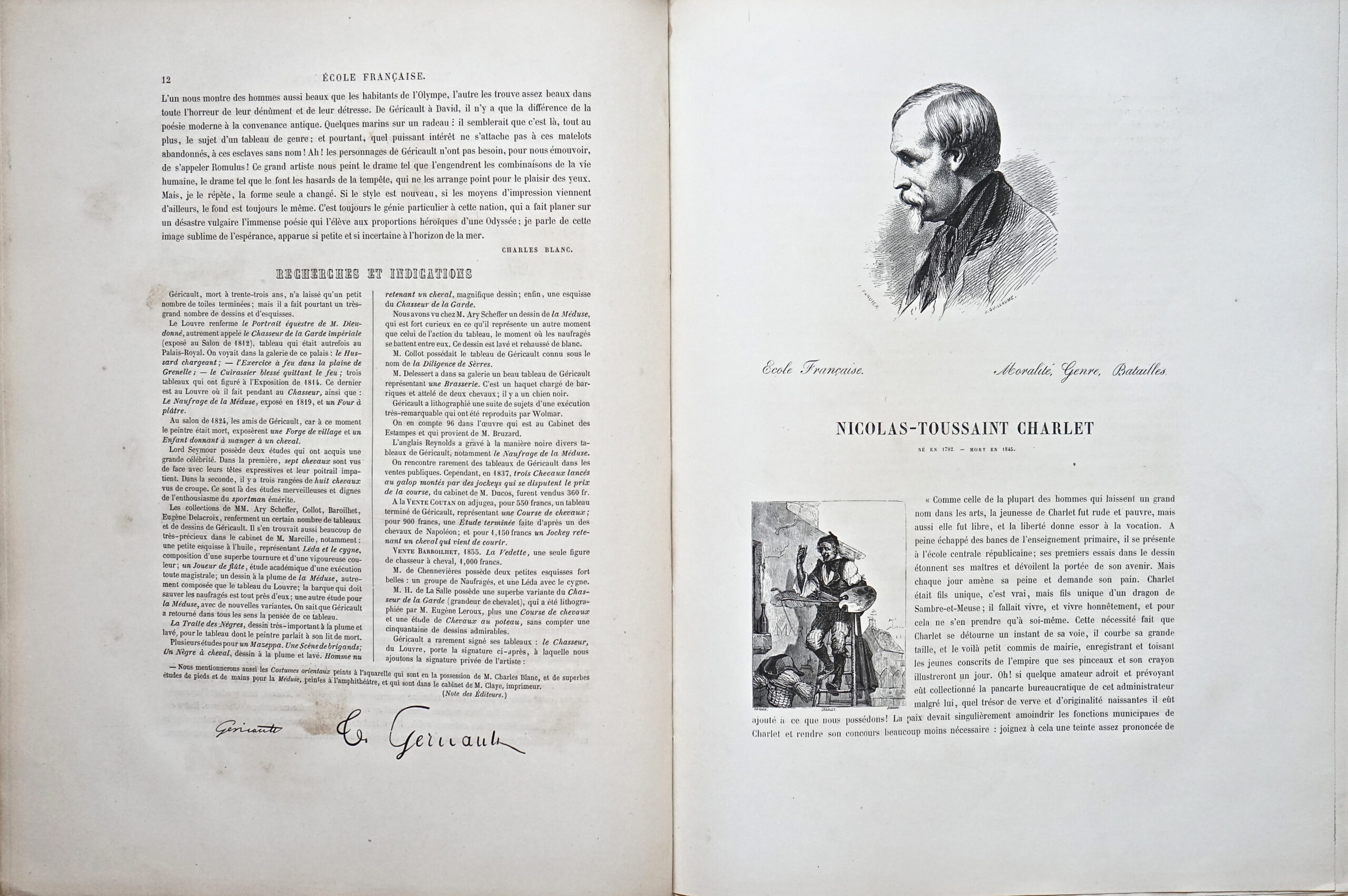
Final page of Blanc’s 1865 essay on Théodore Géricault adjoining the first page of Blanc’s new essay on Nicolas Toussaint Charlet in Histoire des Peintres de Toutes Les Écoles – École Française (Vol. 3). Note – in this volume, pagination is restricted to invididual essays. Blanc’s essay on Géricault runs 12 pages; Charlet 20 pages, including illustrations and supplementary commentary.
Charles Blanc: Nicolas Toussaint Charlet
Blanc’s essay on Charlet is worth reading for any number of reasons. Charlet is an important artist in his own right. I have therefore included Blanc’s description of Charlet’s early life and career. We then move to Blanc’s description of two of Géricault’s suicide attempts. The first suicide attempt occurs in Géricault’s room in London, where he attempted to asphyxiate himself. The second suicide attempt Blanc documents occurred whilst Géricault was walking along the banks of the Thames with Charlet.
“Like the majority of men who left a great name in the arts, the childhood of Charlet was harsh and poor, but it was also free, and liberty expands our choice of vocations. As soon as he escaped from the restrictions of primary school, he presented himself at the école centrale républicaine [higher education institutions of the republic]; his first attempts at drawing stunned his teachers and opened the door to his future. But each day brings its challenges and demand for bread. Charlet was an only child, it is true, but he was the only child of a dragoon of Sambre-et-Meuse; he had to survive, and to survive honestly, and to do so he could rely on no one but himself. This necessity meant that Charlet had to make detours from his path. He cut short his efforts and became a clerk for the town hall, measuring and registering the young conscripts of the Empire, who he would later reproduce with his brush and pencil. Oh! If some adept collector had the foresight to collect the bureaucratic records of this administrator. What treasures of nascent originality and verve would we now possess! The peace significantly diminished Charlet’s municipal responsibilities and rendered his work much less necessary: combining this with a pronounced taste for Bonapartism, and the reaction of 1815, might have made him into a victim; it forced him to become a great artist.”(1. Notice on Charlet, printed at the head of a the catalogue of his sale, and signed J.-V. Billioux….)
It is thus that the beginnings of Charlet are recounted to us by a man who was his intimate friend, his close companion during his existence as a painter, and drinking partner in the cabarets. But, at the beginning of this biography, Charlet announces himself by workshop pun, that he tells us the exact date of his birth. It was written on the wall of a cottage, in the frontispiece of a collection of drawings in ink which were reproduced in facsimile by Meyer. “Charlet, Nicolas Toussaint, born in Paris, the 20th December 1792, of parents of the poor house.” Poor, in fact, for his father, the dragoon of the republic, left him nothing when he died in the army, “but leather stockings, a pair of boots and his change of linen and socks, worth nine francs, sixty-five centimes.” His mother was no wealthier; but was a true wife of a soldier of the old school, one who had a French heart and who knew how to inspire in her son, a young orphan, these popular sentiments, the full expression of which would become manifest in the strong and vivid genius of Charlet…What large role did these early events play in the life of an artist! For this one here, all the circumstances of his youth shaped his nature and the development of the nascent talents which were within him. Nothing could force him to abandon his roots. Quite the opposite, the disappointments of chance helped him, and all his misfortunes served him well…
In 1816, when he lost the modest position that he had obtained with the city of Paris, Nicolas Toussaint knew enough to draw a head without many shadows, following his expression. However, driven by a hidden instinct, drawing became his sole study. His first master had been a certain Lebel, a student of David, who understood classicism, but knew nothing of the practices…A large school had opened by then, that of Gros, and Charlet presented himself there. It was then 1817. Charlet immediately developed a profound admiration for the painter of Jaffa and of Aboukir, who was at that time a master of genius, and at the same time a bad professor, it must be said. Gros was close-minded as a teacher, intensely classical, with little skill of his own for developing each of his disciples according to their particular faculties. Intolerant in his precepts, but free in his painting, he imposed upon his students rigorous rules regarding drawing and the nude, while at the same permitting for himself every liberty and audacity in color and costume.
Luckily for Charlet, his poverty compelled him to produce his first works without waiting for the approval of his teacher. And, as chance would have it, in this same year, 1817, a new process had just been invented: lithography, as if fortune conspired to open a new path for the genius of Charlet. The first lithographic press was founded by the Count de Lasteyrie, who had imported the discovery to France and Charlet was among the first to draw upon the stone…
The Grenadier of Waterloo was, I believe, the fifth or sixth stone of Charlet: which still betrayed the inexperience of the beginner, more occupied with the idea which he wished to express, rather than the means to do so. But one can discover there already the son of the dragoon and of the past, an artist, so to speak, who would be the echo of popular memory and protest through images of a bloody irony, against the easy victory of Wellington and of Blücher. A grenadier of the guard, his left arm in a sling and his back supported by a tree, defends one of his comrades, who, more grievously injured than he, and on his kness, clings to his upright companion with both arms. A troop of English infantry arriving with bayonets fixed halts before them, stunned by the immensity of this courage. One easily imagines the moral effect which such a print must have produced among these old soldiers we still call the brigands of the Loire, and who walk the streets of Paris, heads down with a somber regard, still red-faced at the shame of the invasion. One almost had to see the Prussians in Paris and the sacred pavements of our boulevards sullied by the boots of Souwaroff, in order to fully appreciate the profound sentiments expressed in the Grenadier of Waterloo, as this drawing was titled, and in another of a truly epic beauty: the Death of the Cuirassier. I know of nothing of this genre more touching and at the same time more heroic than simplicity of this piece…Géricault would have been happy to sign a composition as beautiful, as eloquent without emphasis, as expressive.
As it happened, Gros secretly encouraged Charlet, not daring to praise work which defied his precepts and rigid teachings before his other students. The editor Delpech repeated stories which Charlet came to discover – that Gros had said, when looking upon certain lithographs of his student: “I would have liked to have made this.” The colonel La Combe provides the following exchange, which evidently took place several days after Charlet’s entrance into the studio of Gros, “Charlet brought a stone to Delpech. The latter had been waiting for a piece promised by the master, from which he had printed several sample lithographs. Delpech took the stone from the hands of Charlet, looked at, appeared stupefied: “But why then,” he said “Did Gros not sign his work? – For an excellent reason,” replied Charlet, “because it is I who produced it.” – Delpech did not want to publish the piece, however, and gave it to Engelmann, who produced from it a small number of prints. However, a bit later, and probably upon the recommendation of Gros, Delpech became Charlet’ publisher and brought his lithographs to the public from June 1818 to November 1819. We can assume that he must have sold a great number of the two collections of the Costumes militaires français, drawn in pen, and of the imperial guard, if only to children to color. These two collections are little known; some pieces of the first are very rare…
“…Towards 1820, Charlet became closely connected with Géricault when a certain Juhel, painter, performer, and philosopher, commissioned him to decorate the auberge of the Trois-Couronnes [Three Crowns] at Meudon. Charlet was busy painting voles, rabbits, ducks, patés, pastries, and other food stuffs, when the hotelier came to ask him to ascend to the first floor. There I found, says Charlet, recounting this episode in his life to Mr. de Lacombe; a joyful group dining and, in the middle of this gathering, an individual who, after informing me that his name was Géricault, added; ‘You do not know me Mr. Charlet, but I, I know you very well, and hold you in high esteem; I have seen your lithographs, which could not be produced by the pencil of anyone but a hero. If you might like to join us here at this table, you would do honor and please us. – How so, gentlemen! For all the honor and pleasure would be my own.’ I sat down then to join them and all went well, and so well even that from this day began a friendship that death alone could frustrate. Poor Géricault! Excellent heart of an honest man and of a great artist.
In 1820, the two friends travelled in England. Géricault transported his great painting of the Shipwreck of the Medusa there, which had been poorly received the preceding year by the classicists at the Salon, an immense majority at that time. He proposed to hold an exhibition in London, and in effect, display his work directly to the public by means of charging one shilling per person, and thus earned abroad twenty thousand francs from a work which, after his death in his own country, could not command six thousand! During the first days of the exhibition, visitors received a drawing which Charlet had crafted in ink upon a lithographic stone and which Hullmandell printed with this legend: Shipwreck of the Medusa. Without any doubt, Charlet took some part in the execution of the beautiful and powerful lithographs that Gericault published during his time in London. Already accomplished in the exercise of an entirely new art, he certainly assisted his friend with practical advice. Their partnership, for the rest was free of clouds, and we can actually say that Charlet saved the life of Géricault. Possessed to the extreme by an impressionable nature, the painter of the Medusa had contracted in his spleen, a black melancholy and continual ideas of suicide. One day, when he and Charlet were walking along the Thames together, Géricault tried to hurl himself into the river; but Charlet reacted quickly, and held him fast by the arm. Another time, returning to the hotel at a late hour at night, Charlet learned that Géricault had not left his room that day. Fearing this part of some sinister project, he went straight to his room. He knocked without any response, knocked again, and still heard nothing, and so forced open the door. He had arrived in time! A brasier burned still and Géricault was unconscious upon his bed. In a short time, he was returned to life. Charlet cleared the crowd from the room and sat next to his friend. ‘Géricault,’ he said to him in the most serious tone, ‘we have several times seen that you wish to die; if that is your course, we can do nothing to stop you. Going forward, you will do as you please; but at least allow me to offer a word of advice. I know you are religious; you know well that, once dead, it is before God that you must appear and give account: what will you say, unfortunate one, when he interrogates you? You did not merely dine!’ Géricault, bursting out laughing at this sally, solemnly promised that this suicide attempt would be his last…”
Conclusion
My view is that Blanc wanted readers to regard his 1865 essay on Charlet, in part, as a pendant to his preceding essay on Géricault, in that volume, and as an update to his original essay on Théodore Géricault of 1845. In his essay on Nicolas-Toussaint Charlet of 1865 Blanc explicitly refers to Théodore Géricault’s ‘continual thoughts’ of suicide, a mental state which Blanc refers to only obliquely in his essay on Géricault of 1845, and reprinted in 1865 just pages before. In his essay on Géricault of 1845 Blanc is emphatic that Géricault underwent some sort of minor change before his return to Paris after his stay in London, writing that Géricault’s letters betray hints of deep melancholy and boredom, and that Géricault was tormented by ‘vague and insatiable desires’ after returning to Paris – “Quand Géricault revint à Paris, sa santé était déjà un peu altérée. Ses letres trahissaient même un fond de mélancolie e d’ennui. Il était tourmonté de désirs vagues et insatiables…” (Blanc, 1845, p. 431) Critically, in 1865, Blanc repeats exactly his oblique description of Géricault’s changed mental state in Paris (Blanc, 1865, pp. 9-10)
Thus, when reading Blanc’s article on Théodore Géricault in his Histoire des Peintres de Toutes… of 1865, and the essay on Charlet which follows immediately after, we get the clear sense that Blanc, in 1865, is finally giving voice to details of Géricault’s troubled mental state which Blanc may have long held secret, which he releases finally in his essay on Charlet of 1865.
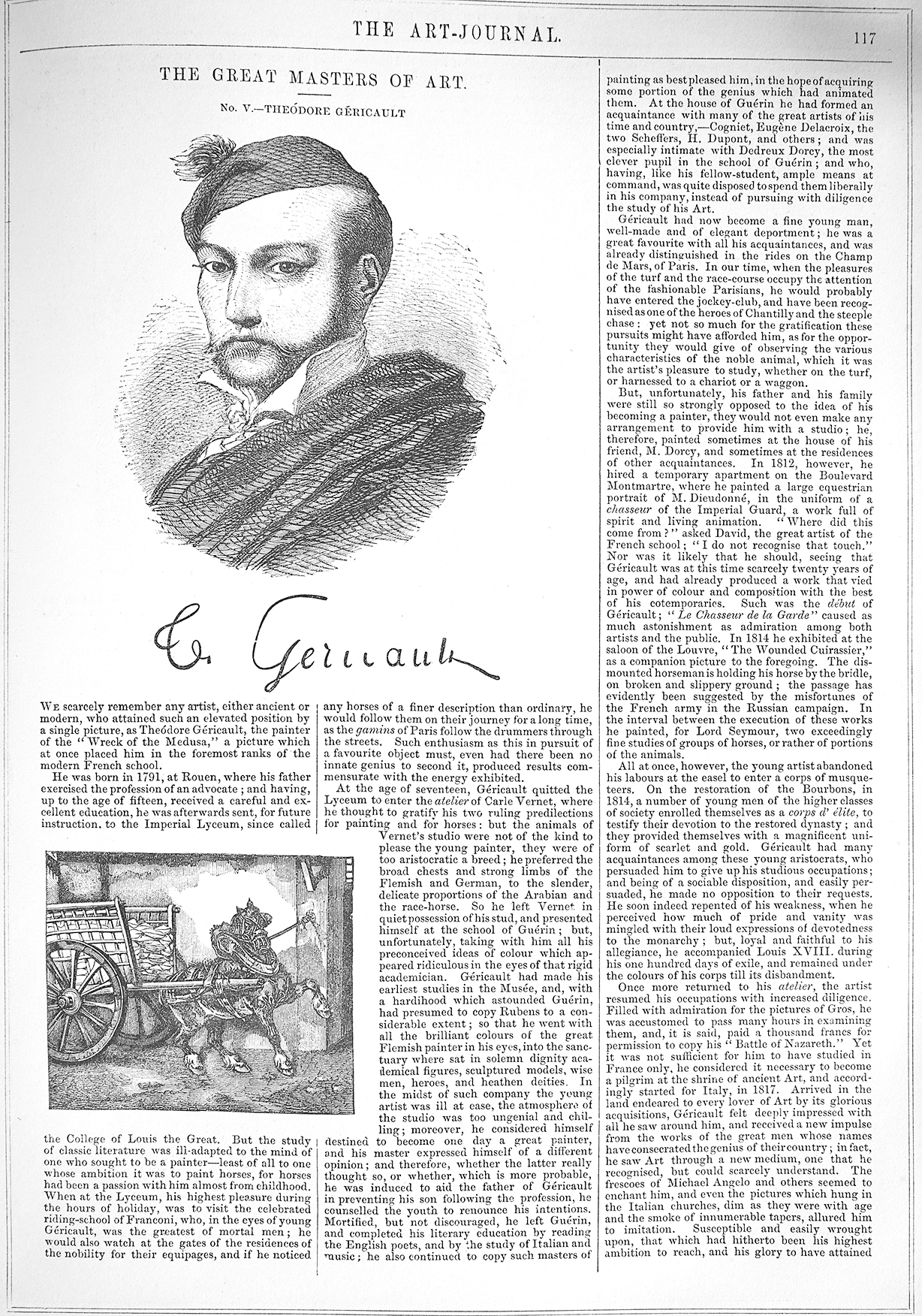
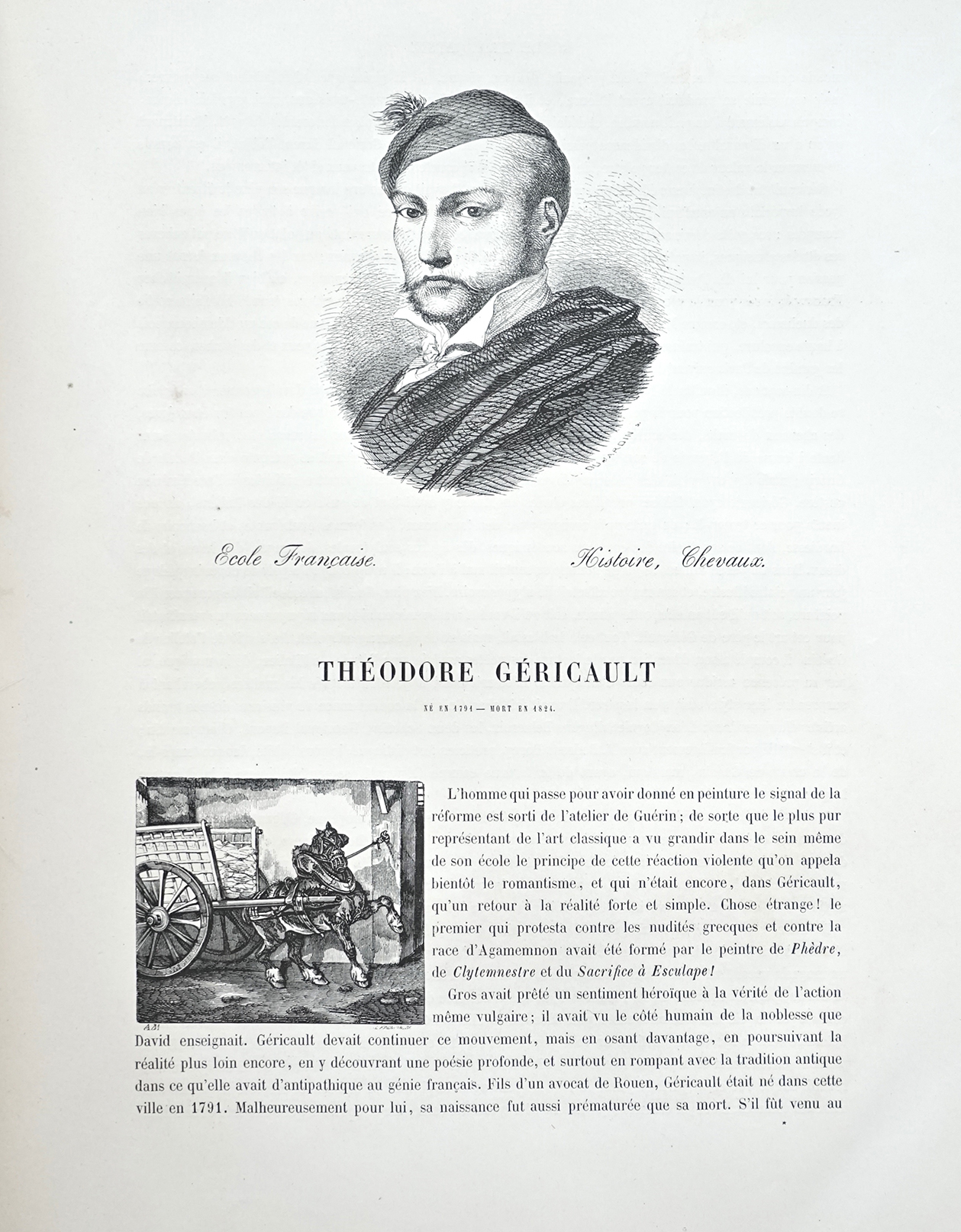
We find hints in 1851 that Blanc knew more about Théodore Géricault’s mental state in 1845 than he wished to reveal. I have argued elsewhere that Blanc may well have been the anonymous author of an essay on Géricault written in and published in English in the Art Journal in London in 1851. (GLM August, 2019). The content of the 1851 essay in the Art Journal is strikingly similar to Blanc’s 1845 essay on Géricault; and the illustrations and formatting of the 1851 essay in the Art Journal strongly resemble the formatting and illustrations of Blanc’s 1865 essay on Géricault.
In 1851, the anonymous author of the Art Journal essay penned a paragraph very similar in style and content to that of Blanc’s above, in which Blanc describes the hints of melancholy and boredom present in Géricault’s letters to his friends. The anonymous author, however, unlike Blanc in 1845, completes this description by adding a blunt and unambiguous assessment of Géricault’s mental state upon his return to Paris.: “In short, his mind, for a time, was altogether unhinged.” This strong assertion, very possibly by Blanc, published in English in 1851, that Géricault’s mind was, for a time “altogether unhinged’ certainly fits more closely with accounts of Géricault’s mental state in France at that time, in 1848 by Jules Michelet, and then in 1851 by Gustave Planche.
Was this 1851 essay in the Art Journal, Blanc’s attempt to share more of what he knew of Géricault’s ‘true’ mental state, by publishing anonymously in a second language? Or, did Blanc in 1865 simply copy the Art Journal of 1851, including the Du Jardin portrait of Géricault, and employ similar images to similar effect in his revised essay on Géricault? We do not know. What is clear is that the formatting and content of the Art Journal of 1851 and Blanc’s essay on Géricault of 1865 share too many similarities to be explained entirely by coincidence. (Again, see the images below.)
A second fact more concretely supports the view that Blanc knew more than he allowed in 1845 and that Blanc regarded his two essays on Géricault and Charlet of 1865 as pendants.
In his essay on Charlet of 1865, Blanc presents a second, entirely new account of Géricault attempting suicide. By 1865, Charlet’s account of his rescue of Géricault from asphyxiation in their rooms in London was a feature in all major studies of Géricault and Charlet. The asphyxiation rescue account also appeared in a medical textbook on suicidal insanity published in 1865 by Alexandre Brierre de Boismont, one of France’s most distinguished physicians, as we discussed in the GLM July 2020 issue. We should not be surprised therefore that Blanc would include Charlet’s account of rescuing Géricault from asphyxiation in his own study of Charlet that same year. Blanc does far more, however.
Blanc describes Charlet twice rescuing Gericault from suicide on different occasions, during their stay in London in his essay on Charlet. Blanc begins his discussion of Géricault’s suicide attemts by noting: “One day, when he and Charlet were walking along the Thames together, Géricault tried to hurl himself into the river; but Charlet reacted quickly and held him fast by the arm..”
To the best of my knowledge, Blanc’s description of Géricault trying to hurl himself into the Thames is unique prior to 1865. (More to say on that elsewhere.) I can find no record of any such account in any Géricault scholarship anywhere prior to 1865. I can find no record of such an incident in any other study of Charlet, either. I apologize if I have overlooked such a reference, if such a reference exists.
If no other published record of Théodore Géricault trying to hurl himself into the Thames existed in print prior to 1865, how then did Blanc know of this incident? Logic suggests that Blanc had his own unique source which he believied, and that Blanc also believed in the veractiy of Charlet’s long publicized account of rescuing Géricault from death in their rooms, stating explicitly that Géricault might have died in London had Charlet not rescued the painter at least twice. If Charles Blanc had no source for this account of Géricault trying to hurl himself into the Thames, why would a critic of his stature needlessly invent such a detailed falsehood?
My view is that Blanc travelled freely among the artists and politicians of France – Blanc knew people. Blanc knew Dreux D’Orcy and other members of Théodore Géricault’s circle. D’Orcy provided Charles Blanc with information for the critic’s 1845 essay on Géricault. Blanc undoubtably knew others, including Gustave Planche, who would write of Gericault’s suicide attempts just six years later in 1851. (See my translation of Planche’s study of Géricault GLM, July-September, 2019.) Blanc certainly read Planche in the 1850s and read Ernest Chesneau in the 1860s. At some point, before or after 1845, Blanc acquired information about Géricault which did not appear in his essay of 1845.
Recall that Charles Blanc was one Théodore Géricault’s first biographers. Was Blanc piqued that he had special knowledge of Géricault’s mental state and, perhaps, even of Géricault’s suicide attempts which he had held back in 1845, knowledge which by 1851 was circluating freely.
Blanc’s 1865 account of a second suicide attempt by Géricault, and of being saved on a second separate occasion by Charlet strengthens the original account of a suicide attempt by asphyxiation. Blanc’s description of a second suicide attempt also strengthens the by then standard claims that Géricault attempted to take his own life on a number of occasions.
Blanc’s hitherto unknown account of Théodore Géricault’s second suicide attempt, and his support for the asphyxiation account, cannot have gone un-noticed. That same year, Ernest Chesneau unlocked the secret door leading to the Géricault family in Mortain in the spring of1865, inviting further inquiries into Caruel and Géricault family history. We know Dreux D’Orcy and his circle keenly tracked publications on Géricault, concerned as D’Orcy was with protecting Géricault’s posterity in the broadest sense of the word. D’Orcy must have regarded Blanc’s enthusiastic endorsement of the first Charlet suicide account, and the description of a second suicide attempt by Blanc, as a shock, as a betrayal, and as a mortal blow to Géricault’s reputation. Blanc, after all, had been D’Orcy’s loyal ally, more or less, for decades.
All of which leads to the most critical questions, as far D’Orcy and Alexandrine-Modeste Caruel de Saint Martin, Théodore Géricault’s secret lover and maternal aunt by marriage, are concerned. What did Blanc, in 1865, know of Géricault and Alexandrine-Modeste Caruel de Saint Martin and their child born in 1818? Georges-Hippolyte Géricault was by then a man, living openly as Théodore Géricault’s son in Normanday, and using his father’s name as his own. Was Blanc aware of the history of mental illness in males of the Caruel family? Was Blanc aware that Louis-Sylvestre Caruel de Saint-Martin, the eldest son of Alexandrine-Modeste, and half-brother of Georges-Hippolyte, was still alive and living in a mental instutition in 1865? Or that Louis-Sylvestre had been cared for and studied by collegues of Briere de Boismont since 1845, when he was confined to institutional care by court order? These questions will have been of intense personal interest to a number of Théodore Géricault’s relations and closest companions alive in 1865.
We can be sure that Alexandrine-Modeste Caruel de Saint-Martin, who had been ennobled the same year she surrendered her son by Géricault up for adoption, was well aware of Blanc’s new claims. What action, if any, would Alexandrine-Modeste and Dreux D’Orcy take to prevent the ongoing assault on the reputation of Théodore Géricault, and upon their own secrets, raging through 1865?
I will address these questions and others in our next issue.
On the left, Art Journal, 1851, “Théodore Gericault”; on the right, first page of Blanc’s 1865 essay “Théodore Géricault”