
1865 – Géricault: A Suicide Case Study
Géricault Life
On the Nature of Suicide (detail), On Suicide and Suicidal-Madness 2nd edition, 1865 by Brierre de Boismont (p.455)
Dr. Alexandre Brierre de Boismont
In 1865, Dr. Alexandre Brierre de Boismont (1797-1881) was one the most distinguished medical experts in the world. He was an internationally recogized authority on cholera, hallucinations, monomanie, alienism and suicide – and something of a celebrity. De Boismont’s name appeared in the pages of Figaro and the popular press. He was much sought after and willingly signed his medical texts and monographs for collegues and admirers. The publication of the new revised edition of Boismont”s Du Suicide et de la Folie Suicide (2nd edition), in 1865, was therefore an event of some significance.
The second edition of Du Suicide et de la Folie Suicide contained several important additions, one of which was a discussion of madness and suicidal artists. Théodore Géricault’s mental problems and ‘several’ suicide attempts figure prominently in de Boismont’s discussion suicide, bracketed between discussions of madness and suicide in the lives of Paul-Pierre Prud’hon and Pierre-Jean David, better known as David de Angers.
Suicidal Artists
(Excerpted from Du Suicide et Folie-Suicide, 2nd edition, by Dr. Alexandre Brierre de Boismont, Paris London New York: Germer-Baillière, 1865)
“…The painter Prud’hon was naturally good, gracious like Correggio, tender like Lesueur. His maternal education rendered him affectionate. His soul was passionate, without being flighty; his will, often ardent, was firm, stubborn; he had a natural penchant for revery, and from revery to melancholy is but a short step. Unhappily, his private misfortunes served to nourish his already somewhat somber disposition and, in place of chasing chimeras, his restless thoughts crashed each day upon the realities of life. His interior existence had become bitter, unbearable; and more than one time the dark ideas of suicide came to torment him. He had to put an end to this impossible life, and pressed by his friends, Prud’hon finally determined a complete separation, resolving to submit to the most severe privations to serve the wellbeing of his wife and for the the education of his children. Perhaps, too, that which helped save him was the affection then so pure and so sincere of Miss Mayer, the student of Greuze.
The demise of this amiable soul, who had such a happy influence upon the melancholy character of Prud’hon, was most unfortunate. The faculty of theology had reclaimed part of the Sorbonne and the government had warned the artists there that they would have to cede their places and receive a housing allowance in return. Miss Mayer was at this time ill and much changed; her gaze often wandered, she uttered strange ramblings. News of this forced relocation induced in her a state of intense consternation. Concerned over what she saw as the delicacy of her situation, she imagined that her master would be compromised, that their liaison would cause a stir, and that she would an obstacle to the peace and happiness of Prud’hon.
The morning of March 26th, 1821, she was discovered with a bizarre expression fixed upon her face. She had before her a small girl of 12 years, named Sophie, who was her student; she had the presence of mind to let her leave. A short time after, the sound of a body falling was heard. Miss Mayer was found stretched upon the ground bathed in her own blood. She had taken the razors of Prud’hon; and after having tried to slice her wrists, she placed herself before the mirror and cut her own throat. The bleeding lasted not more than several minutes, she was dead. Prud’hon was working in his studio before going that day to the Institute. He rose to dress, but no doubt perceiving in the court pale faces and a slight murmur which diminished at his approach, he had a vision of his misery.
He wanted to avoid the facts, but could not be restrained and took all in before his eyes. What a scene! He could not be wrenched from this body, which he held in an embrace; a search was undertaken for Mr. Trezel, his best friend, who finally pried him free. He was then transported to the house of Mr. de Boisfremont.
A man such as Prud’hon could not survive such a frightful blow. He languished two years more. Before dying he had an inspiration, he painted the Christ dying; he took up the brush, when death came to call for him. “Do not weep,” he said to his friends, “you weep at my happiness.” He expired, thus, with serenity in 1823. The French school had just lost one of its greatest painters. (Charles Blanc, Histoire des peintres de toutes les écoles.)
Another painter, Géricault – who engraved his name upon history with his painting of the Shipwreck of the Medusa, sick in London in body and soul, wanted several times to end his days. One night, Charlet, returning late to the hotel, received no response from him; he forced open the door of his room in time to save him from asphyxiation by charcoal.
When Géricault was revived, Charlet sat at the foot of his bed and gravely addressed him: “If you wish to die, if this is the path you have decided upon, we cannot prevent you; in the future, you will do as you please, but before that, permit me first to offer you some counsel. You are religious, you know very well that once dead, it is before God that you must appear, and what will you say to him, unhappy one? After all, you did not merely dine!” Géricault burst into laughter and his fatal resolution was disarmed. (Mr. de la Combe, Charlet, sa vie, ses lettres.) Alongside these two painters…” (pp. 453-455)
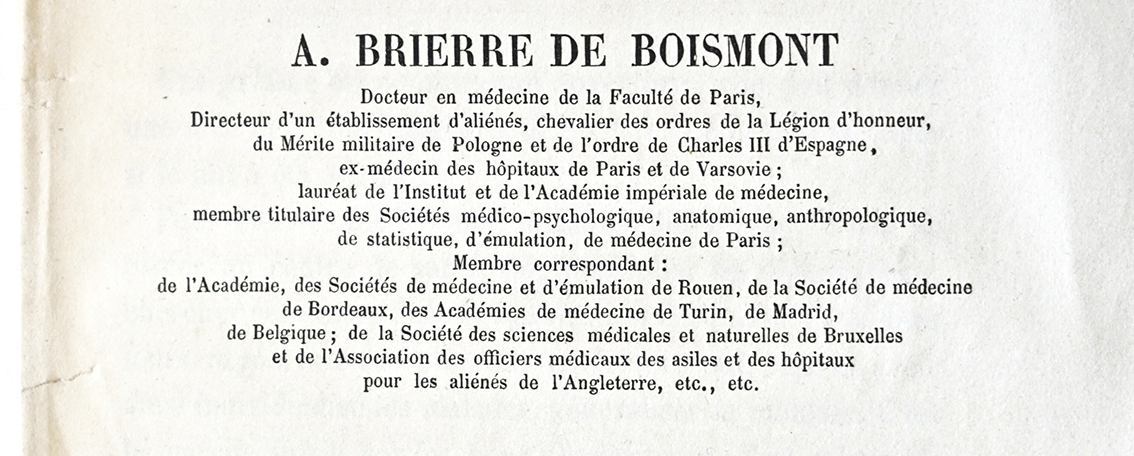
Frontispiece (detail) Du Suicide et De La Folie Suicide 2nd Edition, A. Brierre de Boismont, 1865
Commentary: De Boismont and Géricault in 1865
The significance of de Boismont’s clinical discussion of Théodore Géricault as a suicide case study in 1865 is hard to overstate. Reviews of de Boismont’s text appeared in medical journals and in the public press. (Read the 1865 Le Temps review of de Boismont’s Du Suicide elsewhere in this issue.) We will explore the impact of Géricault’s place in de Boismont’s text more fully in our next issue, but begin that discussion here.
No reference to Théodore Géricault and de Boisment appears in any Géricault scholarship I can identify, however – despite considerable recent interest in Géricault’s mental health and Géricault’s depictions of the mentally ill. The absence of any reference to de Boismont’s discussion of Géricault as a suicide is, thus, a significant ommision in Géricault historiography, an ommision all the more important when we consider the 1865 publication date of the second edition of Du Suicide et De La Folie Suicide.
During Théodore Géricault’s lifetime, the artist was virtually unknown outside the community of artists and art aficionados. He won no major prizes. After Géricault’s death, most of his paintings and drawings went into private collections. Almost everything substantial written about Théodore Géricault prior to 1865 appeared in publications catering primarily to those who enjoyed the arts.
De Boismont’s classification of Théodore Géricault, as a case study in suicide and mental illness in an authoritative medical textbook, presented the artist in an entirely new light – as a specimen and example of mental illness of a classifiable and particular kind. Reviews of de Boismont’s 1865 text appeared in English and French.
As noted, the Le Temps review of de Boismont’s book elsewhere in this issue. Géricault’s suicide attempts figure prominently in the Le Temps review, published on the front page of one France’s most respected newspapers. The 1865 Le Temps review moved Géricault’s reported suicide attempts into the mainstream of public discourse. That fact alone is of considerable importance to all interested in Géricault, and of particular interest to the surviving members Théodre Géricault’s immediate circle in 1865.
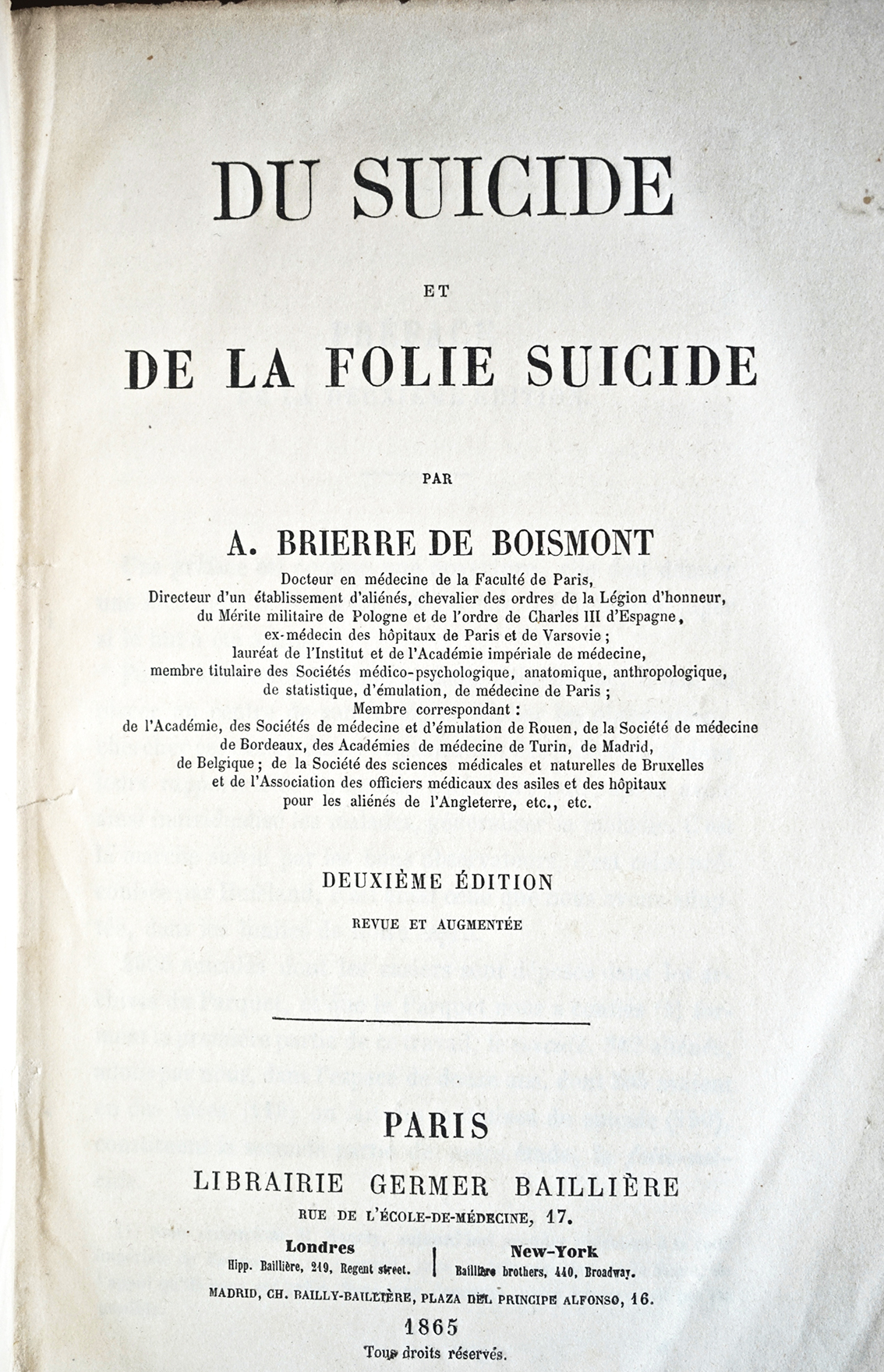
Du Suicide et De La Folie Suicide 2nd Edition, 1865, Frontispiece.