
1865 Le Temps – Géricault Suicide
Géricault Life
Head of a Dead Youth (detail) Théodore Géricault, Musée des Beaux-Arts, Rouen
Introduction
The 1865 Le Temps review of A. Brierre de Boismont’s On Suicide and Suicidal madness ( Du suicide et de la folie-suicide), 2nd edition, published on the front page of the paper’s July 26th issue placed Théodore Géricault’s reported sucide attemps before a wide audience. Le Temps was one of most respected newspapers in France with a signfiicant readership abroad. Read an long excerpt of the Le Temps review below.
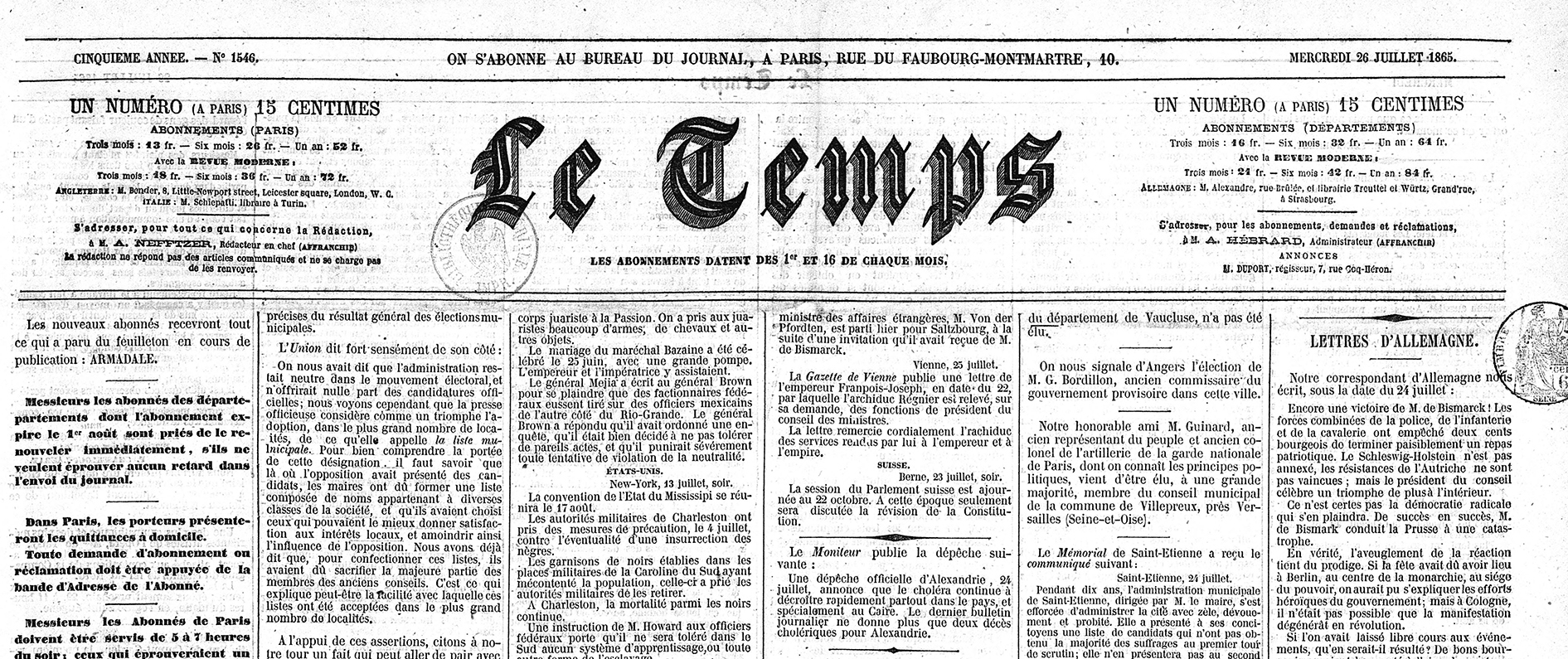
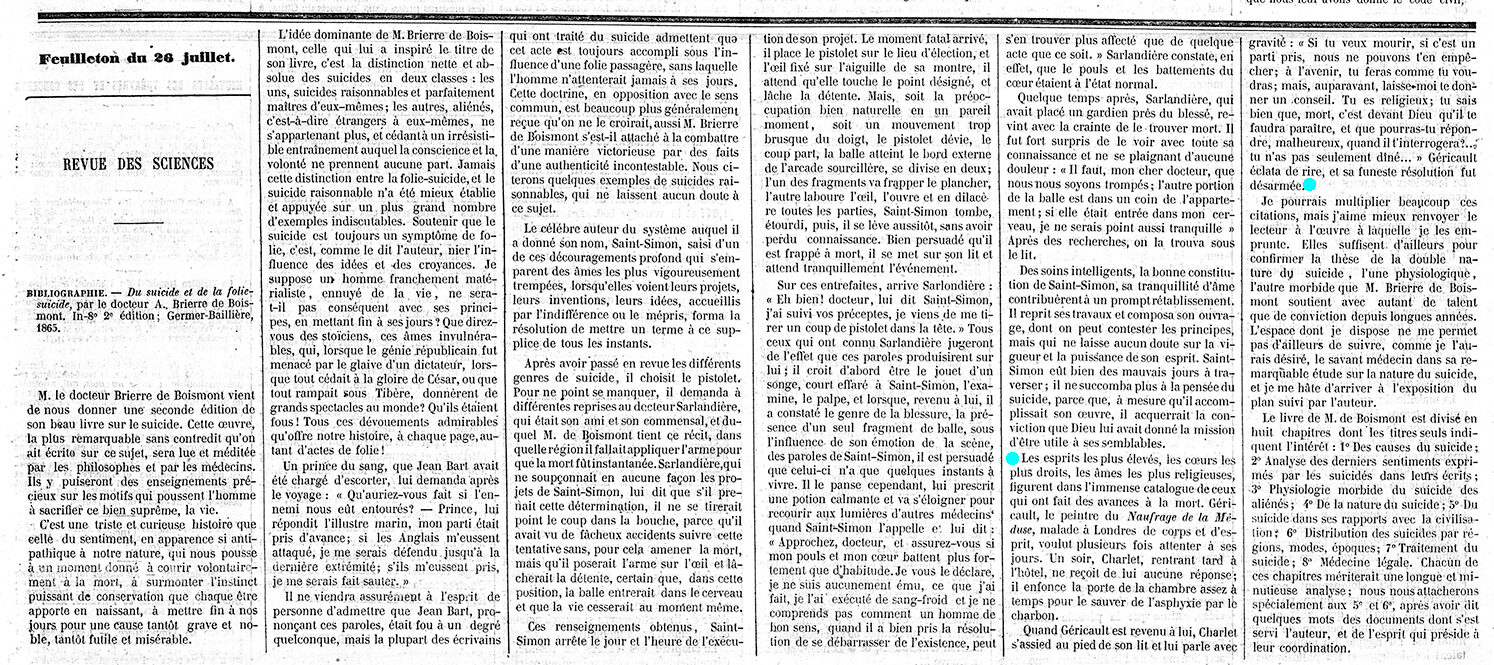
1865 July 26th issue, Le Temps – front page. The blue dots indicate the references to Géricault’s suicide attempts. I have translated the review’s discussion of Géricault’s suicide attempts below. (Image courtesy of Gallica)
“Review des Sciences”
Bibliographie: Du suicide et de la folie-suicide, by Doctor A. Brierre de Boismont. In-8° 2nd edition; Germer-Baillière, 1865.
The honorable doctor Brierre de Boismont has just given us a second edition of his handsome book on suicide. This work, without dispute the most remarkable that has been written on this subject, will be read and meditated upon by philosophers and by physicians. They will draw valuable lessons on the motives that permit man to sacrifice the supreme possession – life.
It is a sad and curious history of this feeling, so antithetical in appearance to our nature, which pushes us in a given moment to run voluntarily towards death, to surmount the powerful instinct for self-preservation which each carries from birth, to put an end to our days for a noble cause, sometimes futile and miserable.
…The most elevated spirits, the most upright hearts, the most religious souls, figure in the immense catalogue of those who sought an early death. Géricault, the painter of the Shipwreck of the Medusa, sick in London of body and of spirit, wanted several times to attempt suicide during these days. One night, Charlet, returning late to the hotel, receiving no response from him; forced upon the door of his room in time to save him from charcoal asphyxiation.
When Géricault returned to life, Charlet seated himself at the foot of his bed and spoke to him with gravity: ‘If you wish to die, if it is your preference, we cannot stop you; in the future you will do as you will; but, before that, allow me to give some advice. You are religious; you know well that upon your death, it is before God that you must give account. And what will you say, unhappy one, when he interrogates you?…after all, you did not merely dine…’ Géricault burst into laughter and his deadly resolution was disarmed… [by]L. Grandeau.
Commentary
The 1865 Le Temps review of A. Brierre de Boismont’s Du suicide et de la folie-suicide (2nd edition, 1865) ensured that reports of Théodore Géricault’s sucide attemps would enter the canon of accepted medical knowledge as fact. That development would have horrified Géricault’s surviving friends, who had worked tirelessly to preserve a particular profile of the painter, one largely free of discussions of mental illness, in general, and suicide in particular.
Alienism, as mental illness was then described, was a topic of interest to very broad sections of the educated public Hereditary illnesses were part of this discussion. Théodore Géricault’s surviving friends and relations, especially those aware of the history of mental illness in males of Théodore Géricault’s maternal line might well have reason to be concerned. Géricault’s maternal grandfather died in a mental instutution. Louis-Sylvestre Caruel, the eldest son of Géricault’s maternal uncle Jean-Baptiste Caruel de Saint-Martin and Alexandrine-Modeste Caruel de Saint-Martin, had been confined to a mental hospital in 1845 and was still under care in 1865.
Louis Sylvestre’s younger brother, Paul Caruel de Saint-Martin, also known as the Baron Caruel de Saint-Martin, inherited his father’s title. Paul Caruel de Saint-Martin and his wife Elisabeth Green de Saint-Marsault ranked among the elite of French society during the Second Empire and after. In 1865 both Henri Moulin and Ernest Chesneau linked Théodore Géricault to Jean-Baptiste Caruel de Saint-Martin in the press. The Le Temps review of Brierre de Boismont’s revised study of sucidal insantity with Géricault’s name and suicide attempts prominently featured was exactly the kind of press the Caruel de Saint-Martin family and Géricault’s friends would have been keen to avoid.
(I discuss Brierre de Boisment’s background and international reputation elsewhere Brierre de Boisment’s profile and publications list can be found here.)