1797 – Louvre Changes
Géricault Life
Suppression d’un passage qui était commun au Musée et aux habitans des Galleries (Suppressing a Passage Shared by the Museum and Residents of the Galleries du Louvre) 1797 detail – Image courtesy of the Archives Nationales (France) F/21/569
Théodore Géricault and his family moved from Rouen to Paris in 1796 or 1797. All family members, those already living in Paris and those residing in Normandy and beyond would have been fully aware of the national museum of art located at the Louvre.
Our examination of the Museum Central des Arts and the community of artists residing in the Louvre and adjoining galeries du Louvre, (the long gallery connecting the (old) Louvre palace to the newer Tuileries palace to the west), began with Minister Roland’s famous letter to Jacques-Louis David of October, 1792. (see GLM September, 2019)
In this open letter, reprinted in the press, Roland described to David and the people of France his vision of the new Museum. The people of France now owned the royal collection of art and the buildings of the Louvre. Space within the galeries du Louvre would be home to the new Museum and the artists serving the Museum‘s needs. One day, however, all the buildings connected to the Louvre would be entirely dedicated to housing the national collection, predicted Roland. Such was the scale and scope of this great national project. Individuals not directly involved in advancing this enterprise must make way before the needs of the people and their Museum.
After the publication of Roland’s letter, a number of changes followed. The most dramatic began after France invaded Italy and began ‘relocating’ treasures from Italy to Paris after 1796. Competition for working and living space withing the Louvre became more intense as a large number of artists continued to make the Louvre their home.
Jacques Louis David (see the plan below) was a significant presence in this community. Carle Vernet, Géricault’s ‘first’ teacher lived in apartments in the Galeries du Louvre with family. Carle’s father, Joseph Vernet, received his brevet for painting his Ports of France series. Edme Verniquet, the cartographer and maker of the map below, also lived in apartments there, as did Pierre-Narcisse Guérin, Géricault’s teacher after Carle Vernet. The influx of paintings and statuary newly ‘liberated’ from Italy placed new demands upon the administrators of the Musée Central des Arts.
I present here a report from the Museum administration to the government recommending the suppression of the Passage d’Artistes – the long passage within the Galeries du Louvre connecting the Tuileries palace with the Museum, and the garden of the Infante and the Louvre beyond.
Equally interesting and important, are the details enclosed in the report illuminating the lives of the ‘invisible’ figures residing and working in or around the Louvre in 1797, the first year Géricault and his extended family can be definitively situated in Paris: the nurses, domestics, guardians, and others. Géricault, the Vernets, and other members of higher society interacted with these individuals on a daily basis, but very little is written of their exchanges. We will continue to examine the concerns of this ‘invisible’ community as we proceed.
…to the Minister of the Interior
“The Administration is deliberating upon several subjects important to the Museum. 1.° Museum security, 2.° the decency the establishment requires, 3.° the means to find space for the objects from Italy already here, and for the others in transit, 4.° to ensure uniform standards for the police working within the Museum, and to do so make the following recommendations for your review.
The garden known formerly as that of the Infante used to be a site frequented by wet-nurses, and by governesses, who would conduct the children of the families of the artists living in and around the Louvre to play there. All these people have been forced to retreat from this place. Vagabond children and lost young girls have taken possession of it, even as the museum’s military guards attract the latter, rather than engage in suppressing the former.
This garden, which has become part of the Museum, contains many art objects already which suffer from close proximity with these young libertines. Guards struggle in vain to restore peace and order and control these malefactors who flee, escaping pursuit, and are in no way constrained by the feeble defences erected to encircle this garden, fences the administration has several times requested be demolished.
If the security of the Museum of Arts is found wanting because of the ease with which vagabondage penetrates this garden and is exercised there as a result of these useless barriers, as we have both acknowledged several times, it is no less compromised by the easy communication of traffic to the gallery through the interior of the Museum. All the residents of this Gallery, in their turn, travel without cease through the court to the garden as one travels a street; the sheer number of packages and crates which enter daily is impossible to track and makes security an illusion, as a result.
You share our fears, Citizen Minister, and the knowledge that it only takes an uncrupulous individual among the domestics of the artists to use this gallery to introduce thieves into the interior of the Museum.
We therefore request first the closure of the garden to the public, at least provisionally, a measure which is absolutely necessary in order to make space for the objects arriving from depots and those arriving from Italy…”
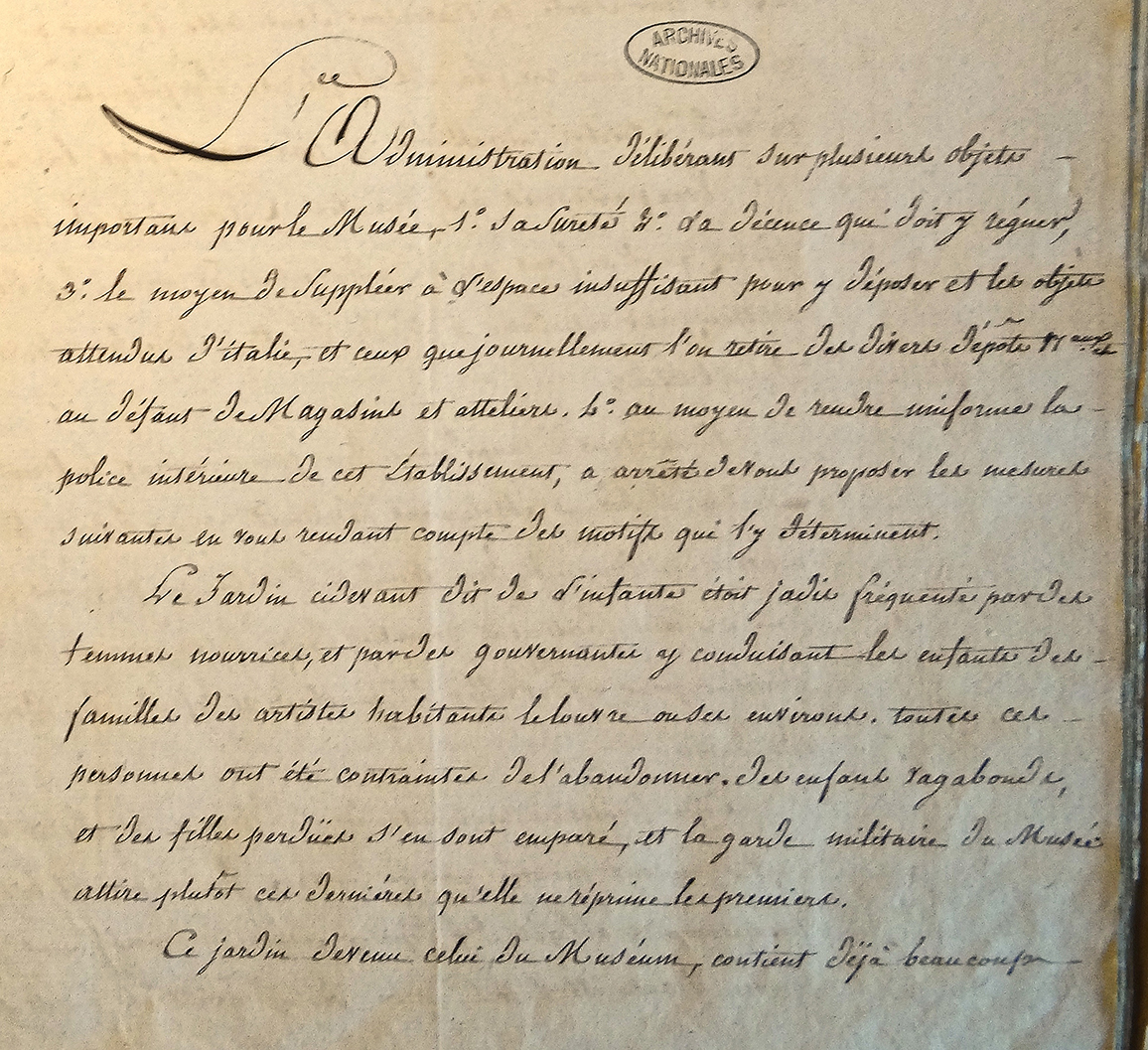
22 germinal an 5 (April 11, 1797) (detail), Image courtesy Archives Nationales (France) F/21/569
Conclusion
Prostitutes cajole clients as the poor beg and cavort upon the statues and other priceless works of art swelling the garden adjoining the Museum Central des Arts. The juxtaposition of the genteel and the desperate fighting to assert their authority over this venerable historic space fuels the imagination and is somehow fitting. Guards neglect their duties, or are unable to perform them. Gawkers and sightseers wander unchecked from the garden of the Infante to gawp, mixing with museum administrators and artists. Some no doubt made their way into and along the passage d’artistes, where the Vernets and other families resided.
In a very real sense, the cacaphony and carnivalesque on display, and illuminated in the opening paragraphs of the administration report capture life in Paris as it was under the Directory, the five-member executive which ruled France then. Paris had a strong royalist contingent among the populace. This body, allied with others, rose up to challenge the national authority in 1795. Paul de Barras, cousin of Marie-Anne-Charles de Barras (wife to Louis Robillard de Peronville), led the troops which defeated the uprising. Barras relied heavily upon a young artillery officer who placed canon at strategic points in the narrow streets of the Tuileries, which could fire upon the approaching citizens. Napoleon placed several of these canon outside the Géricault family apartments in the Hotel de Longueville.
Paul de Barras was perhaps the single most powerful individual in France from 1795 to 1799. Barras, therefore, was one of those ultimately in charge of the people’s museum in the Louvre. As noted, family ties linked the Robillards to Barras. Marie-Anne-Charles de Barras married Louis Robillard de Peronville, a Géricault relation, in Saint-Domingue in 1788. When Napoléon siezed power in 1799, with the help of his brother Lucien, the Robillards developed close relations with Lucien Bonaparte, as we shall see.
We will continue our examination of the Louvre in our next issue, and strive to keep our focus on the invisible as well as the powerful. In the timeless conflicts, however, between the poor and the well-to-do, the final outcome is rarely in doubt.

1795 Verniquet, Atlas du plan…Paris… (detail) courtesy of David Rumsey Maps.