1812 Landon’s Annales – Robillard
Géricault Life
The Public Viewing David’s Coronation (detail) Léopold Boilly, 1810 (Courtesy of the Metropolitan Museum of Art)
The Importance of Engravings and Reproductions to Artists and the Public
In a world without photography and film, hand-drawn illustrations and drawings reproduced as engravings and prints were an integral part of daily life. Print reproductions of illustrations, drawings, statuary, paintings and objects from everyday life mattered to science, industry, and the arts. Print reproductions of paintings, drawings, and sculpture of different sorts were of particular importance to artists and their audiences. A painting might sell for a large sum, or not at all. However, if the painting achieved a measure of popular success, reproductions of the work allowed the artist to earn more. Part of this additional income was shared with the publisher and invididuals hired to produce the engraving.
A larger and higher-quality engraving, such as those produced for Géricault relations Louis Robillard de Peronville and Pierre Laurent, might itself be regarded as an object of status and beauty. Indeed, high-quality reproductions of paintings, sculpture, and bas-reliefs perfectly suited detailed and nuanced discussions of the merits of a particular work whether in the museum, or in private salons. A simpler engraved reproduction, such as those in Charles Paul Landon’s Annales du Musée, discussed in the previous issue, sufficed as an illustrated reference for the accompanying commentary. Then, as now, a reference book one can slip in a pocket is a useful thing to have on hand.
Boilly’s painting above illustrates this distinction clearly. The uniformed figure on the left consults a book. The cluster of figures in the center consult a folio of engravings. The composition is both serious and a comedy of manners. The uniformed figure on the left, book in hand, stands with his female companion to anchor that part of the composition. To their right, we see another couple, and then a third. A gentlemen holds a large image of some kind as his companions look on. The groups are linked by a younger woman, or girl, gazing upon the military figure, and her gentleman companion who gazes upon the art before him. The large image held in the hands of the gentleman commands their attention. The smaller reproduction in the hand of uniformed gentleman is a mere reference point, with nothing original to offer any viewer.
Cultural capital in the form of ownership, patronage, and knowledge mattered. Patronizing the arts was formerly restricted to the nobility. However, large amounts of capital allowed the wealthy to purchase titles of nobility. Ordinary citizens in Republican France had free access to one of the world’s great art collections in the Museum Central des Arts. The extremely modest subscription cost of Landon’s Annales meant that the ordinary French citizen could participate fully in the appreciation of culture, as culture was defined by the state.
Library of Jacques-Florent Robillard and Pierre Robillard
In our March issue, readers discovered that the inventaire after the death of Angélique-Louise Morize of 1812, confirmed that Théodore Géricault’s Robillard relations in Paris owned a large and expensive collection of the Musée français engravings mentioned above. (On May 12th, 1812, Angélique-Louise Morize Robillard, the wife of Jacques-Florent Robillard, passed away at the family hotel on the rue de Mont Blanc.) The engravings of the Musée français were published by Jacques-Florent Robillard’s younger brother Louis Robillard de Peronville, a plantation owner in Saint Domingue relocated to Paris, and Pierre Laurent, a prominent engraver, who obtained reproduction rights for the original royal collection in 1791. Robillard de Peronville and Laurent published the Musée francais (also known as the Musée Napoléon) from 1803 until their deaths months apart in the summer of 1809. From our March issue:
“…The references to the Musée Français in the inventaire of Angélique Morize appear in the section entitled: “Suite de l’inventorie des livres composant la Bibliothèque de M. Robillard et dans laquelle sont compris ceux de M. Le Chevalier Robillard son fils.” (What follows is the inventory of the books comprising the library of Mr. Robillard and which comprises those of his son the Chevalier Robillard.)
The large library Jacques-Florent Robillard shared with his son Pierre reveals much about their tastes. The excerpt of the inventaire listing the books in their library begins with n° 425 Ouvres de Molière (Works of Molière.) Along with Molière, we find classical authors such as Virgil. We also find a substantial number of books in English… the most valuable books in their collection, by far, are items n° 485 and n° 486.
Item n° 485 consists of ‘figures of the Musée Français – avant la lettre (before the letter) divided into eleven hardback volumes valued at 1500 francs.’ Item n° 486 consists of three volumes of the “même ouvrage” (same work) valued at no more than 600 francs.’ Thus, the inventaire confirms that, in 1812, Jacques-Florent Robillard and his family possessed fourteen bound volumes of Robillard de Peronville and Laurent engravings, valued together at more than two thousand francs…”
Landon’s Annales – Robillard Library
In the same inventaire after the death of Angélique-Louise Morize of 1812, we discover in the same library Jacques-Florent Robillard shared with his son, sixteen volumes of Charles Paul Landon’s Annales du Musée, along with individual livraisons among their history volumes. “…445° annalles de Musée by Landon…sixteen volumes… with engravings along with twelve unbound livraisons valued at sixty francs…”
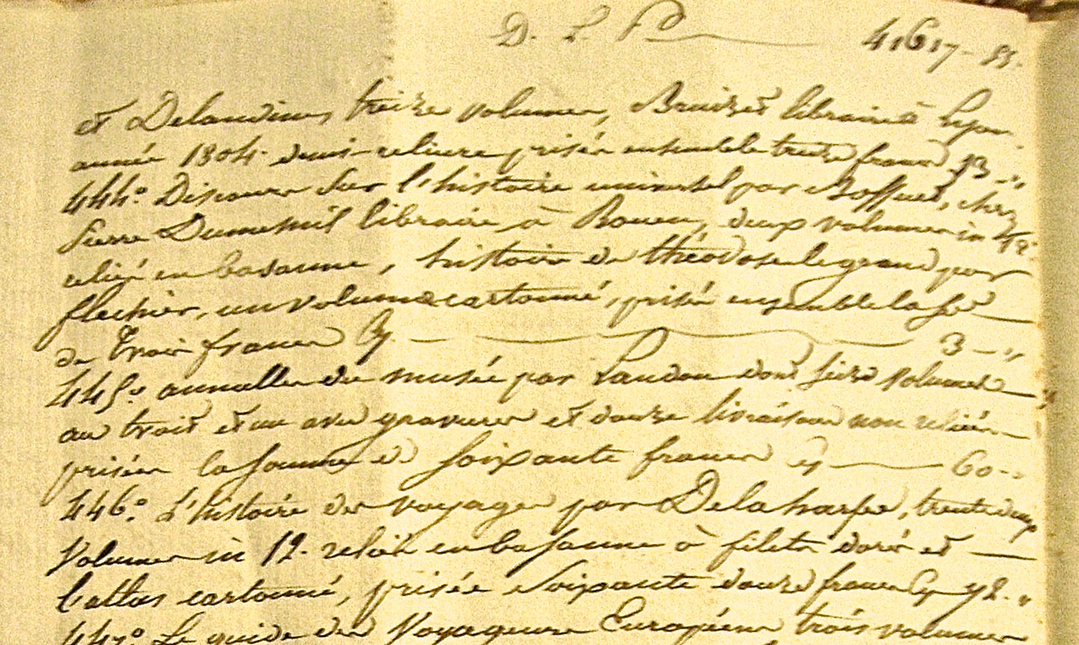
Inventaire après la décès de Mad. La Baronne Robillard – Angelique-Morize (detail), 13 Nov, 1812. Image courtesy of the Archives Nationales (France) MC/ET/XIX/941
Conclusion
Banker Jacques-Florent Robillard, and his wife Angélique-Louise Morize, were immensely wealthy. The Musée français engravings were among the most expensive available and of a quality to satisfy the most demanding and discerning consumer. Jacques Florent Robillard was one of the first subscribers and one of the most loyal supporters of his brother’s enterprise. Yet, we we also find sixteen volumes of Landon’s Annales in the Robillard library. Why would Jacques-Florent Robillard and Pierre Robillard own both the Annales and the Musée français collections? The most likely answer is that the Landon Annales were inexpensive, comprehensive, and highly portable.
As we confirmed, (GLM January, 2020) Jean-Baptiste Caruel, Théodore Géricault’s uncle, also owned a large collection of Péronville and Laurent engravings at the time of his death. Jean-Baptiste Caruel, like his cousin Jacques-Florent Robillard, was one of the earliest Musée français subscribers. We can therefore place Musée livraisons within the Géricault family home on the rue de l’Université from 1804, when Jean-Baptiste Caruel quit his apartments in the Hôtel de Longueville. That March, Jean-Baptiste Caruel renegotiated the lease for his mother’s home on the rue de l’Université, apartments also home to Théodore Géricault and his parents. Under the terms of the new lease, Jean-Baptiste assumed all responsibilities for the lease and obtained his own rooms within the shared family space. (GLM July, 2019)
Young Théodore Géricault clearly learned something about art from his family – through direct contact with artists such as Titon Laneuville, another early Musée subscriber who also painted the individual portraits of Théodore’s cousins Pierre and Amédée-Selim Robillard, and from visits to studios and galleries with family members; from the commentary and engravings in the Musée français, and almost certainly from Landon’s Annales, and from similar publications. Art was important in the Géricault family homes, both for the sake of art, but because the Robillard family was a mover and shaker in the Paris art world. We should not be suprised at all that Jacques-Florent Robillard owned a large collection of Landon’s Annales. The fact that Jacues-Florent Robillard also owned a number of unbound livraisons strongly suggests Jacques Florent was an Annales subscriber.
What of Théodore Géricault, and his closest relations? We lack concrete proof at this point. Yet, looking upon the children present in the Boilly canvas above, we can easily envision a similar scene, with Théodore Géricault standing before Guérin’s Marcus Sextus, or the battle paintings of Wouvermans and Le Brun, alongside his uncle Jean Baptiste Caruel, or another relation, reading about the work from the Annales, or some similar study. Afterwards, Théodore would return home, or rush to some private place to sketch and draw, and sometimes to study some of the same objects reproduced in the Musée français, the family art enterprise, his young imagination awakening and forming images, already ready to take flight.