Paul de Barras & Robillard de Péronville
Géricault Life
Minutes des bulletins de police F/7/3701 (detail) Courtesy of Archives Nationales (France).
Paul de Barras belonged to the same family as Marie-Anne-Charles de Barras, the wife of Louis Robillard de Peronville. Louis Robillard de Peronville and Marie-Anne-Charles de Barras married in Saint Domingue in 1788. Seven years later, Paul de Barras, almost certainly a cousin of Marie-Anne-Charles de Barras was one of the most powerful men in France. My own view is that Paul de Barras acted as the principal political patron of the Géricault-Caruel-Robillard family during the years 1795 to 1799, when Paul de Barras served as one of five members of the Directory, the executive which effectively ruled France during this period. However, we possess just one piece of documentary evidence situating Paul de Barras in the home of his cousin Marie-Anne-Charles de Barras and her husband Louis Robillad de Peronville.
In November of 1799, Napoléon Bonaparte and his allies seized power and overthrew the Directory. Soon after, Napoléon’s police placed Paul de Barras, the former Director, under surveillance fearing that Barras might be plotting to undermine the government, or perhaps seek to return to power. The police report below of April 23, 1800, allays some of these concerns and provides documentary evidence linking Paul de Barras to Marie-Anne-Charles de Barras and her husband Louis Joseph Robillard de Peronville.
Bulletin de Police (April 23, 1800)
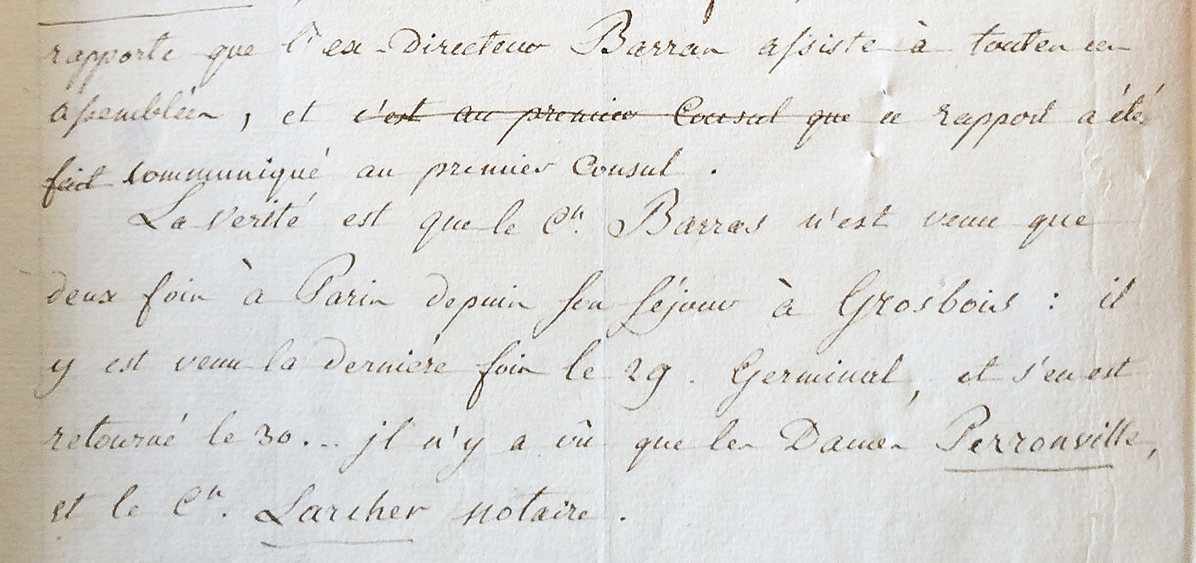
Minutes des bulletins de police F/7/3701 (detail) courtesy of the Archives Nationals (France).
Situation de Paris: 3 floréal, An 8 (April 23, 1800)
“…The truth is that the Cn. Barras has come but two times to Paris since his retirement to Grosbois (the country home of Barras): he came here the last time on germinal 29 (April 19, 1800), and returned on the 30th (April 20, 1800) …he was not seen anywhere other than with the “Dame Perronville,” (sic) and the Cn. Larcher, notary…”
Conclusion
We do not know how often Paul de Barras visited the Peronville-Barras home on the Rue de la Concorde. The police report, however, does place the former Director in the Robillard de Peronville-Barras family home on April 19, or 20, 1800. Did Paul de Barras spend the night at his cousin’s home? We can only guess. We can be confident, however, that the visit of Paul de Barras to the Peronville-Barras family home recorded by the police was not his first, and perhaps not his last. The observed visit suggests clearly to us some form of family bond, or friendhip. And why not?
We know of the famous parties at the Robillard de Peronville home from other sources. The Barras cousins shared a love of luxury and the good life. We can speculate with some confidence that Marie-Anne-Charles de Barras and her Robillard relations visited the apartments of Director Barras at the Luxembourg palace after Marie-Anne-Charles and her husband returned to Paris from Saint-Domingue in 1797. We can also expect that the wealthiest members of the extended Robillard-Caruel-Géricault family (such as Jean-Baptiste Caruel, Théodore Géricault’s maternal uncle) also attended parties at the Luxembourg palace during the Directory. Proximity and family ties to the Director may well have conferred some sort of caché and social status upon all members of the extended Géricault-Robillard-Caruel family, albeit to varying degrees, from 1795 to 1799.
The rank, wealth, and social status of individual family members was likely clearly recognized within the family and without. Our view is that Georges-Nicolas Géricault, the lawyer from Mortain and Rouen, and father of Théodore Géricault, occupied one of the lowest places on this family pecking order, a fact Théodore Géricault probably sensed even as a young child.
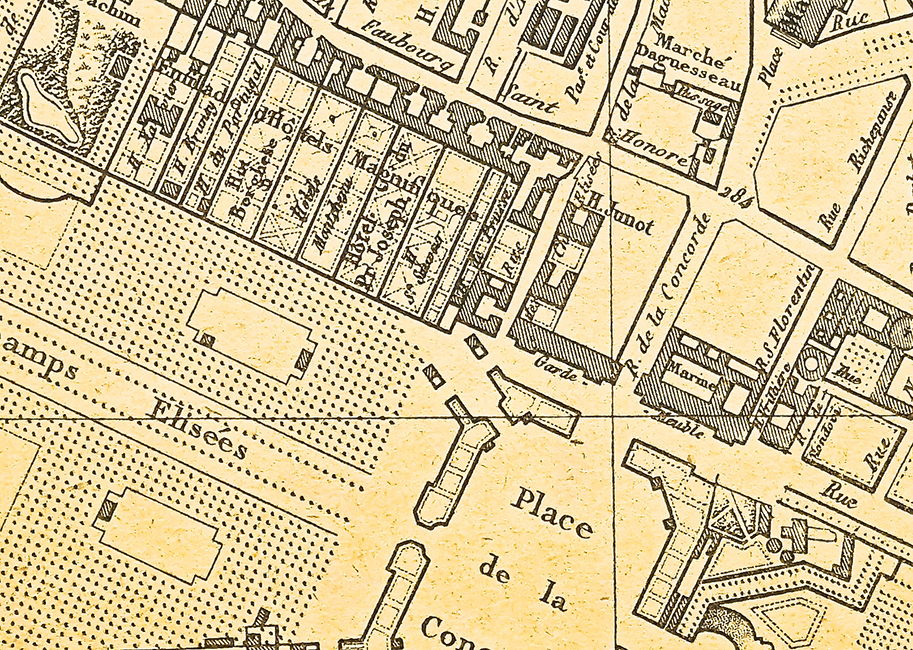
Maire Map 1808 (detail) Rue de la Concorde