
1862 Chesneau – D’Orcy
Géricault Life
1862 Chesneau – D’Orcy
Ernest Chesneau published La Peinture Française au XIXe Siècle Les Chefs D’Ecole, L. David, Gros, Géricault, Decamps, Meissonier, Ingres, H. Flandrin, E. Delacroix (Paris: Librairie Academique Didier et Cie. Libraires-Editeurs) in 1862. Ernest Chesneau first published this 1862 essay on Théodore Géricault a year earlier in 1861 in the Revue Européen. (pp. 131-186) (See Chesneau’s 1861 essay in earlier issues.)
Pierre de Dreux D’Orcy Complains
In 1862, Ernest Chesneau made a number changes to his original 1861 essay on Théodore Géricault: moving information from footnotes into the body of the text, and the opposite; changing section breaks, and adding section summaries. However, Chesneau also made two substantial changes to the content of the essay. In 1862, Chesneau recrafted his 1861 paragraph on the state of French art, situated on the penultimate page of the essay. Elsewhere, Chesneau also added a description of an exchange with Pierre de Dreux D’Orcy, Théodore Géricault’s friend, who was still living. Chesneau reported that D’Orcy, having read Chesneau’s 1861 essay on Géricault in the Revue Européenne, reached out to the critic to register his unhappiness, via a third party.
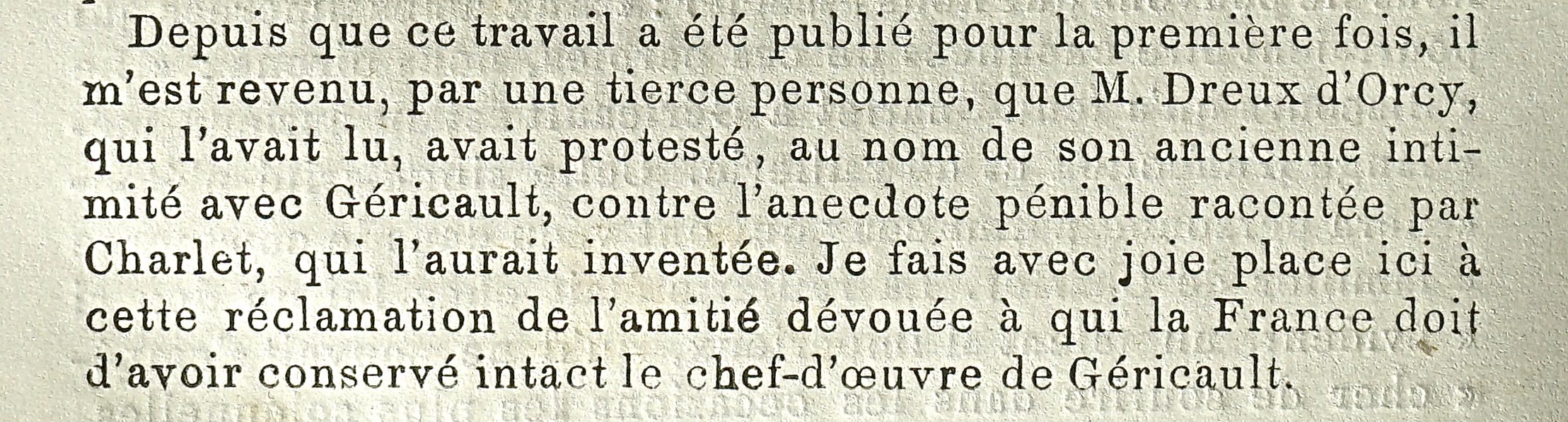
Ernest Chesneau: “Géricault” Les Chefs d’Ecole 1862. (p. 168)
Chesneau’s 1862 description of his exchange with D’Orcy in Les Chefs d’Ecole consists of just two sentences.
In the first sentence Chesneau writes “In the time since this work was first published I was alerted, via a third person, that Mr. Dreux D’Orcy, having read it, protested in the name of his former intimacy with Géricault, against the upsetting anecdote recounted by Charlet, which Charlet must have invented.” The “upsetting anecdote” D’Orcy refers to is Nicolas-Toussaint Charlet’s firsthand account of Théodore Géricault’s suicide attempts in 1820, and of preventing Géricault from taking his own life in a hotel room in London. Charlet’s account first surfaced a decade earlier in the Revue des Deux Mondes of November, 1851, in Gustave Planche’s essay on Géricault. (Read Planche’s account in our September, 2019, issue.)
In his second sentence Chesneau writes: “I am happy to place here this claim of a devoted friendship, a friendship which preserved intact the masterpiece of Géricault for France, and for which France is indebted.” Chesneau here refers to D’Orcy’s purchase of the Raft of the Medusa at the sale which followed Géricault’s his death in 1824. D’Orcy later sold the Raft to the national collection for the same price he paid, 6,000 francs. D’Orcy’s role in keeping the Raft of the Medusa in France was a standard fixture of 19th-century Géricault scholarship.
Chesneau’s tone is polite. We note, however, that Chesneau provides no clear sign of his own views on the substance and merit of D’Orcy’s complaint. Chesneau describes D’Orcy’s objections in the briefest possible terms in his first sentence, and then in his second effectively dismisses D’Orcy’s charge with flattery, rather than offer any detailed response.
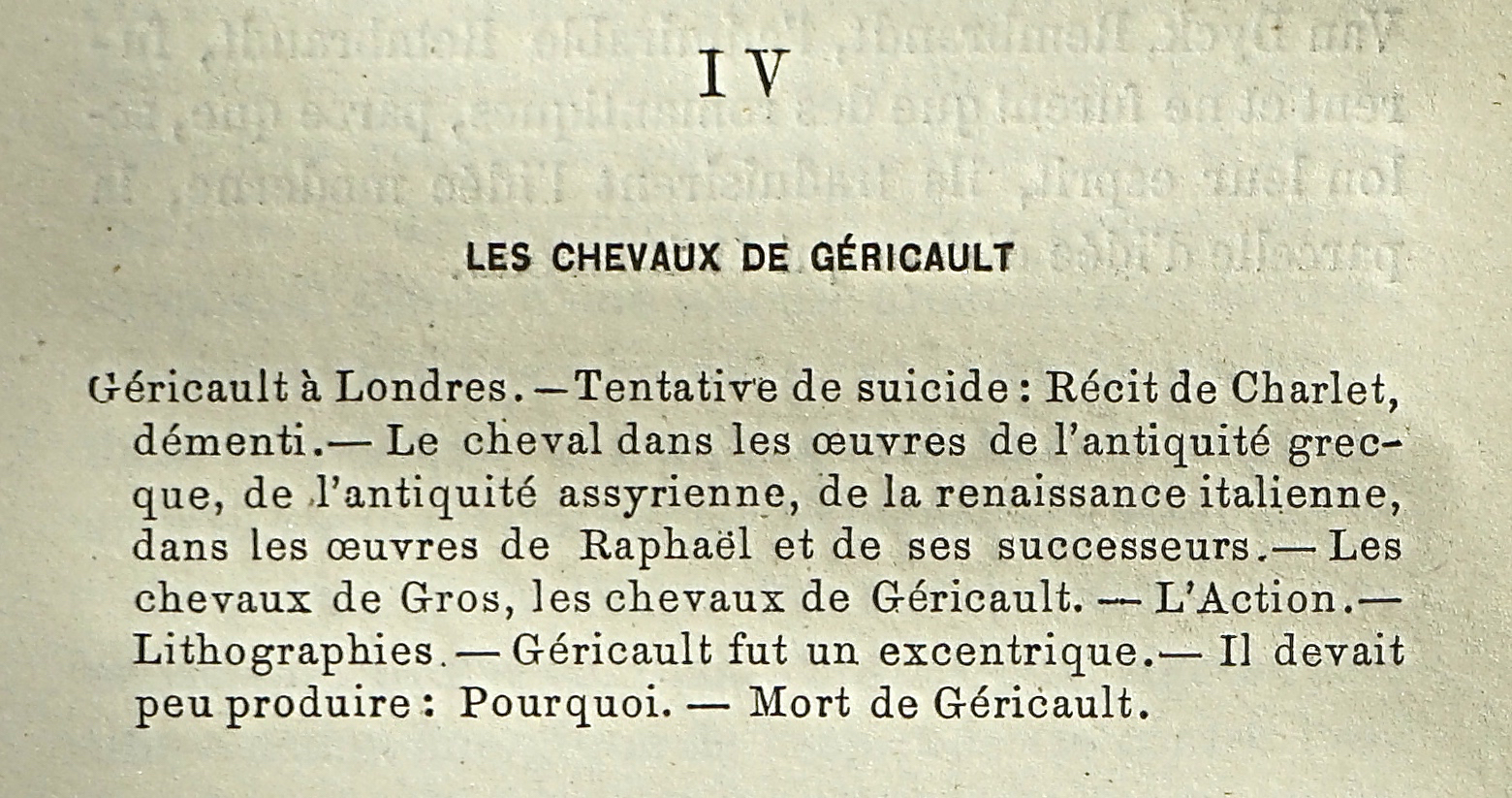
Ernest Chesneau: Section IV summary “Les Chévaux de Géricault” in “Géricault” Les Chefs d’Ecole 1862. (p. 166)
“Géricault to London – Suicide Attempt: Charlet’s account, denial – the Horse in the works of Greco-Roman antiquity, of Assyrian antiquity, of the Italian Renaissance, in the works of Raphael and of his successors – the horses of Gros, the horses of Géricault. – The action. – Lithographs. – Géricault was an eccentric. – he would produce little: Why? – the death of Géricault.” (Chesneau, Chefs d’Ecole, p.166)
One change Chesneau makes to his 1862 essay is to alert readers about the contents of each section. Reading this section introduction on page 166 above, Chesneau’s readers might reasonably expect to find early on a description of Géricault’s trip to London, Charlet’s account of Géricault’s suicide attempt, and a refutation of Charlet in some form, each presented in somewhat equal measure, followed by Chesneau’s discussion of Géricault’s horses.
As we have seen, however, Chesneau offers no substantive discussion or refutation of the merits of Charlet’s account at all. Chesneau does include a reference to the refutation of Charlet’s account, but does so in a way far more likely to infuriate d’Orcy than provide any sense of satisfaction, a fact which becomes much clearer when we briefly review the first three pages of section IV.
Chesneau begins the section (p.166) by very briefly describing Géricault’s departure from France in the company of Charlet and the economist Brunet. The critic then fills page 167 and much of page 168 with a detailed description of Géricault’s suicide attempt in London, presented as fact just as Charlet described the events. No refutation of Charlet’s claim appears anywhere in the body of the text of these pages, or anywhere in the essay for that matter. Only as the readers’ eyes fall below the body text on page 168 to the attached commentary of Planche do readers discover Chesneau’s description of his contact with d’Orcy, appended below Planche as an un-numbered footnote in small font, as it were, at the bottom of the page beneath the more essential commentary of Planche.
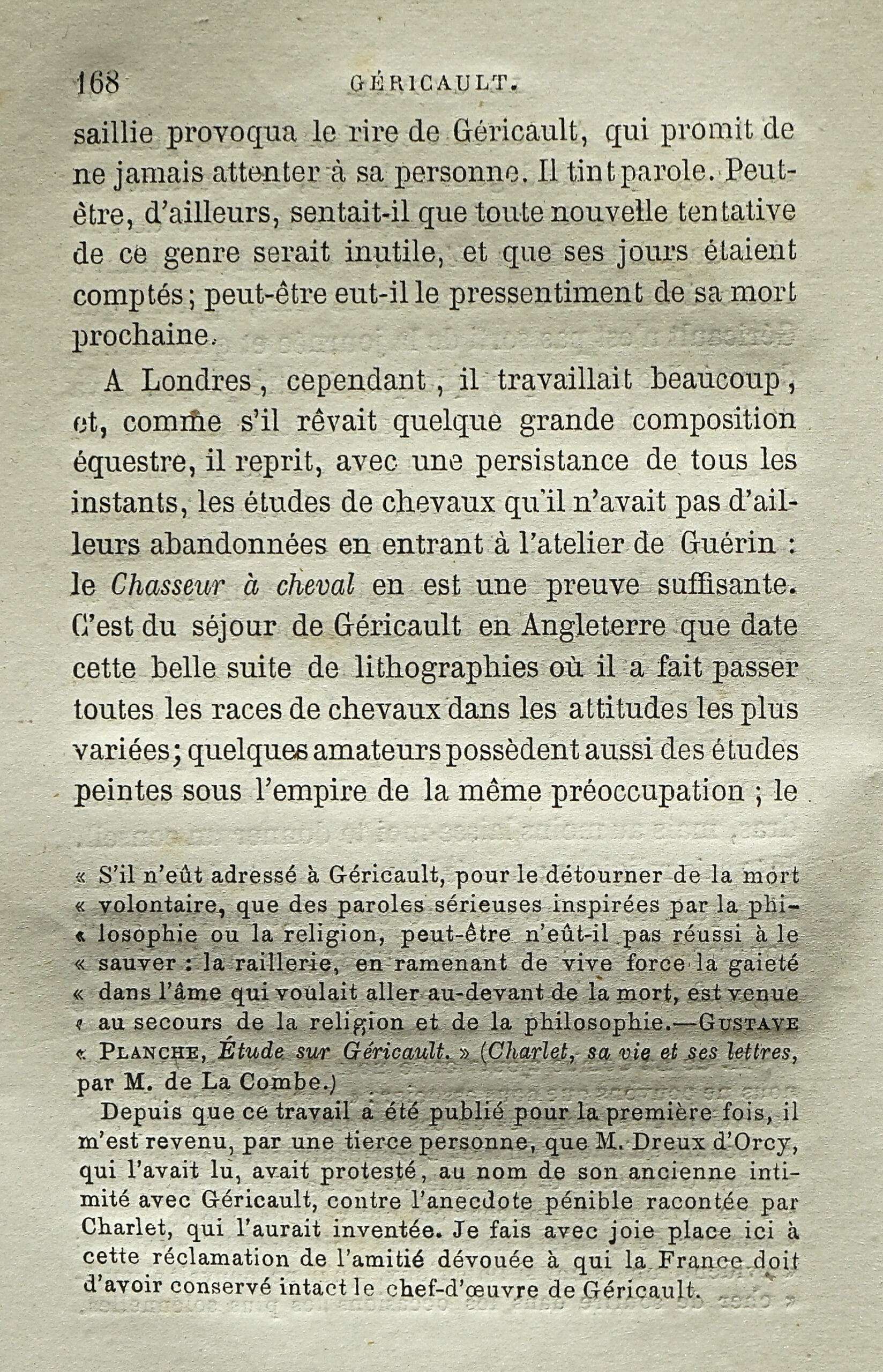
Ernest Chesneau: “Géricault” Les Chefs d’Ecole 1862. (p. 168)
Conclusion
The content and placement of d’Orcy’s complaint against Charlet within the essay borders on insult. Without doubt, D’Orcy will have hoped that in 1862 Chesneau discuss and refute Charlet’s account within the body of the essay, just as the section heading promises. D’Orcy probably hoped that Chesneau might even take Victor Darroux as his example: remove all details of Géricault’s mental and emotional struggles from the essay and condemn the suicide story as calumny without even mentioning Charlet’s name.
In 1862, Chesneau does the opposite and more. Indeed, not only does Chesneau grant Charlet the same large amount of page space within the essay in Les Chefs d’Ecole, (while pinching d’Orcy’s complaint into a footnote) Chesneau adds an abridged version of Jules Michelet’s essay on Géricault of 1848, as an appendix to Les Chefs d’Ecole .
Chesneau observes in his introduction to this appendix that Michelet’s essay on Géricault is both criticial to our understanding of Géricault, and was by 1862 – maintenant rare – well out of public view. (Les Chefs d’Ecole p. 393.) It is too much to suggest that D’Orcy’s attempt to interfere with the content of Chesneau’s upcoming book may have played some part in Chesneau’s decision to retrieve and republish the most damaging sections of Michelet’s account of Géricault’s life as an appendix, an account in which Michelet describes in detail Géricault’s tranformation and descent into a torrent of self-destructive pleasure in the latter stages of his short life, the pull of which the painter was unable to resist. (See our May, 2019 issue.) Even so, Chesneau does seem to take a kind of glee when describing, but not responding to, D’Orcy’s initial complaint.
Chesneau’s Les Chefs d’Ecole received good reviews when published in May of 1862. A second edition appeared in 1864 with the Charlet passage and the Michelet damaging account of Géricault’s short life intact. Pierre de Dreux D’Orcy almost certainly hoped to find a strong denunciation of Géricault’s suicide attempts in Chesneau’s 1862 volume when he contacted the critic via a third party sometime between October, 1861, and May, 1862. Instead, Chesneau presented a portait of Géricault for the general public which prominently featured Charlet’s account of Géricault’s suicide attempts in all its rich detail, as well as an equally damaging appendix which further described Géricault’s self-destructive predilictions. The presentation of these charges again in the second edition of 1864, as well as the public’s appetite for Chesneau’s account, must have been frustrating for D’Orcy, and those who shared his views. How would Pierre de Dreux D’Orcy respond?