
1867 Clément vs. Charlet
Géricault Life
1867 Charles Clément vs. Charlet
During the early 1860s, Charles Clément obtained unusual levels of co-operation from Théodore Géricault’s surviving friends and family while preparing his study of the artist’s life and work. We will discuss this co-operation elsewhere.
Our question is: why did Pierre de Dreux D’Orcy provide this level of co-operation to Clément from 1862 to 1867, and after?
We know from contemporary sources that in 1861 Pierre de Dreux D’Orcy was extremely unhappy with the direction Géricault scholarship had taken during the Second Empire. (See our September and October issues.) D’Orcy objected particularly to the publication of Géricault’s alleged suicide attempts made by Géricault’s collaborator and companion Nicolas-Toussaint Charlet. We know that D’Orcy contacted critic Ernest Chesneau sometime in late 1861, or early 1862, via a third party, to express his unhappiness with Chesneau’s willingness to treat Charlet’s claims as credible. As we discussed in our October issue, Chesneau, responded to D’Orcy’s complaint by reprinting Charlet’s claims again and by making public D’Orcy’s concerns. By 1866, D’Orcy and those seeking to refute the Charlet charges badly needed a champion. (See our article on Géricault’s public persona in 1867 elsewhere in this issue.)
Our view is that D’Orcy, acting on his own, in concert, or at the direction of others, provided Clément with the access Clément wanted on the condition that the critic discredit Charlet and give full voice to D’Orcy’s complaints.
Clément seems wholly committed to destroying Charlet as a man, a companion, and as a reliable witness in the opening pages of the final installment of his 1867 Géricault study in the Gazette des Beaux-Arts (Part III – XI, May, 1867.) Read Clément’ assessment of Charlet and Géricault below.
Part III – XI
“Géricault departed for London early in 1820, very shortly after the closing of the Exhibition, in the company of Charlet and of the economist Brunet. His relations with Charlet, then very close, intensified following their meeting in 1818. At that time, Géricault greatly admired the sly and skillful designer, whose lithographs were attracting a growing following. He purchased new pieces the moment Charlet put them on the market. With his violence ordinaire, (typically headstrong habits), Géricault desired to make Charlet’s acquintence at any cost. This notion became fixed in his mind and was, in truth, a nightmare. He made his intentions clear to Mr. Dorcy and the two friends agreed to do so at the first opportunity. They discovered that Charlet, still very poor then and forced to engage in all manner of work to survive, was then installed in Meudon at a small inn, the Three Crowns, which Juhel, ‘painter, wall-painter, philosopher’ had hired him to decorate. They set out for the country and had little difficulty découvrir le bouchon (releasing the cork), and finding Charlet at work. The irreverant and perceptive artist had painted the shutters with rabbits, hares, ducks, and buns with a man standing and pointing at the door of the stable. (Clément here cites Charlet, quoted by La Combe)
I was completely involved in these compositions, he writes, when the inn-keeper requested that I ascend to the first floor where he awaited me; I found there two happy guests at table, and amidst these one fellow who, after telling me his name was Géricault, added: You do not know me, mister Charlet, but me, I know you and esteem you greatly; I have seen your lithographs which could only come from the pencil of a hero, and if you would like to join us, you would do us honor and give me great pleasure. – I then joined them at their table, and all went well, so well in fact that from this began a friendship that death alone could end. Poor Géricault, excellent heart of a great and honest man. (1.- Charlet, sa vie, ses lettres, by Mr. de La Combe, p. 17.)
Géricault returned to Paris at two o’clock in the morning. The libations flowed freely; he was enchanted and in such a state of exaltation that when returned to his studio he clasped himself to Mr. Jamar, who was waiting for him, and refused to release him.
From this moment the artists saw each other frequently, and a real intimacy was established between them which did not, I believe, have a happy influence upon Géricault. Charlet was a man of much talent and sprit, an incisive observer, ingenious, and often profound, an artist of great talent; but, on the question of talent, he was not the equal of Géricault. I do not wish cast any shadow upon Charlet’s fascinated admirer and author of his biography, the excellent colonel de la Combe, but Charlet did not at all possess a heart of gold, as his pangyrist repeats again and again. He did possess private virtues surprising to find in a man of his nature: he was a good father to his family and of a constant probity. Without doubt, he loved his friends in his manner; but he made them victims of cruel jokes which crossed all boundaries, and that I cannot excuse. His greatest happiness was leading young people astray; he took them to the edge, intoxicating them on blue wine, amusing himself like some mad villain as they wallowed drunkenly in a state he had created. Gericault had no defense among those he loved. Charlet made him his creature often. One day Mr. Dorcy saw him return from one of these escapades covered in mud, in a pitiful state. He had fallen into the river and had a large wound on his thigh. Poor Géricault was very ashamed of these adventures, swearing that they would end, but these resolutions did not last long.
It is Charlet who recounted this story of a suicide attempt in London, an episode which only he has ever reported.
Charlet returned to the hotel late one night, reports Mr. de la Combe. Learning that Géricault had not left his room all day, and fearing some sinister plot afoot, he went straight to their room. He knocked without any responses, knocked again, and receiving no response, forced open the door. He was in time! A braisier still burned and Géricault was unconscious, lying upon his bed; with some effort he was returned to life. Charlet cleared the room of others and sat at the foot of his friend’s bed. ‘Géricault,’ he said to him in the most serious voice, ‘we have seen several times already that you wish to die; if that is your choice, we cannot prevent it. In the future, you will do as you please, but at least permit me to offer some consel. I know you are religious; you know well that once dead, it is before God that you must appear and render account; what can you say, unhappy one, when he interogates you?… You did not merely dine…’ Géricault, burst into laughter at this sally, solemnely promising that this suicide attempt would be the last. (1.- Charlet, etc. by the colonel de La Combe, p. 19.)
And yet, all this is just one of those cynical pranks, one of those ferocious inventions of which Charlet was more than once guilty. Géricault was sombre at times, without doubt; but during his time in England he was relatively tranquil and happy, as his letters suggest; and Mr. Dorcy, who travelled to London to join him early in 1821, never knew of, or ever saw, anything to give the least credence to these reports which he denies in the most categoric manner…”
Conclusion
Charles Clément obtained details about Géricault’s life the painter’s friends and family denied all other critics. Clément even learned the identity of Géricault’s long sought for secret lover, Alexandrine-Modeste Caruel, a topic we will discuss in our next issue. We can surmise that D’Orcy and company were satisfied with Clément’s full-throated attack on Nicolas-Toussaint Charlet.
In our October issue we described how Chesneau in 1862, and again in 1864, offered d’Orcy an asterisk instead of assistance. Clément used the opening pages of his final article on Géricault in the Gazette des Beaux-Arts to deny Charlet’s account, and to imply that Charlet, callously and for his own amusement, all but pushed a nearly defenceless Géricault into an early grave. Clément’s attack on Charlet in this section of his essay actually extends beyond the passages cited above.
Clément’s 1867 refutation of Charlet, which figured in of all editions of Clément’s Géricault biography, served also as an indictment of Charles Blanc, Jules Michelet, Gustave Planche, Ernest Chesneau, Brierre de Boismont, Bathild Bouniol and all others who had embraced Charlet, as well as any who might credit Charlet’s account of Géricault’s suicide attempts in the future. Clément’s authority as a critic and his deep familiarity with Géricault’s life and work was such that Clément effectively ended all further inquiries into the artist’s private life. No studies of Géricault today even mention Brierre de Boismont. Alphonse Rabbe, a highly-respected historian during the 19th century, is noted only for his 1824 obituary of the painter. Very, very few scholars today know of Bathild Bouniol and public attack on D’Orcy of 1866.
We do not know how much more Clément actually knew about Géricault’s private life. We know only that we learned little more for more than a century, until Michel le Pesant, in 1972, stumbled upon documents confirming the role Alexandrine-Modeste played in Géricault’s life, and the history of mental illness in Géricault’s family. Thanks to Le Pesant’s efforts and those of a new generation of scholars and researchers we can begin to dismantle the wall Charles Clément helped erect around the artist he so admired and respected half a century after the painter’s death.
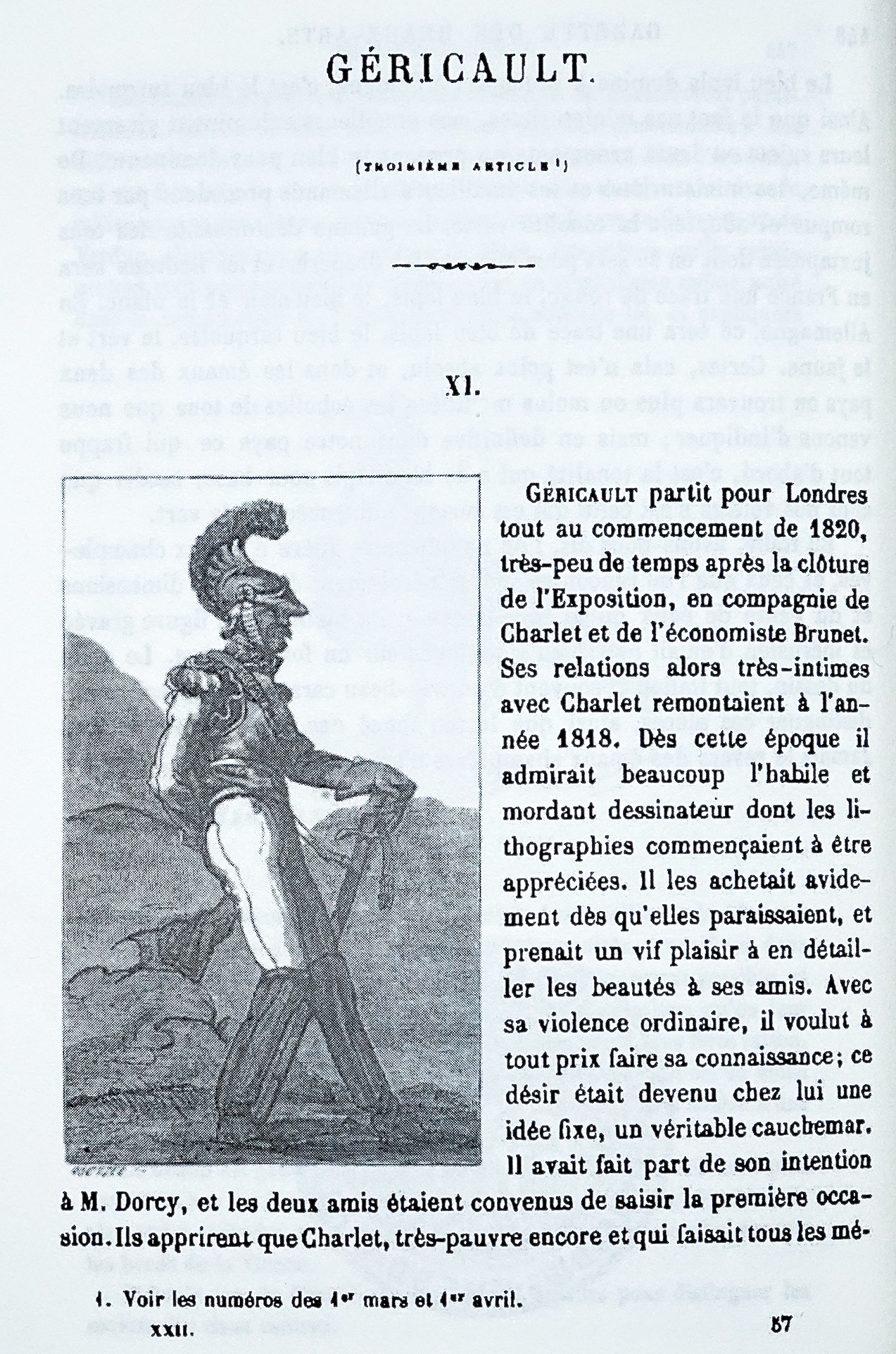
Title page of Géricault (part III) May, Charles Clément, 1867 May, Gazette des Beaux-Arts.