1865 Charles Blanc – Géricault
Géricault Life
Title page (top) of the article on Théodore Géricault in Histoire des Peintres de Toutes Les Écoles – École Française Vol. 3, Charles Blanc, 1865.
Géricault ‘illustrated’ – Charles Blanc, 1865.
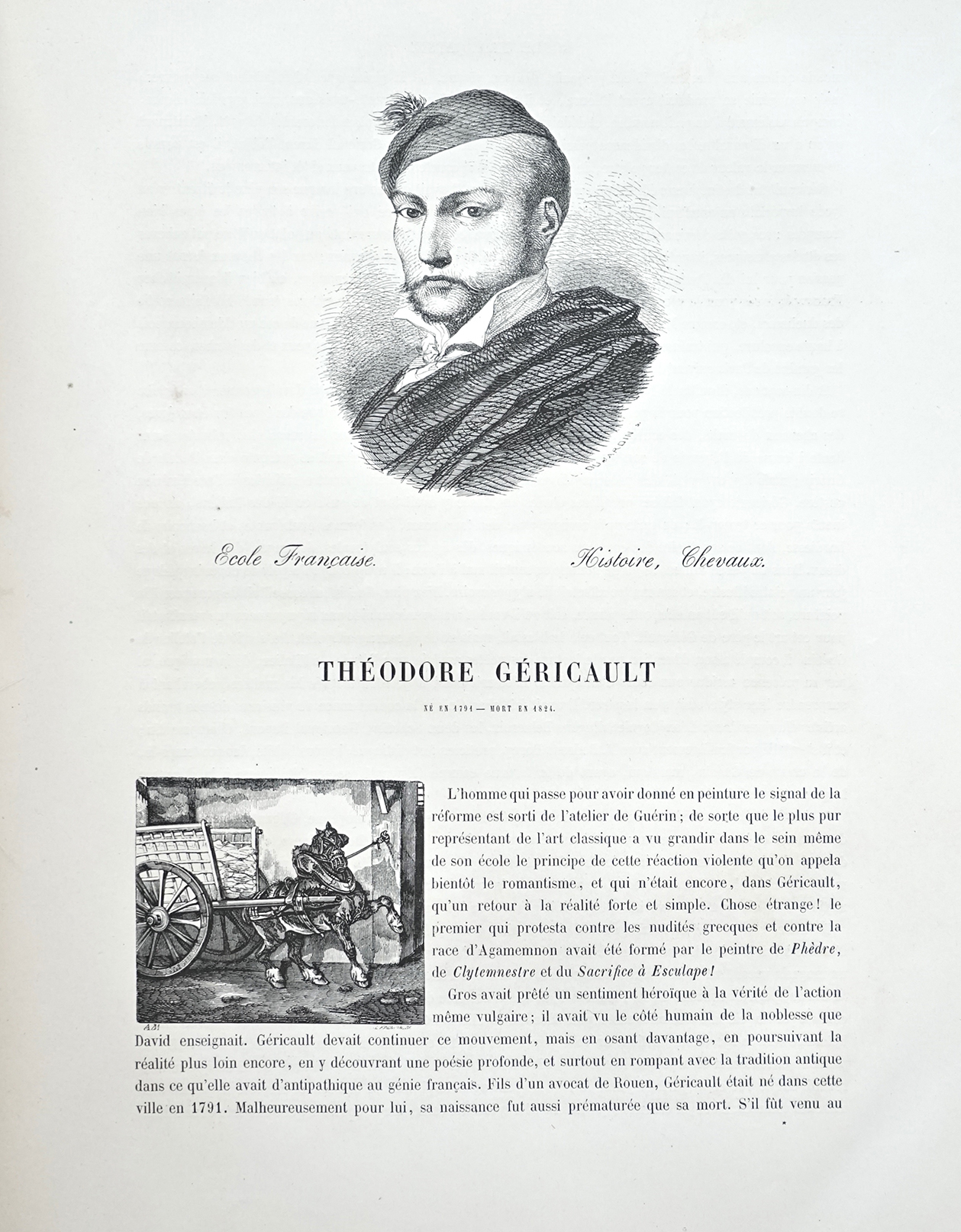
Title page (full) of Charles Blanc’s essay “Géricault“ – revised from 1845 and published in 1865 with images added in Blanc’s Histoire des Peintres de Toutes Les Écoles – École Française Vol. 3, 1865.
* Note the similarity of the image above to the title page of the article on Géricault in the Art Journal (1851) below.
“Géricault” Art Journal – April, 1851.
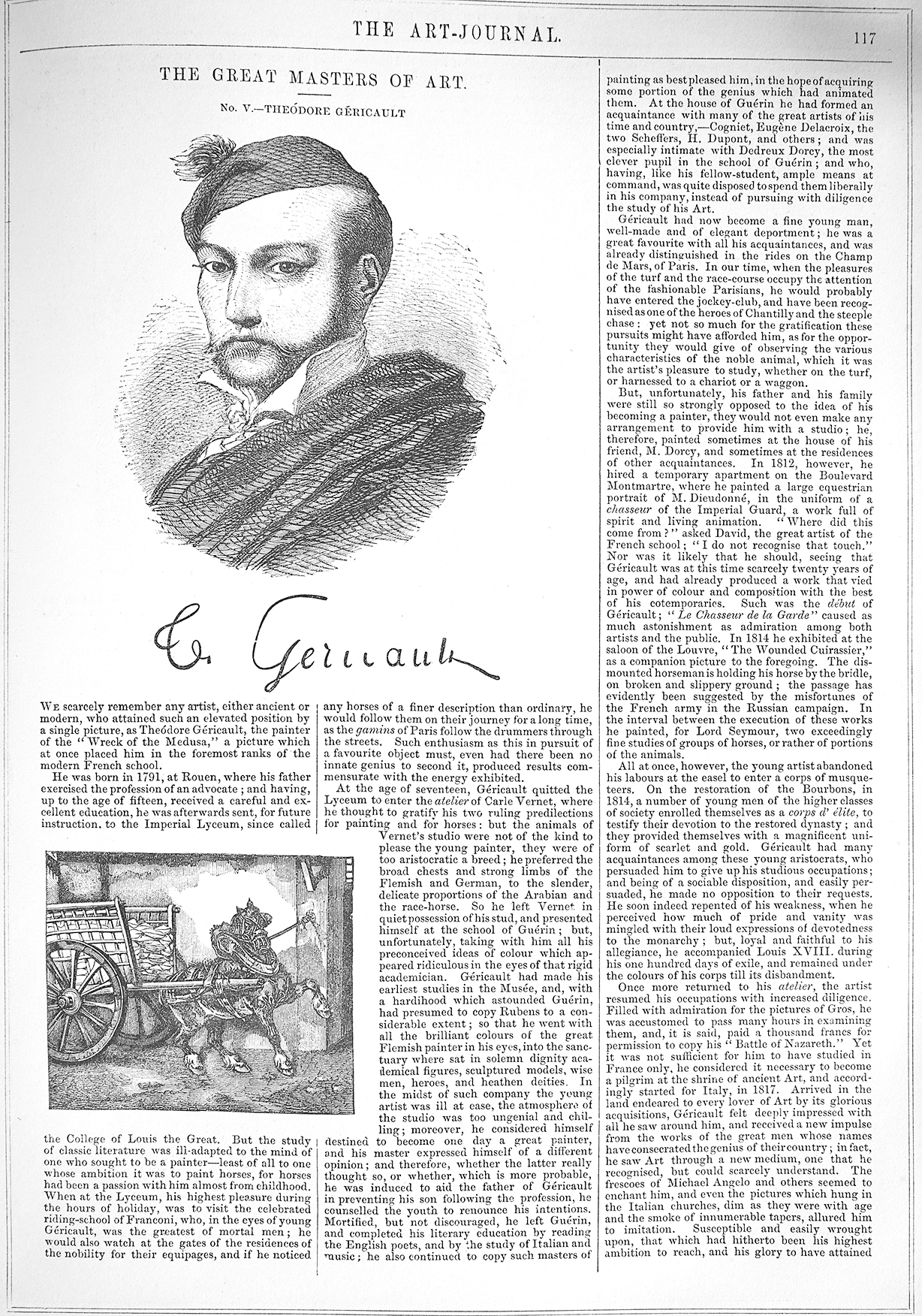
Title page of the illustrated essay on Théodore Géricault published (in English) in the Art Journal, 1851, April, London, p.117-119.
The anonymously authored Art Journal essay on Théodore Géricault was part of the publication’s Great Masters of Art series, an illustrated series of articles on artiste which usually included a copy of the signature of the featured individual. The Art Journal presents an unsigned portrait* of Géricault, the painter’s’s signature, and the Plastermaker’s Horse (discussed below) on the first page of their essay on Géricault. The second page features the Coal Wagon and the Horse Dealer’s Stud. The anonymous author/editor concludes the essay with a copy of the Wreck of the Medusa on page 119. (The illustration is identical to the signed portrait by Louis Dujardin in Blanc’s 1865 article on Géricault.)
As we can see, the similarites connecting the title page of Charles Blanc’s 1865 essay on Théodore Géricault with the unsigned article on Géricault in the Art Journal of April, 1851 are striking. Did Charles Blanc play some part in crafting the 1851 essay in the Art Journal?
Charles Blanc’s “Géricault” – 1865
Charles Blanc published his original essay on Théodore Géricault in 1845, in his Histoire des peintres français au XIXe siècle. Paris : Curville, 1845, vol. 1. (See the translations of this essay in GLM, issues April-June, 2019).
In 1865, Blanc republished this 1845 essay in his Histoire des Peintres de Toutes Les Écoles – École Française Vol. 3, of 1865, with some elisions to the text and the addition of a number of images. Blanc’s most important change to the text involved removing key sections of his analysis of Géricault’s Raft of the Medusa, in particular all references to the Negre (black) standing on the barrel on page 421. This change is of no small significance for scholars who choose to read the Raft as an abolitionist text. In 1845, Blanc explicitly promoted the Raft as an abolitionist statement. After France banned the slave trade in 1848, Blanc perhaps felt he no longer needed to present the Raft, and Géricault by implication, as serving the cause of abolition, a curious editorial decision to say the least.
Image and Text
Our primary interest here, however, is on Blanc’s representation of Théodore Géricault’s mental health – both in his original 1845 essay and in his revised Géricault essay of 1865. Blanc reprinted his original 1845 observation on Géricault’s mental health intact in the text 1865 essay.
I contend, however, that Blanc added images specifically selected to influence the way we read and understand the 1845 text. The images and their specific position on these two title pages strongly point to some sort of connection. In addition, the impact of this new combination of images and text on Théodore Géricault is affected by the position of this essay within the volume, a topic we discuss elsewhere.
We first discussed the significance of these images upon the accompanying text in our analysis of the Art Journal title page which we presented in August, 2019. The portrait of Géricault at the top of both pages is by Dujardin. The title of the image by Géricault at the bottom of both pages is known as the Plastermaker’s Horse. To help readers understand how the two images are connected, we refer to our original analysis of August, 2019.
We first invite readers to examine the Dujardin portrait uppermost. We detect no particular warmth in the eyes, the unsmiling mouth, or the subject’s general demeanor. The Dujardin portrait of Théodore Géricault is opaque. The contrast between this placid portait and the animal straining in harness in the Plastermaker’s Horse could hardly be more dramatic. The eyes of the horse stare out between the leather straps and buckles, bound between the shafts, stamping, and tied to an iron ring on a stone wall, the image positively pulses with tension, energy, and implied violence. The editor/author cropped Géricault’s lithograph (the full image is linked below) to focus our attention on the animated animal.
When first viewed, the Dujardin portrait appears neutral. Seen again with other elements of the page, the excited state of the horse below bleeds into the portrait of the painter above – implying, at least, a similar battle for control raging below the artist’s calm veneer. The necks of man and beast are both encollared. The tassle above the horse’s wild eyes echoes the tassle on the top of Géricault’s cap. Why did the author or editors select this particular image – an image of a solitary animal, bound up and full of constrained vitality as pendant to the Dujardin portrait? Is the author or editor implying a connection between the mental states of the artist and the horse he depicts? The Dujardin portrait of Géricault coupled with the companion image of the straining horse seems to me striking, even provocative.
I contend that this juxtaposition is far from accidental, as we noted when discussing the Art Journal essay. The neutral (at best) portrait of Géricault set above the image of an isolated animal bound up in a state of nervous excitement, below on the same page, is an effective and subtle way to introduce an essay in which the author will flatly assert that Géricault was “altogether unhinged” during a signficant period in his life. Consider how different the effect of the opening page might be had the author/editor selected instead the docile animals in the Horse Dealer’s Stud above, for example, or one of the other article images as pendant to the Dujardin Géricault portrait. Much of the public, we contend, was visually literate and would consciously, or subconsciously, connect images and text. We will continue to examine how 19th-century critics approached the delicate problem of explaining the state of Géricault’s mental and emotional health in our next issue.
The juxtapostion of images and text in the Art Journal essay of 1851 operates in exactly the same way in Blanc’s 1865 title page. Blanc’s remarks regarding Géricault’s mental health which appear in his 1865 essay ‘tormented by vague and insatiable desires’ acquire a new potency when appearing within an essay that framed by this juxtaposition of the Durjardin portrait of Géricault and the Plastermaker’s Horse. Indeed, the dynamism at work in the 1865 version is, in fact, made more potent by the juxtaposition of Blanc’s essay on Géricault with a second essay Blanc places immediately after this work, within his 1865 volume. No such complementary dynamic is present in the 1851 Art Journal essay.
As we discussed in our June and July issues, discussions of Géricault’s mental health figured prominantly in studies of the painter. This was even more the case in 1865, with the publication of Géricault’s suicide attempts as a case study in Briere de Boismont’s medical text on suicide and insanity (See our July issue). The addition of these particular images make Blanc’s 1865 essay on Géricault part of this larger discussion. Indeed, Blanc’s essay on Géricault is only half of Blanc’s contributions on the topic of Géricault’s mental health in his 1865 volume.
To appreciate how Blanc reformulates and situates his discussion of suicide and mental health in this text, we need to turn to Blanc’s 1865 study of Charlet, Blanc’s companion article which I discuss elsewhere in the current issue.
*View a high-resolution version of the Plastermaker’s Horse courtesy of the Metropolitan Museum of Art. (Opens in a new window.)