1854 La Combe – Charlet
Géricault Life
Frontispiece: Portrait of Nicolas-Toussaint Charlet – La Combe, Charlet – Sa Vie, Ses Lettres suivi d’une Description Raisonnéé de Son Œvre Lithographique, Paris: Paulin et le Chevalier 1856.
Joseph-Felix Le Blanc de La Combe published his essay“Biographie Charlet. Sa vie, ses lettres et ses œuvres” in 1854 in the Revue Contemporaine, Volume XI, pp. 489-512. Nicolas-Toussaint Charlet collaborated with Théodore Géricault in London in 1820. La Combe’s account of Charlet’s early career as a student of Antoine-Jean Gros and of Charlet’s time with Géricault in London is critical to our understanding of both Géricault and Charlet. Enjoy this extended excerpt from La Combe’s 1854 essay below.
‘…having decided to follow his calling and wanting to learn, Charlet was constrained by the fact that he was working as a teacher himself, and living hand to mouth. At this time his mind was filled with little but darkness. He took for his teacher a most ordinary painter named Le Bel, a feeble individual and former student of David… It is likely that Charlet paid for his training by working for his master as a teacher in several schools. For his part, Charlet also had his own students. We know an artillery officer who received lessons from Charlet as a very young boy. These lessons were long and, while supervising his students, Charlet worked on his own drawings, enough to fill two great volumes. The pages of these were later used to light fires, a painful memory for our comrade, who was by then already an artist of some talent.
In 1817, Charlet presented himself at the studio of Gros. There he found a great number of students who have since acquired celebrity, more or less. Among these we name: Delaroche, Roqueplan, Bonnington, Hyp. Bellangé, Eug. Lami, Robert Henry, Barye (the sculptor), Belloc, Destouches, Coutan, Debay, Signol, etc., etc.
Charlet presented his first lithographs to the public during this same period. These were not appreciated except by a very small number of connoisseurs, and owed almost all of their success to the political nature of their subjects.
Gros, whose remarkable art often displays little connection to his training methods, was eminently classical as a teacher. He cited no authority but that of David, and in his corrections and in his advice, he endlessly repeated the same phrase: “It is not I who speaks to you, but David, David, and always David. Gros made the mistake of not accepting the vocation of each student for this or that genre, and wanted to place all in the same Greek, or Roman mold. (2. In fact, David told his students: “One can study the masters, but it is nature which you must follow. We are always making and remaking ourselves. I want you to prepare yourselves for yourselves, for your nature and not against nature.” – Feuillet de Conches, Vie de Léopold Robert.) Thus, Bonnington (among others), this talented water-colorist, was truly ground down and tormented by this master, who called him a maker of superficial and simplistic works, and who did nothing but draw after nature without even attempting to paint.
Gros routinely disregarded his own teachings and doctrines when pursuing his own success and glory; and by virtue of this manifest contradiction he attained immortality through works such as the Battle of Eylau and the Plague Sufferers of Jaffa. He later returned to the classical approach to painting and produced nothing of great merit, and died of despair.
In that studio of Gros, alone and following his own path, Charlet was judged and appreciated with dignity by his master from the first day, who predicted for Charlet a bright future. Also, with him there was never any question of great prizes, competitions, or trips to Rome. Quite idle by nature, Gros made frequent and lengthy visits to the shop of Delpech, where he could learn, and enjoy the company of a man he liked. Delpech sold the some of Charlet’s first lithographs printed by Lasteyrie. Gros could view the beautiful works from the pencil of Charlet there.
One of our artist’s biographers recounted how Charlet received the first public evidence of his master’s respect for his work in the studio of Gros. This seems most unlikely, for Gros could hardly repudiate the principles of his own instruction before other students. But when he took the palette of Charlet to correct his work, he moved close to him and, in this way, gave Charlet his compliments in a low voice: “I saw much promise in your compositions: this is good, very good, continue…” Yet, Gros still appears to have feared that despite all these precautions, his companion did not hear these elogies raised to a piece departing so freely from the classic path. We heard from Delpech himself that Gros, several times, when looking upon a drawing from Charlet, cried out: “I wish I had done this.” Towards 1820, after studying for about three years in his studio, Gros finally said to Charlet: “Go, work alone, follow your impulses, and abandon yourself to your caprices, you have nothing to learn here.”
V
Let us stop and consider these first years from 1817 to 1820, during which Charlet produced a great number of masterpieces printed and sold by Lasteyrie and Delpech. These years were difficult, except for the encouragments of several rare friends and artists, from Gros, of whom we have already spoken, and from Gericault who we will speak of soon, encouragements which must, without doubt, have exercised a considerable influence upon him. For Charlet received no support from the public. Only one of these compositions, the Grenadier of Waterloo, reverberated with the public and was sold in a great number of copies; in fact it was necessary to remake a second stone. But let us not fool ourselves: this beautiful translation of the celebrated word [merde – shit] attributed to Cambronne (and we have reason to believe that the expression belonged to Charlet), had little success except as a form of public expression and opposition to the Restoration. The artistic merit of this work counted for nothing; and the proof of this is that at this same moment no buyers could be found for his other magnificent pieces, even from editors at the lowest prices. Several of these works exist only as publishing proofs. He made few stones. Our artist, seeing his work misunderstood, believed that he had failed. So, he wiped clean his stones, and commenced again with a courage and a perserverance which promised more success.
Several days after entering the studio of Gros, Charlet carried a stone to Delpech, who was waiting for a design promised by the master. Delpech had in fact printed some early lithographs by Gros. He took the stone from the hands of Charlet and looked upon it with apparent satisfaction. “By why then,” said he, “did Gros not sign his design?” – “He did not for an excellent reason,” responded Charlet, “because it is I who made the stone.” Delpech did not want to print it, and gave it instead to Englemann who printed a very small number of copies.
However, a short time later and probably upon the recommendation of Gros, Delpech became the publisher of Charlet and printed his lithographs from June, 1818, to November, 1819. One would imagine that he must have sold a great number of these two collections drawn in pen of the Imperial Guard, but they were used only by children as coloring books. We know little of these two series. Some pieces of the first are very rare.
The success had to be substantive enough to permit the editor to continue to print Charlet. However, he had so little consideration for the talent of the artist, this talent so little appreciated by the public, that the name of Delpech is not found on several of the drawings he published; nor did he include any of Charlet’s drawings in the album he produced each year of lithographs from the most fashionable artists of the time, judging Charlet to be insufficiantly worthy to take a place among these luminaries.
During this period, Charlet provided Delpech with drawings which sold for six to twelve francs. They did not sell any better than his lithographs; some of these later attained very high prices in public sales.
VI
Charlet did not gain any advantage from his numerous efforts and was forced to try his fortunes with a new publisher. He presented himself to Motte, who lived then on the rue des Marais.
Motte – excellent man, talented lithographer, and one who loved artists, was no more successful a publisher of Charlet than his predecessors. Some of Charlet’s most beautiful drawings were printed chez Motte. As with so many others, they were printed in very small numbers, thanks to the editor’s conviction that these prints would never sell.
The series of infantry uniforms (army of 1809) is one Charlet’s most energetic creations. We note especially the frontispiece, depicting an old sapper, the sapper in full-dress uniform, and the flag bearer – among others. These are masterpieces. Had these been widely reproduced, the statues of military types which now decorate several of our monuments today might not look so ridiculous.
When beginning this project, Charlet wrote to Motte: “Tomorrow send me stones; if they arrive here early, I will be happy – for I am ready to work. This collection could run to forty or fifty stones and will depict the Imperial Guard. – Perhaps they will enjoy some success among connoisseurs, and will not look in any way like the soldiers who longer excite interest. And they will be a thing for the friends of our old glory to treasure.”
Let us recall how this series, which is so beautiful and commenced with so much verve, incomprehensibly resulted in just twelve numbers (three others produced three prints) instead of the forty or fifty announced. This collection was edited (and sold) for Charlet by Motte. The artist first produced twelve stones, and several months later, after their printing, went to see Motte to inquire about the success of his work. Sales amounted to twenty-four francs. “I see,” said Charlet, “they are not to the public’s taste, and I understand that. This is my fault, my drawings lack tone. Place all these stones on a table in the room next door; I will make several corrections.” A moment later, Charlet had scraped the stones clean; Motte, arriving in the midst of this massacre, saved just a few and only with great effort; but as usual the most beautiful ones were destroyed. One understands therefore that this complete set is of the greatest rarity.
If one surveys the diverse military sets which we have identified and collected under the classification: the lithographic works of Charlet, we remain convinced that these are the most faithful and most vibrant images of the men who, beneath their different uniforms and with their fine arms, upheld the glory of the French name so well.
Hyp. Bellangé, such a good judge in this matter, tells us: “Nobody will ever surpass in the truth, in the allure, and in the types which Charlet possessed so well and that he inimitably rendered. In one hundred years others will consult his work, as the most faithful reproductions of the military uniforms of our epoch.”
The soldier of Horace Vernet, and of the greatest number of contemporary artists is a soldier of convention, a comedian dressed as a soldier, the soldier of Scribe if you prefer; spiritually rendered, drawn, bound, but lacking character and truth. The drum beat sounded, a regiment passed, Charlet followed; the regiment exercised and returned to their barracks. Charlet returned to his studio; and from his pencil emerged a soldier exactly like those of the regiment he had just studied. One cannot admire too much this spirit of observation which he employed to fashion the character of each soldier. Not only does the infantryman not resemble the cavalryman, the grenadier is completely different from the rifleman, and the dragooon from the hussar and the lancer.
We must say, however, to be fair, that Horace Vernet succeeded better in painting our young army. It is true this shines forth much more in the depiction of large numbers of troops, than in the character and form of our young soldiers.
VII
One of the most beautiful compositions of Charlet, the Ouvrier endormi (Sleeping Worker), was printed chez Motte. It is a large piece, of which there are only three prints. Here is a description: As a worker sleeps upon a stone bench with his right hand supporting his head; he is surrounded by other workers, one old comrade opens his coat and discovers a cross of honor.
Charlet very much disliked looking at his own work. Even so, one day he showed me a particularly beautiful piece. – “Look at this,” I said to him, “You’ll never do better.” Contrary to his usual reaction, Charlet seemed to regard his offspring with some pleasure. “It’s amusing,” he said to me, “I haven’t seen this since I made it (this was about fifteen years prior).” – “Tell me now: why were only three prints produced from this stone?”- He replied: “Motte did not want to give me the thirty francs which I wanted for my stone; so I erased it.” Since then a respected collector offered to pay up to one hundred and fifty francs for one print from this stone, if one could be found. One more anecdote, and we will have nothing further to add to our account of the tribulations of our poor artist.
Motte published the great work of Arnault, entitled: The Political and Military Life of Napoleon. The most celebrated artists of this epoch would provide the lithographs. As always in such circumstances, several could not be included. H. Vernet furnished three stones, Louis Gudin several as well; then from Grenier, Marlet and from others. Expending great effort, Motte ensured a place for Charlet would supply one drawing. He produced the Siege of Saint-John of Acre; not only was Charlet’s first submission the most beautiful in the work, it was “a conceptual masterpiece worthy of serving as the pendant of the Plague Sufferers of Jaffa”, according to Hip. Bellangé. It is curious to examine all the transformation of this piece, evident in the seven different drafts of which we possess. Suffice to say that Charlet, in the end, finally rebelled against all the demands and constraints placed upon him to modify his first ideas, and to the point of production, in some form, another stone; his drawing was corrected by Champion, an artist ignored in our time. It is he who retouched all the heads, marching his pencil awkwardly upon the stone, and only then was it included among the mass of studies deemed worthy enough to figure in the work. Several rare prints of the primitive drawing by Charlet were inserted in the first copies of the book.
This is enough to demonstrate how wrong Charlet’s biographers are when they affirm that his first lithographs were popular and suppressed, and that they had some revolutionary impact upon the tastes of the public. Not at all, quite the contrary, his early career could not have been more difficult, or less well-encouraged. We must credit the artist’s humility, the force of his calling, and the energy of his character in surmounting such great obstacles.
Charlet did not begin to become popular, to gain some material rewards for his works, until 1822, when he had the Gihaut brothers for editors; from then until the final years of his life, he walked in concert and in close communication with them.
VIII
In 1818, Charlet, obliged to take on all manner of work to live, was working for Juhel, painter, barbouilleur, philospher (barbouilleur – “dauber, decorator, wall-painter”), decorating an inn called the Trois Couronnes, (Three Crowns). One can probably still see the rabbits, hares, ducks, buns, etc., Charlet painted on the shutters of this inn in Meudon, as well as the figure of a man standing and pointing to the stables. Here is how Charlet recounted this episode to me, so interesting in his life, one day when he took me to dinner in Meudon, to help him remember, he said.
“I was fully engaged with these compositions, when the innkeeper came to me, and ask me to go up to the first floor where someone awaited me. There I found a jovial group dining together; in the midst of these, one companion introduced himself as Géricault, and then added: “You do not know me, Mr. Charlet. But me, I know you, and I esteem you greatly. I have seen your lithographs which could only come from the pencil of a hero, and if you would like to join us at our table, you would honor us and give us great pleasure.” – “Of course, gentlemen, but all the honor and pleasure belongs to me.” – I joined the company and all went well; so well, even, that from this day a friendship was born that death alone could end. Poor Géricault, excellent heart of an honest man and a great artist!”
The two friends made a trip to London in 1820; they had for a companion Brunet, the celebrated economist. This trip was connected to the exhibition of the Shipwreck of the Medusa, that canvas by Géricault today classed among the masterpieces of the French School, but when presented at the Salon of 1819, received no honors.
Charlet, in his artistic writings which will later explore, renders a just elegy to the enlightened actions of the painter Dorcy [Pierre de Dreux d’Orcy], who purchased this painting at the sale of Géricault from his own pocket, rather than allow it to pass into the hands of foreigners. We must add that on this occasion, as always, Charles X then acted as a King must, by acquiring this masterpiece for France using the funds from the civil list in the face of considerable political opposition. And since we are speaking of generous actions, let us recall that the duc de Riviere, while in Constantinople, presented to the king the Venus de Milo, which this excellent prince immediately donated to the Museum, thus providing France with this masterpiece of statuary.
The public of London were admitted to see the painting of Géricault by paying a shilling at the door. In the first days visitors also received a small ink reproduction of this painting. We believed for very long that this was a piece by Géricault. However, we know from Charlet himself that this drawing belongs to him, and that we must catalogue it among his works.
Charlet often stated that he had written notes about Géricault, and that these would come to us if we survived him. Upon his death, we could find not trace of this work; but we should be aware it may exist. And if something on Géricault like this ever appears, so valiantly written and well conceived, and in a style so lively and so original, we should not mistake the author’s identity.
Géricault exhibited some of his beautiful lithographs during his stay in London, including, among others, his remarkable series of great horses, and several individual pieces of a very great rarity. The English editor Hullmandell had no more understanding of the works of Géricault than Charlet’s early editors in France, and Géricault’s lithographs were printed in similarly small numbers.
These first lithographic studies of Géricault prove that he initially understood little of how to use the pencil upon the stone; he was compelled to consult Charlet, who repeatedly collaborated to assist him. Two pieces in ink, among others, belong almost entirely to Charlet, which despite not bearing his name, are accepted as works by Géricault.
We know that Géricault had a difficult and unhappy character…In London, the climate seemed to influence this unhealthy mix, and several times he wanted to bring an end to his life. Charlet, returning to the hotel at an hour late in the night, learned that Géricault remained within the hotel all day. Fearing some sinister project afoot, he raced to Géricault’s room, banged on the door loudly, banged again to no response, before breaking open the door. He was in time! The fire in the stove still burned, and Géricault was lying unconscious on his bed. Several helped him back to life; Charlet cleared the room and sat down next to his friend…
“Géricault,” he said to him with the most serious air, “Here we are; you have tried to kill yourself several times now. If this is your chosen path, we can not prevent you; in the future you will do as you will. But at least permit me to offer a word of advice. You are religious, very religious; and you know well that once dead, it is before God that you must render accounts: how will you respond, unhappy one, when he questions you? … you did not only dine!”
Géricault burst into laughter at this sally, promising solemnly that this attempt at suicide would be his last. Charlet returned to Paris alone, he continued to produce his lithographs and drawings, and lived as modestly as he had in the past…’
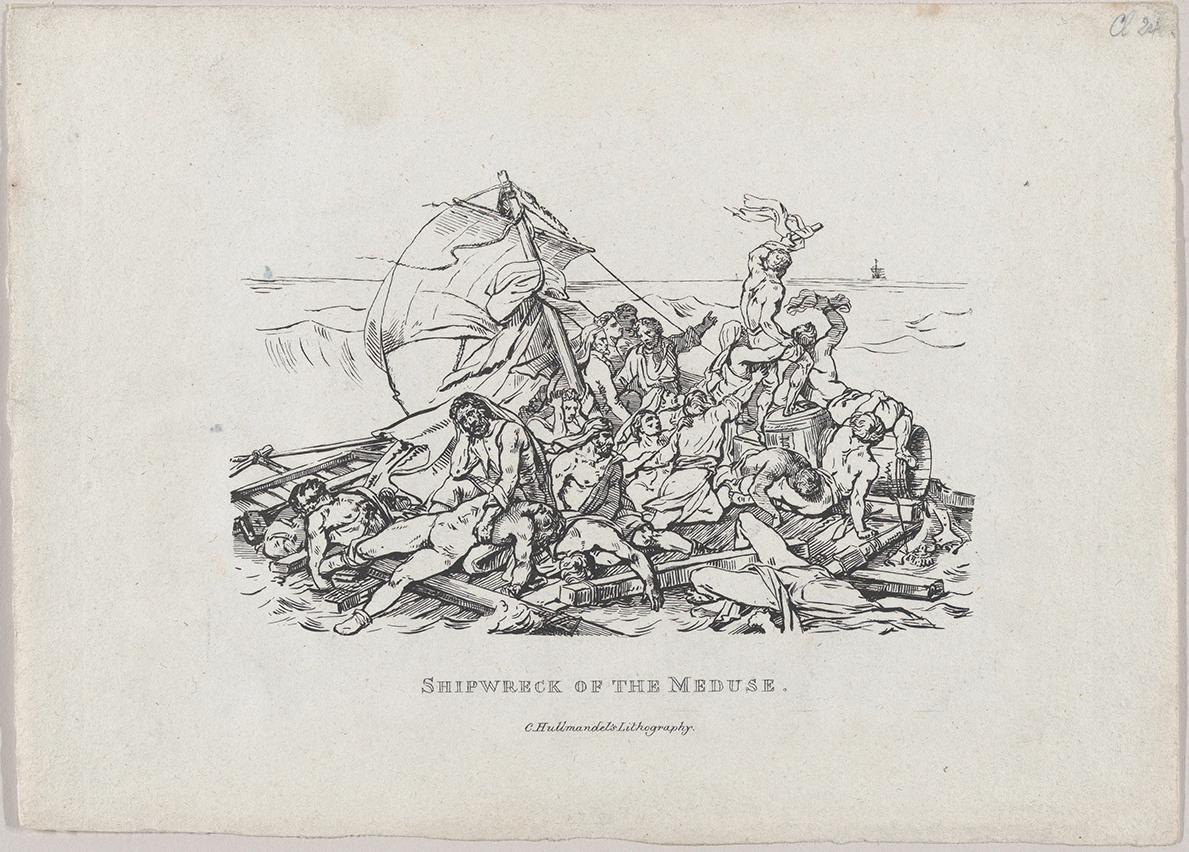
Charlet & Géricault print published for London exhibition, 1820, Image courtesy of the Metropolitan Museum of Art.