Culture & Commerce (2)
Géricault Life
As I noted in our March issue, Théodore Géricault’s family was keenly interested in both the consumption and production of material culture. Opportunities to participate more fully in these activities increased from 1791, as key family members quickly became very wealthy. We continue this discussion with a look at the production of high-quality art for the general public at the Hôtel de Longueville, home of Jean-Baptiste Caruel (Géricault’s uncle) in 1792. We then examine how a naval artist in England promoted quality reproductions of his work as prints.
Manufacture Républicain – Hôtel de Longueville
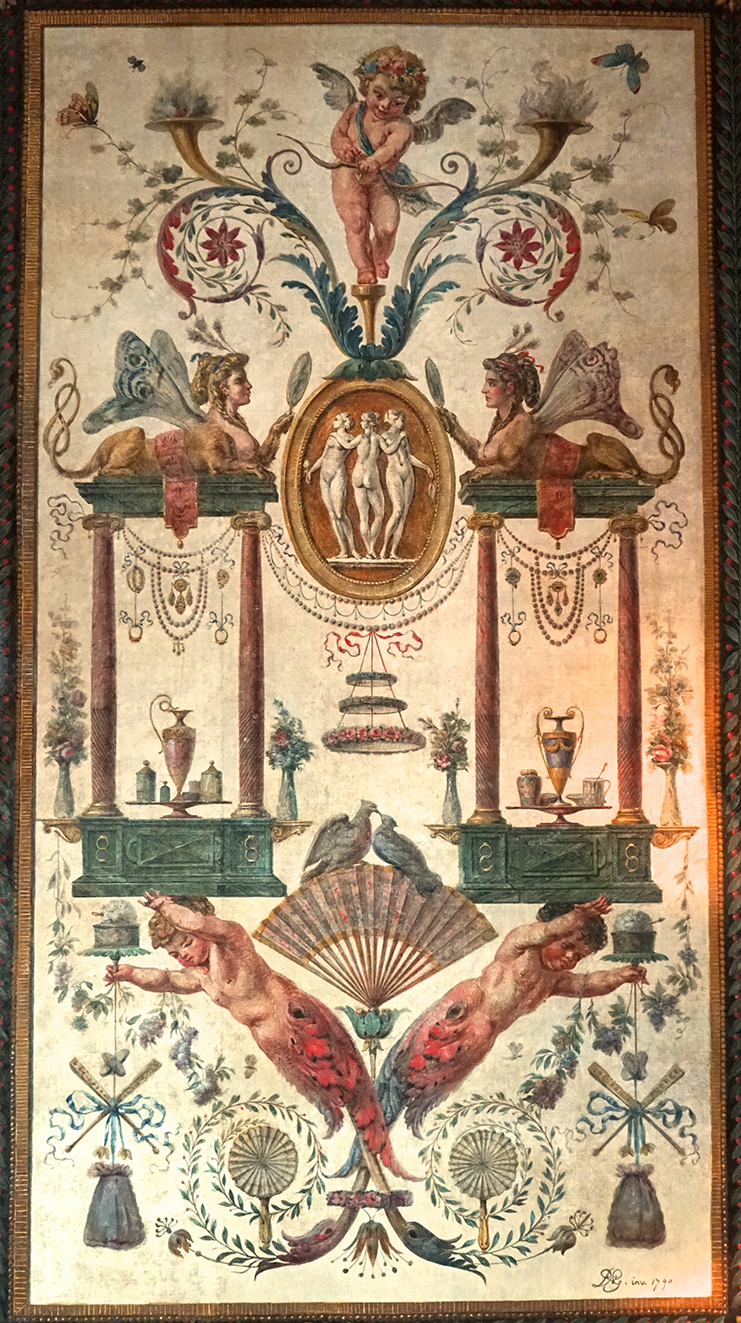
In my March issue I presented a black and white print which the designer Jean-Démosthène Dugourc (Dugoure, Dugourre) produced circa 1782 to promote his arabesques. In January of 1792 Dugourc began designing wallpapers for the Manufacture Républicain (Republican Wallpaper Manufactory) at the Hôtel de Longueville. Relatively few samples of period wallpaper survive, and none can be reliably linked to the Republican Manufactory. However, a number of arabesques by Dugourc similar to those produced for the Republican Manufactory are today in private hands. The Venus or la Coquetterie (above) comes from the same 1782 series mentioned earlier and is one of those adorning the walls of the Hôtel de la Vaupaliere in Paris. (Our sincere thanks to AXA group for making this arabesque available to us.) Dugourc’s dated signature in the bottom right corner confirms authorship and allows us to place the piece in the Hôtel de la Vaupaliere in 1790.
Arabesques were employed in a variety of media – decorating tiles, walls, ceilings, floors, furniture, fabrics, wood, and plates. The art and skill involved in their production can be of the highest order. Raphael’s arabesques (designed by the artist and completed by Giovanni de Udine) for the loggie (halls, or corridors) of the papal residence in Rome are among the most beautiful in the world. Period guidebooks of Rome made them famous. Catherine II of Russia had copies of the Vatican loggie made for her collection. Indeed, the brothers François Vernet and Claude-Joseph Vernet (father of Carle Vernet, Géricault’s teacher) together embarked on a commercial venture to reproduce the loggie arabesques and sell them as prints in 1770. François Vernet, a talented artist in his own right, traveled to Italy to make copies. François was afterwards awarded a commission to decorate the interiors of Versailles. Examples of François Vernet’s arabesques and illustrations on wood at Versailles can be seen here. In our discussion of the Louvre elsewhere in this issue, we note that Claude-Joseph Vernet and his family lived in an apartment granted by royal brevet in the Galeries du Louvre, close to the Hôtel de Longueville.
Wallpaper for the People
Dugourc was a minor partner of Étienne Anisson Duperon, the king’s printer, who leased a large part of the Hotel de Longueville and there established the Republican Wallpaper Manufactory [see our March issue].
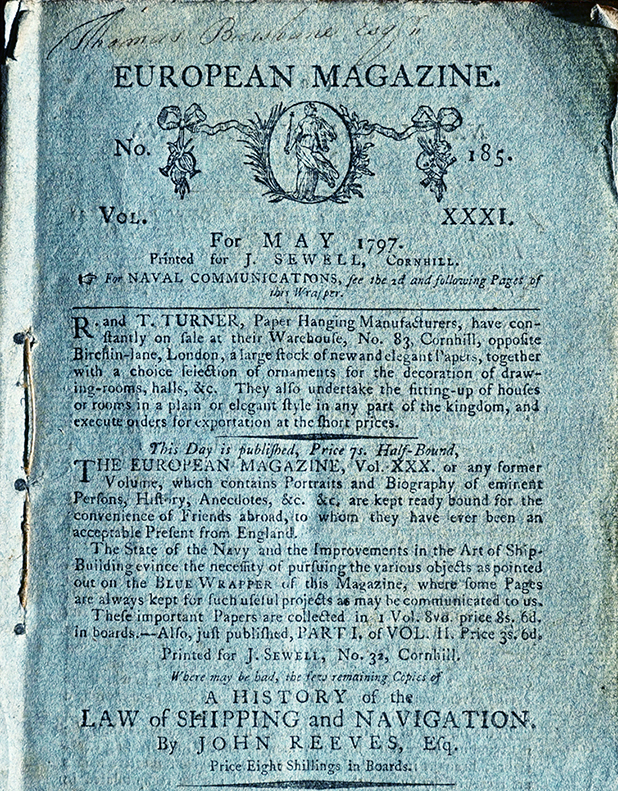
“R and T. Turner” were English manufacturers of wallpaper, advertising on the front cover of the European Magazine of 1797. France looked to England for innovation and technical expertise, but had confidence in French artists and aesthetics. By 1792, the principal manufacturers in Paris each employed hundreds of workers in their manufactories and produced high-quality papers for a rapidly expanding market. Like the English firm “R. and T. Turner” advertising in the European Journal of 1797, Dupéron hoped to sell wallpaper to private individuals, corporations, and government institutions. Paris was home to more than forty manufacturers when Duperon established his manufactory at the Hôtel de Longueville. His long experience as a printer provided Duperon with a keen understanding of production and consumers. Duperon planned to sell high-quality wallpaper to a new public with new tastes; partnering with Dugourc was a key part of his production and marketing strategy.
Here is Duperon’s Affiche (notice) published in Le Républicain Français, 1793, January 1st:
“True republican wallpaper, perfect for administrative offices; public establishments; and private offices and apartments, is always on hand at the Republican Manufactory, place du Carrousel, Hôtel Longueville; those wishing original designs should address citizen Dugoure (sic), inventor of the wallpaper.”
Dugourc was one of the premier designers in France, frequently commissioned to design very high-quality items for royal clients and the aristocracy. Yet, we see him effectively working in “trades,” quite happy to sell his wallpaper to one and all. The Republican Wallpaper Manufactory at the Hôtel de Longueville allowed Anisson Duperon, the royal printer, to market high-quality wallpapers to private individuals, an international clientele, middle-class consumers, and to administrators of large businesses and goverment officers keen to demonstrate a refined taste and enthusiasm for the republican cause.
The Géricault family certainly qualify as consumers of quality goods. Inventories taken for the purpose of executing wills do not normally make any mention of boiserie (wood work) or wallpaper installed in building interiors, so we do not know what kind of wallpapers (if any) adorned the interiors of the Géricault homes. Géricault family wills, however, do make clear the family appreciated fine furniture, high-quality time pieces, curtains, and clothes. We would be surprised, therefore, if Géricault family homes were not decorated with fine wallpapers, plaster, and wood work.
We have no idea how popular Dugourc’s republican-themed wallpapers actually were, or how different these designs were. The inventory of wallpapers conducted at the Manufactory in 1795 offers few clues. All the wallpapers are listed with some identifying remarks, usually very brief. We find a great many rolls of wallpaper, many of which identifed as “arabesque” in patterns of different sizes and other popular motifs. Very few rolls are explicitly identified as “republican.” Other republican motifs in different media persist until the present – the French national flag, for example. Even so, we do not have enough information to determine with any precision how popular these wallpapers actually were with consumers. We must also recognize, of course, tastes changed over time and that inventory values of 1795 probably do not reflect prices set in 1792.
Wallpaper provided elite designers like Dugourc with a new media to be exploited for both artistic and commercial purposes. Wood cracks and paint chips; even the most elegantly carved furniture and wall panels, gilded and painted, are often marred by chips and cracks which accumulate over time. Bernard Jaqué describes the change in wallpaper production in France (summarized here): Wall coverings such as tapestries were not at all new, but the tenture, or wall coverings manufactured from paper in France during early to mid-18th century were manufactured as blocks/sheets to complement fabric hangings. Wallpapers manufactured in rolls, after the English style, were less expensive, more colorful, and could be manufactured in bulk to be dispatched and installed anywhere. Jaqué also points to a move away from wooden homes to stone and plaster, as well as the emerging markets described already. (“Le papier peint en France au XVIIIe siècle” pp. 30-34, in Les Papiers Peints en Arabesques de la fin du XVIIIe siècle, Paris: Editions de la Martinière, 1995)
Géricault family members in Paris, particularly, valued objects of quality. My view is that the modern apartments on the rue de Belle Chasse which the architect Pierre Rousseau leased to Pierre-Antoine Robillard and Marie-Thérèse de Poix in March of 1792 were decorated with very fine wallpaper, either by leaseholder or landlord. Rousseau was one of the most innovative architects in France and had recently completed the Hôtel de Salm (today the Palace of the Legion of Honnor) with gardens fronting the Seine on land opposite the Robillard building.
I believe that Jean-Baptiste Caruel’s apartments at the Hôtel de Longueville and the de Poix-Robillard apartments on the rue de Belle Chasse were of at least passing interest to Théodore Géricault’s mother, aunts, and grandmother. Wallpaper quality and patterns matter. Colorful arabesques and other designs on wallpaper, furniture, curtains, ceramics, walls, ceilings, and woodwork helped define and organize interior spaces.
We have firm evidence suggesting that the interiors of key buildings at the Hôtel de Longueville were decorated with arabesque wallpapers, almost certainly papers designed by Dugourc. Théodore grew up in interior spaces filled with stimulating visual experiences, experiences which enhanced his understanding of motif and color, and his overall visual literacy. Paintings and engravings were features of interior design, set as special objects of attention within these richly decorated spaces.
The commercial and cultural activities of Brunton, Duperon, and Dugourc at the Hôtel de Longueville, and their impact on Théodore Géricault, are part of a larger story, one we continue to explore. Changes in technology and social changes affected lifestyles and tastes. Painters, architects, and artisans needed paying customers to support their work in 1792, more than ever perhaps, with the exodus of France’s aristocrats. We will continue to examine how artists adapted to changing tastes and national events to enhance their own stature/brand, expand their customer base, and increase revenue.
Selling Battle Prints – An English Example
The European Magazine of 1797 includes an invitation to purchase a series of prints. Reproductions of famous battles, especially victories, were popular for a number of good reasons. This prospectus also helps illustrate how realism functioned in print media at this time.
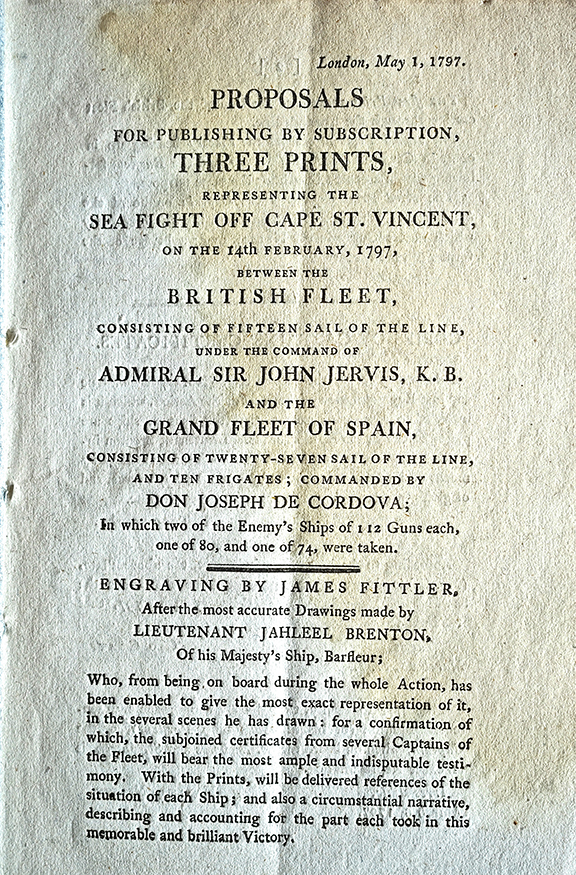
The prospectus cover page outlines clearly the prints advertised to subscribers. In this case, the value of the prints resides in the accuracy of the depictions, not their beauty. The target consumer is offered a chance to support and reward the British Navy, and to own a piece of history.
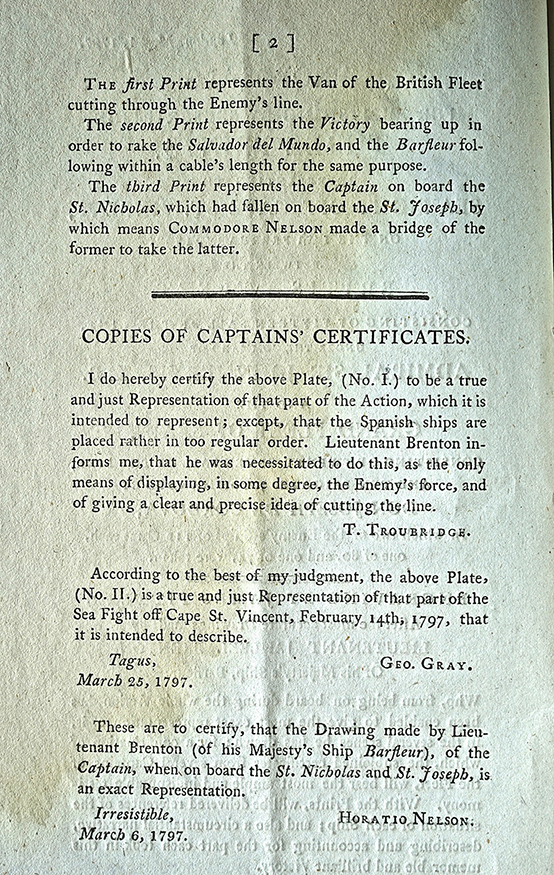
Prospectus page two presents a brief summary of each of the prints; more space, however, is granted to the three certificates confirming the veracity of the prints. Note the name of Horatio Nelson.
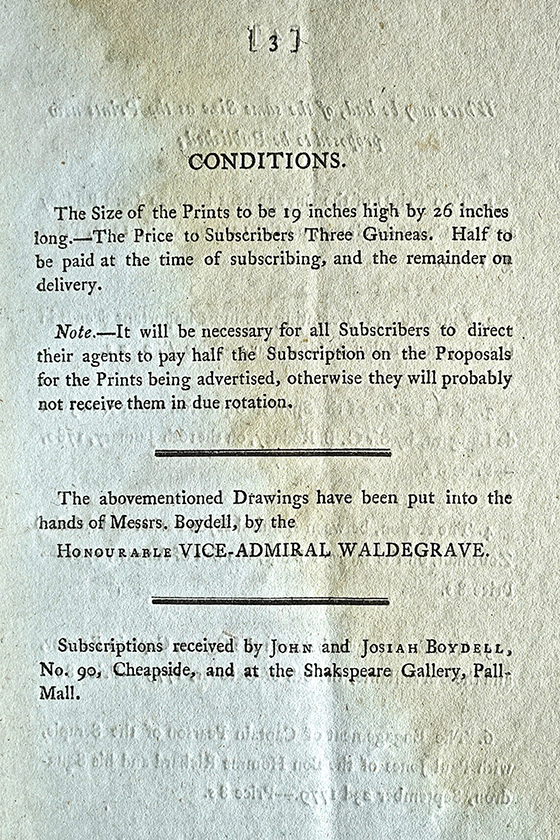
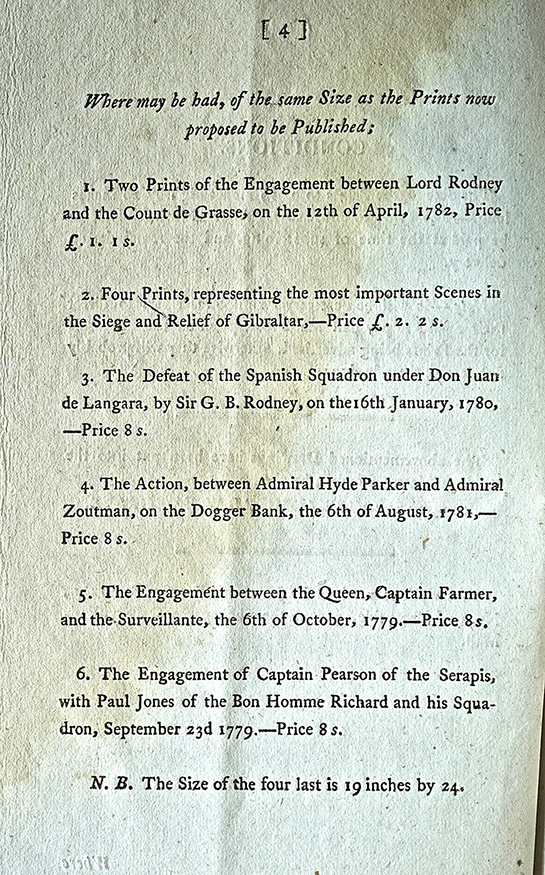
Again the emphasis is on accuracy – the who, what, where, and when of the matter, plus the price clearly spelled out. Was Vice-Admiral Waldegrave involved in the marketing of the series, or just a ‘big’ name happy to promote patriotism and the Navy? The same question might be asked of Nelson? Page four below allows the publisher to advertise other prints.
We now turn to the cover of the European Magazine, from which both the naval prospectus and the R. and T. advertisment are taken.
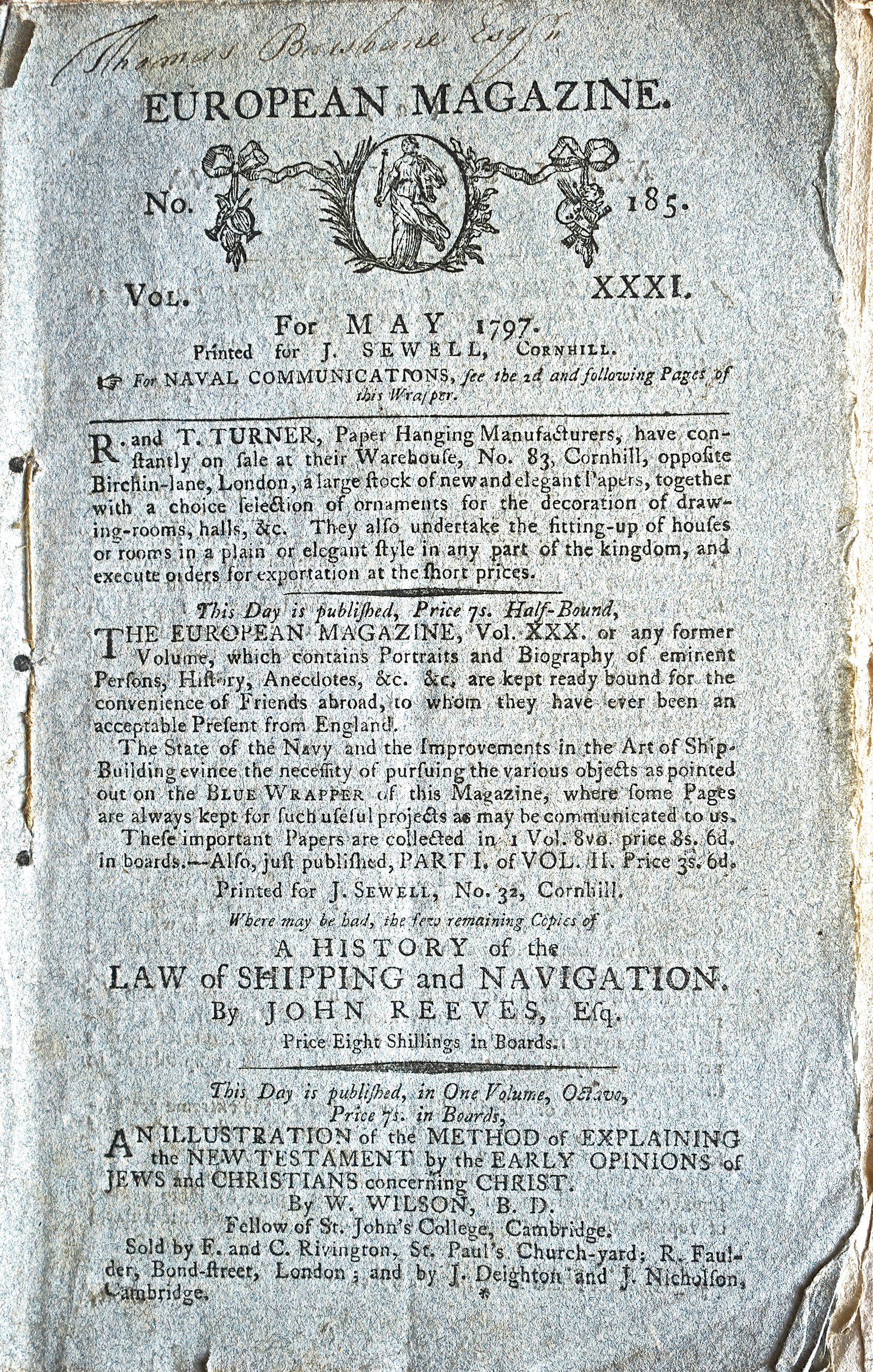
The European Magazine offered news to readers interested in commerce, shipping, and manufacturing with a special section for naval communications, making it an ideal marketing platform for a subscription series of naval prints. Contrast the four pages of the naval prints prospectus which appear at the very beginning of the magazine interior with the magazine cover. The cover page in blue is crowded and contains limited space for advertisements. The publishers, of course, almost certainly sold advertising space on the front cover at higher rates. That said, the fee for the four-page prospectus will not have been cheap. The naval prints prospectus within is almost ostentatious in its use of large fonts and capitals; and the extra expense will have been factored into the subscription price. The series celebrates a great victory for the entire English nation.
The personal attestations of Horatio Nelson and the other ‘heroes’ confirming the accuracy of the depictions are as much a part of the purchase experience as the accompanying text and the subscription prints themselves. The use of space underlines the significance of the series and the event, while the text of the prospectus affirms the accuracy of the history depicted. The emphasis is entirely on facts and “getting it right.”